Unlocking Mars’ Water Mystery: What Really Happened?
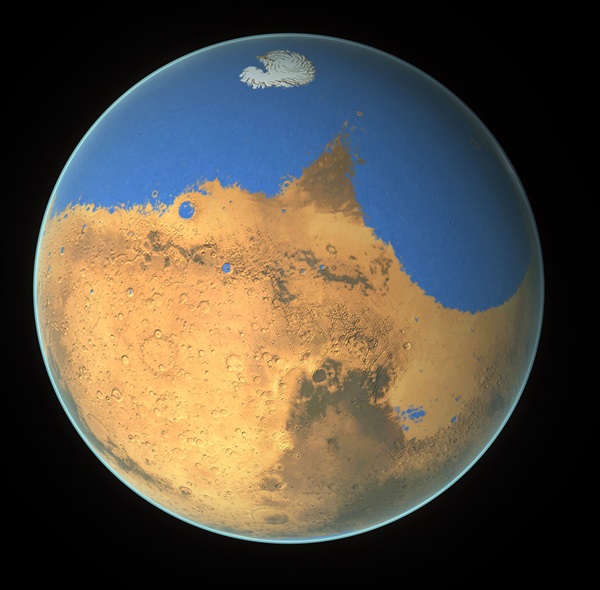
Few scientists doubt that Mars once boasted a warm and wet climate. The accumulating evidence for this past is compelling, and even the most skeptical can’t easily dismiss it. This raises an intriguing question: Where did all the water go?
Clues from Mars’ Ancient Landscapes
Mars still shows the remnants of a time when water flowed freely across its surface. The evidence includes clear river channels, ancient lakes, and even shorelines. NASA’s Perseverance rover, exploring Jezero Crater—an ancient paleolake—has uncovered minerals that only form in the presence of water. Similarly, the MSL Curiosity rover has made comparable discoveries in Gale Crater.
The Fate of Mars’ Water: Polar Caps or Beyond?
Currently, some water remains frozen in Mars’ polar caps. However, there are only two other possible destinations for the remaining ancient water: underground or lost to space.
Subsurface Water Evidence: The Case of Mars’ Hidden Lakes
In 2018, researchers detected a large subglacial lake about 1.5 km beneath the southern polar region of Mars. While these findings are promising, they’ve been met with skepticism. Even if this lake exists, it holds nowhere near enough water to account for all the lost Martian water.
New Insights from Space Research: How Mars Lost Its Water
Recent research published in Science Advances sheds light on Mars’ water loss to space. This study, titled “Martian Atmospheric Hydrogen and Deuterium: Seasonal Changes and Paradigm for Escape to Space,” is led by John Clarke, a Professor of Astronomy and Director of the Center for Space Physics at Boston University.
Unraveling the Water Escape Mechanism
The research indicates that Mars lost much of its water through atmospheric escape. According to Clarke, “Water molecules can break into atoms, and the atoms can escape into space.” To fully grasp the water loss, understanding how these atoms escape is crucial.
The Role of Hydrogen and Deuterium in Water Loss
The study focuses on two types of hydrogen: regular hydrogen (H) and deuterium (D), which is heavier due to its additional neutron. Ultraviolet light from the Sun splits water molecules into hydrogen and oxygen atoms. In an escape-to-space scenario, deuterium is likely to remain behind more than hydrogen.
Tracking the Escape of Deuterium: MAVEN and Hubble’s Contributions
NASA’s MAVEN spacecraft, launched in 2013 and in orbit since 2014, has been crucial in observing Martian atmospheric loss. Its goal is to determine how Mars lost its atmosphere. The spacecraft’s suite of eight instruments has provided valuable data, though it faces limitations, such as not being able to monitor deuterium emissions year-round.
The Hubble Space Telescope has complemented MAVEN’s data with its high-resolution UV instruments. Combining Hubble’s observations with MAVEN’s, Clarke’s team has monitored deuterium escape over three Martian years.
The Dynamic Martian Atmosphere: How Sunlight and Solar Wind Influence Water Loss
Research reveals that Mars’ atmosphere experiences significant turbulence due to its elliptical orbit. The Sun’s brightness variation affects atmospheric dynamics, causing rapid water molecule ascent and splitting at high altitudes.
Revising Previous Understanding: Rapid Escape of Hydrogen and Deuterium
Previously, scientists thought hydrogen and deuterium atoms diffused upward until they escaped. New findings show that when Mars is close to the Sun, water molecules rise quickly, and atoms escape more readily. This shift challenges prior assumptions and highlights the complex nature of Martian atmospheric escape.
Conclusions and Future Directions
This research advances our understanding of Mars’ water loss, linking it to atmospheric processes and solar effects. While not all questions are answered, the study provides significant insights into how hydrogen escape and deuterium retention relate to Mars’ primordial water.
Why This Matters: Implications for Earth and Beyond
Understanding Mars’ water loss is more than a planetary curiosity; it offers insights into Earth’s water retention and the evolution of other rocky planets and exoplanets. Mars lost its water; Earth did not. The quest for answers continues.
Source: Unlocking Mars’ Water Mystery: What Really Happened?
Are Advanced Civilizations Using Quantum Communications to Hide from Us?
Are Advanced Civilizations Using Quantum Communications to Hide from Us?