The strange mound of the Kuiper Belt object Arrocos could be a trace of where it came from
The farthest object ever explored nearby may have revealed only 1 of the earliest stages of planet formation.1

Arrocos, a Kuiper belt object known for its red tint and the shape of a snowman, has bumpy mounds on a large robe, and these can be the remains of rocks that once smoothed together to create an entire object.
The team, led by planetary scientist Alan Stern of the Southwest Institute, conducted a detailed study of the lobe, known as Wenu, using data from the New Horizons spacecraft, which in 2019 passed Alokos at about 44.6 astronomical units from the Sun.
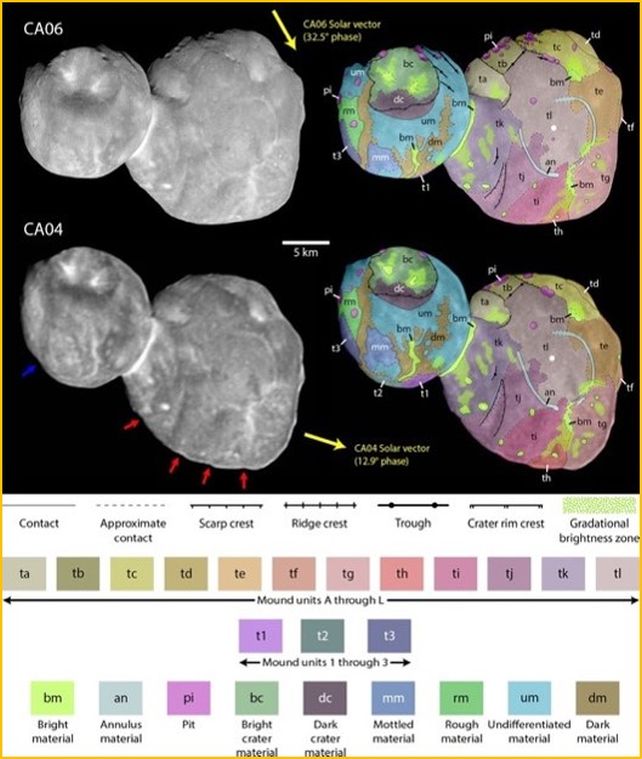
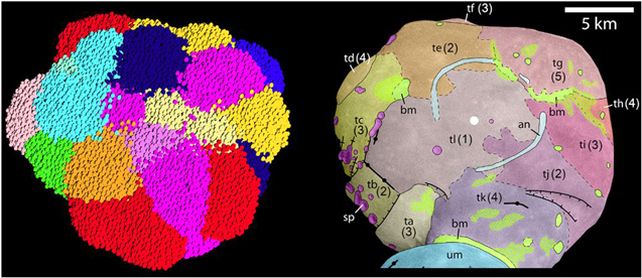
They found 12 bumps with more or less the same size, shape, color and reflectance, suggesting that these are the units in which Wenu was assembled.
“This object is so well preserved that it’s amazing to reveal the details of the assembly directly from a set of building blocks that are very similar in shape,” says Will Grundy, an astronomer at the Lowell Observatory. “Arrokoth looks like a raspberry and is made of small subunits.”
It is believed that Arrocos is a kind of planet that has never fully grown in the Kuiper Belt of ice rock past Pluto, far from the Sun. In addition, due to its location, its changes with solar radiation are considered minimal.
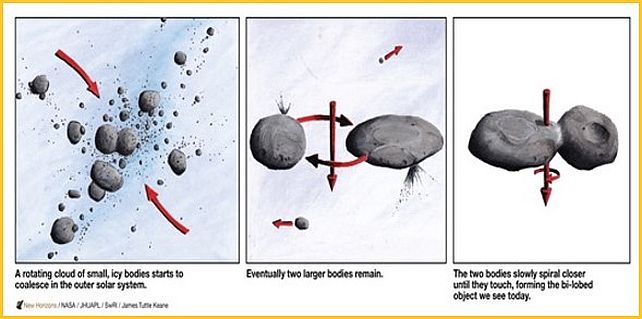
Previous studies have shown that Arrocos was once 2 small objects in a binary orbit and gradually coalesced, but in the history of its formation, a 2020 paper states that it is actually a bunch of objects in a complex orbital dance, gathering gently under gravity at low speeds, forming larger rocks .
This supports the idea that the growth of the planet begins with a bunch of small objects from the same part of the cloud of debris that surrounds the newborn star. And new discoveries further support this scenario.
The Arrocos is about 35 kilometers (22 miles) long, 20 kilometers (12 miles) wide and 10 kilometers (6 miles) thick. And while the Wenu was not smooth, as New Horizons observations revealed, it was covered with a series of interlocking mounds, or bumps, that stimulated curiosity about how it formed.
Stern and his colleagues used 2 close-up images from the New Horizons Flyby to conduct a detailed analysis of Wenu’s mounds. They counted 12 mounds in total, generally about 5 kilometers sideways and have a similar length-width ratio in addition to other similarities.
To understand how Wenu came to be like that, the researchers conducted simulations and focused on 2 formation scenarios.A small object of about 3km is colliding at high speed, or a large object of about 5km is glomming together slowly at low speed.
The first scenario, the fast scenario, is unlikely to be how Wenu was formed. The resulting object was too smooth because the rock was shattered and dirty by the impact. However, in the slow formation scenario, a lumpy mass, like a Wenu, was formed.
This is consistent with previous findings on the slow and gentle formation of Arrocos, but raises another question. This is a question that may require more modeling and more observation of other planetesimals.
“Similarities, including the size and other features of the Alokos mound structure, suggest new insights into its formation,” Stern says. “If the mound certainly represents an ancient planetarium component like Arrokoth, then the planetarium formation model does not account for the preferred sizes of these components,” he said.
At first glance, a small wyo with 2 leaves is not very similar to Wenu with a large crater. However, the team was tentatively able to identify 3 mound-like structures. Therefore, it is not impossible that Weeyo was formed in the same way.
A NASA mission, Lucy, is currently underway to explore a cluster of asteroids that share Jupiter’s orbit. Looking for signs of mounds on these objects will help scientists understand exactly how common this process of formation is.
Source: The strange mound of the Kuiper Belt object Arrocos could be a trace of where it came from
10.000 Meter Hole: China Drills Into The Earth To Investigate The Cretaceous System
The strange mound of the Kuiper Belt object Arrocos could be a trace of where it came from