The Owl That Guards the Dead: Mexico’s Most Mysterious Tomb Awakens After a Thousand Years
A remarkably well-preserved Zapotec tomb discovery dating to around six hundred AD has been announced by Mexico’s government and the National Institute of Anthropology and History (INAH). Officials describe the find as the country’s most important archaeological breakthrough of the last ten years, largely because of its exceptional condition and the volume of cultural information it preserves.
This Zapotec tomb discovery is already being recognized as a rare “window” into Zapotec ritual life, social hierarchy, and beliefs surrounding death and ancestry. Unlike many disturbed burials, the sculpture, architecture, and surviving mural paintings remain largely intact, allowing researchers to study how power, religion, and memory were visually constructed in ancient Oaxaca.
The discovery emerged in Oaxaca’s Central Valleys, in the municipality of San Pablo Huitzo, after INAH investigators followed up on a complaint about illegal looting. Ironically, what began as a protective response quickly turned into one of the most significant archaeological revelations Mexico has seen in a decade. It also highlights an important truth: much of humanity’s heritage survives only when rapid intervention protects it in time.
What stories were hidden behind those sealed stones for more than a thousand years? And what does this Zapotec tomb discovery truly reveal about ancient Zapotec power and ritual life?
Zapotec Tomb Discovery in Oaxaca Reveals a Ritual Space Marked by an Owl of Death
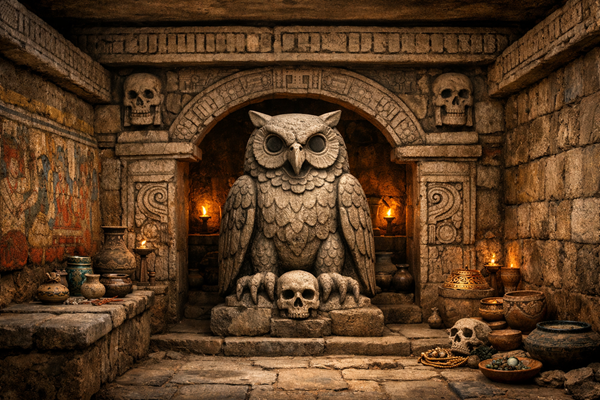
According to INAH, the Zapotec tomb discovery includes both an antechamber and a burial chamber, each featuring elaborately carved stonework and painted surfaces. However, the most striking element stands at the entrance: a large sculpted owl, an animal long associated in Zapotec belief with night, transition, and death.
Even more remarkable, the owl’s beak curves protectively over a painted stucco face believed to represent a Zapotec lord or revered ancestor. This figure may have been symbolically linked to the tomb’s sacred purpose and to later ritual veneration by descendants.
In Zapotec society, ancestors were not passive memories; they were active participants in political legitimacy and divine mediation. Therefore, the iconography in this Zapotec tomb discovery suggests the structure was designed not merely for burial, but for communication—projecting power, sacred authority, and continuity to anyone who approached its threshold.
So, was this tomb meant as a silent grave, or as a living monument to influence the future?
Zapotec Tomb Discovery Preserves Murals, Copal Rituals, and a Frozen Procession
Inside the chambers, researchers encountered something rare: surviving mural paintings still in situ. For archaeologists, this is invaluable, because murals are usually the first elements lost once a sealed environment is disturbed.
The polychrome palette—ochre, white, green, red, and blue—depicts a ceremonial procession of figures carrying bags of copal, a resin widely used as incense in Zapotec ritual practice. These visual narratives do more than decorate the space; they document how ritual, offering, and movement shaped beliefs about the afterlife.
As reported by Heritage Daily, this Zapotec tomb discovery sharpens modern understanding of Zapotec social organization, burial customs, and cosmology during the Classic period. Because so much of the decorative program remains intact, scholars can analyze symbolism rather than speculate from fragments.
In essence, the tomb freezes a sacred ceremony in time. But what message did its creators expect future generations—or the gods themselves—to read from these painted walls?
Zapotec Tomb Discovery Triggers Conservation and Long-Term Scientific Study
Following the announcement, INAH confirmed that an interdisciplinary team at Centro INAH Oaxaca has begun conservation, stabilization, and protection work. Roots, insects, and sudden environmental changes threaten exposed paint layers, and without rapid intervention, centuries of history could vanish in months.
At the same time, specialists are conducting ceramic, iconographic, epigraphic, and physical anthropology studies. These investigations aim to determine who was buried here, how the funerary rites were staged, and what the imagery communicated to the living community.
This Zapotec tomb discovery therefore marks only the beginning of a long interpretive process. Each pigment, carving, and architectural choice acts as data for reconstructing how Zapotec elites expressed authority and sacred connection.
Can science fully recover the intentions of people who lived more than a millennium ago? Or will some meanings remain locked behind symbolism we can only partially decode?
Zapotec Tomb Discovery Connects Oaxaca’s “Cities of the Dead” to Political Memory
In Oaxaca, tombs were never merely resting places. Across the region, Zapotec mortuary architecture functioned as stages where religion, history, and political legitimacy were performed. The newly revealed Zapotec tomb discovery echoes traditions known from monumental centers such as Mitla, long associated with underworld symbolism and sacred landscapes.
By linking burial, ancestor worship, and elite authority, Zapotec society transformed death into continuity rather than closure. The tomb became a space where the past spoke directly to the future.
This is why the Zapotec tomb discovery resonates far beyond archaeology. It reminds us that ancient cultures designed memory with intention. They asked questions through stone and paint that modern viewers are still trying to answer.
What other sealed stories still wait beneath Oaxaca’s soil?
And how many visions of ancient power remain undiscovered, silent, but intact?
Source: The Owl That Guards the Dead: Mexico’s Most Mysterious Tomb Awakens After a Thousand Years
The Owl That Guards the Dead: Mexico’s Most Mysterious Tomb Awakens After a Thousand Years