A Forgotten Technology from four hundred and eighty thousand years ago: Why did prehistoric humans sharpen their axes with elephant bone?
A four-hundred-eighty-thousand-year-old ax sharpener, carved from elephant bone, has become the oldest elephant bone tool ever discovered in Europe, offering a rare and powerful glimpse into the intelligence and adaptability of early human relatives.
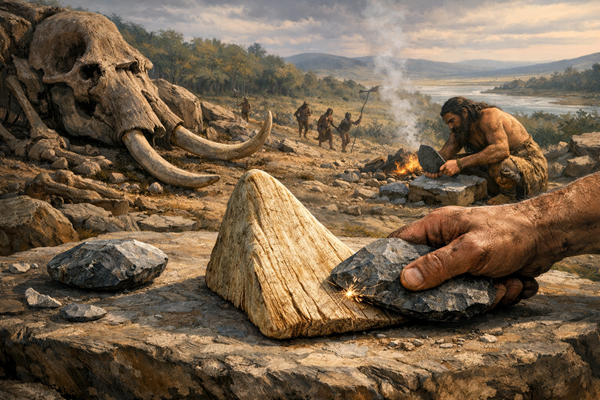
The triangular artifact, shaped from the bone of a prehistoric elephant, was used by archaic humans to sharpen stone hand axes in what is now the United Kingdom. Measuring roughly four point three by two point three inches, the tool shows that early humans were not only surviving — they were innovating.
What pushed these ancient people to experiment with such an unusual material? And how advanced was their technology nearly half a million years ago?
Oldest Elephant Bone Tool Shows Advanced Stone-Tool Technology
According to a new analysis published in Science Advances, the artifact represents the oldest elephant bone tool found anywhere in Europe. The study highlights a surprisingly high level of technological development among early human relatives living in northern climates.
Although elephant bones and tusks were occasionally used throughout the Paleolithic period, finding one this old is described as “very rare.” Silvia Bello, a paleoanthropologist at the Natural History Museum in London, explained that organic tools almost never survive long enough to be discovered.
Yet this one did — and it tells a story of experimentation, planning, and craftsmanship.
Instead of relying only on stone, these early humans recognized that elephant bone had the right hardness and flexibility to reshape cutting tools efficiently.
What other technologies may have existed but vanished with time?
How the Oldest Elephant Bone Tool Was Used as a Retoucher
Further study revealed that the artifact was deliberately shaped into what archaeologists call a retoucher — a tool used to knap and resharpen the edges of stone hand axes.
The oldest elephant bone tool shows impact marks and wear patterns that indicate it was used while the bone was still fresh. This suggests the toolmakers understood material properties and intentionally selected elephant bone for its performance.
At the Boxgrove site, finely worked hand axes are common, and this retoucher likely helped produce their sharp, controlled edges. Without tools like this, precision stone shaping would have been far more difficult.
So, were these humans simply surviving — or were they engineering?
Who Made the Oldest Elephant Bone Tool?
Researchers cannot yet identify the exact group responsible, but based on age and location, two candidates emerge: early Neanderthals or Homo heidelbergensis.
Both groups occupied Europe around half a million years ago and showed increasing behavioral complexity. Bello noted that the tool provides “an extraordinary glimpse into the ingenuity of early human ancestors.”
The oldest elephant bone tool therefore acts as more than an artifact — it is evidence of cognitive planning, problem-solving, and adaptability.
How similar were their minds to ours?
Boxgrove Site and the Rarity of Elephant Bone Tools
The artifact was originally uncovered in the early nineteen-nineties at the famous Boxgrove archaeological site in southern England. Boxgrove has produced some of Britain’s oldest human remains, butchered animal bones, and numerous stone tools.
However, prehistoric elephant remains at Boxgrove are exceptionally rare. This suggests that the people who made the oldest elephant bone tool did not encounter elephants often, yet instantly recognized the value of the material when they did.
Organic knapping tools made from bone, antler, and wood were essential to early humans, but they usually decay. That makes this discovery even more remarkable.
What other organic technologies have we lost forever?
Why the Oldest Elephant Bone Tool Changes Our View of Prehistoric Humans
This discovery reshapes how we see early Europeans. Instead of primitive scavengers, they appear as strategic innovators who understood materials, tool performance, and production methods.
The oldest elephant bone tool demonstrates planning, experimentation, and technical skill almost half a million years ago. These humans were not only adapting to new environments — they were improving them.
If such advanced thinking existed so early, what other forgotten inventions once shaped human evolution?
And how much of our technological story remains buried beneath the soil?
Source: A Forgotten Technology: Why Did Prehistoric Humans Use Elephant Bone to Sharpen Axes?
Did Homo Erectus Speak Two Million Years Ago Before Modern Humans Even Existed?
Did Homo Erectus Speak Two Million Years Ago Before Modern Humans Even Existed?
A Forgotten Technology from four hundred and eighty thousand years ago: Why did prehistoric humans sharpen their axes with elephant bone?