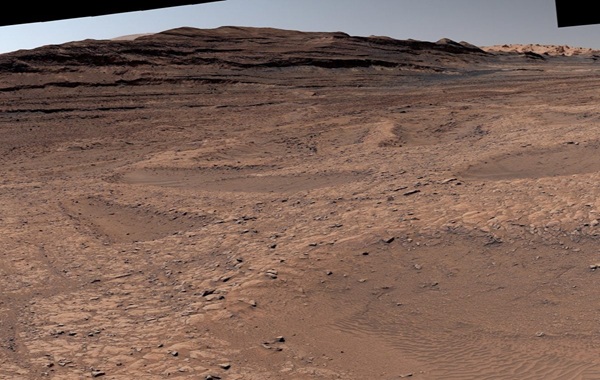
The Martian Labyrinth: Curiosity Uncovers Ancient “Spiderweb” Ridges That Could Redefine Mars’ Watery Past
For billions of years, a geological secret lay hidden beneath the dust of Mount Sharp. Now, NASA’s Curiosity rover has stumbled upon a crystalline network of ridges that suggests the Red Planet stayed “wet” and potentially habitable far longer than we ever imagined.
While climbing the rugged slopes of Mount Sharp, NASA’s Curiosity rover recently transmitted images that stopped scientists in their tracks. Spreading across the landscape like a colossal, stony spiderweb, a series of intersecting ridges known as “boxwork” has emerged from the Martian soil. These formations aren’t just a visual spectacle; they are a “time capsule” of Mars’ ancient groundwater systems.
What is the “Martian Spiderweb”?
Technically referred to as boxwork, these structures look like low, crisscrossing walls, some standing up to two meters (6 feet) tall. From an orbital view, they resemble a vast, interconnected web or a series of empty boxes.
On Earth, boxwork is rare and usually found in small scales within caves. On Mars, however, these structures span vast distances, indicating a massive, planet-wide geological process.
The Anatomy of a Discovery: How They Formed
The story of these ridges begins billions of years ago, during a period when Mars was transitioning from a world of lakes and rivers to the frozen desert we see today.
The Fracturing: As the Martian crust shifted and dried, the bedrock cracked into a network of deep fractures.
The Mineral Infiltration: Long after the surface water had vanished, mineral-rich groundwater continued to flow through these underground cracks.
The Hardening: Over eons, minerals like calcium sulfate precipitated out of the water, filling the cracks and hardening into a substance tougher than the surrounding rock.
The Reveal: Eventually, the softer surrounding bedrock was stripped away by the relentless Martian winds, leaving behind a standing skeleton of mineral “veins”—the spiderweb we see today.
Why This Changes Everything: A Longer Window for Life
The most significant takeaway from the Curiosity mission’s investigation is timing. These ridges are located high up on Mount Sharp, in a layer of rock that formed as Mars was supposedly drying out.
“Seeing boxwork this far up the mountain suggests the groundwater table had to be incredibly high,” explains Tina Seeger, a mission scientist from Rice University.
This discovery implies that even after the Great Lakes of Mars disappeared from the surface, a vast “underworld” of liquid water persisted. For astrobiologists, this is a game-changer. If liquid water remained underground for millions of years longer than previously thought, it provides a much wider window for microbial life to have evolved, survived, or even retreated into the subsurface to escape the thinning atmosphere.
Navigating the Maze
Studying these ridges is no easy feat. Curiosity, a rover the size of an SUV, must navigate through sandy hollows and climb over these mineral walls. NASA engineers at the Jet Propulsion Laboratory (JPL) describe the terrain as a “geological highway,” where one wrong turn could lead to the rover’s wheels slipping in the treacherous Martian sand.
As Curiosity continues to drill into these ridges and analyze their chemical makeup using its onboard laboratory, it isn’t just looking at rocks. It is tracing the final chapters of Mars’ habitability, searching for organic compounds that might have been trapped within these mineral “webs” eons ago.
The “Spiderweb” of Mars is more than a curiosity; it is a map. It shows us exactly where the water went—and perhaps, where the evidence of life might still be hiding.
Source: SciTechDaily
The Martian Labyrinth: Curiosity Uncovers Ancient “Spiderweb” Ridges That Could Redefine Mars’ Watery Past