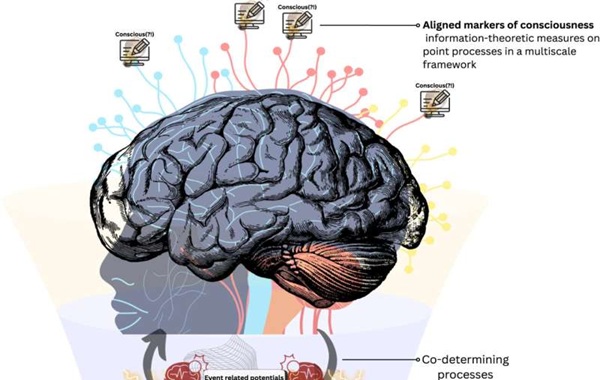
The Ghost in the Biological Machine: Is Consciousness Nature’s Ultimate Algorithm?
For centuries, humanity has been trapped in a binary struggle to explain the “Great Mystery”: Is consciousness a divine spark independent of the body (Dualism), or is it merely a byproduct of physical matter like steam rising from a kettle (Materialism)?
New research is now carving a “Third Path” that could rewrite the rules of neuroscience and philosophy: Biological Computationalism.
Beyond the “Brain as a Computer” Metaphor
We often hear that the brain is like a hard drive and our thoughts are the software. But this new perspective argues that this analogy is fundamentally flawed. Unlike silicon chips, biological systems don’t just “process” data; they live it.
Biological computationalism suggests that consciousness isn’t an “extra” feature added to a complex brain. Instead, it is an intrinsic property of how biological matter calculates its own survival. Every cell, every neuron, and every metabolic pathway is part of a massive, self-sustaining computation designed to keep the organism “aware” of its boundaries.
The Living Logic: Why Biology is Different
Traditional AI follows a set of rigid instructions. If you turn off the power, the “mind” of the AI vanishes instantly. However, biological consciousness is resilient because it is rooted in autopoiesis—the ability of a system to constantly reproduce and maintain itself.
The article highlights that consciousness might be the way a biological system “feels” its own internal computations. It’s not just about calculating the distance to a piece of fruit; it’s about the meaning of that fruit to a living, hungry entity. This “meaning” is the birth of subjective experience.
Solving the “Hard Problem”
Philosopher David Chalmers famously coined the “Hard Problem” of consciousness: Why does it feel like something to be us? By viewing consciousness through the lens of biological computation, scientists are beginning to see that “feeling” is actually an efficient way for a complex organism to summarize massive amounts of data. Instead of processing billions of separate chemical signals, the brain presents us with a single, unified “feeling” (like pain, joy, or hunger). Consciousness, therefore, is nature’s most advanced data compression tool.
The Future: Can We Build a Conscious Soul?
If consciousness is indeed biological computationalism in action, it raises a chilling question: Can we ever create true consciousness in a machine? If the “spark” requires the messy, self-replicating, and fragile nature of biological cells, then our current silicon-based AI might always be “dark” inside—simulating intelligence without ever actually experiencing it. To build a soul, we might need to stop building computers and start growing them.
The path to understanding consciousness is no longer just a journey for philosophers in armchairs. It is becoming a rigorous map of biological logic. We are moving toward a world where we don’t just ask what we are thinking, but how the very fabric of our biology creates the “I” that is doing the thinking.
Source: phys.org
The Hunger Sidekick: Scientists Uncover the “Hidden Partner” Controlling Your Appetite
The Ghost in the Biological Machine: Is Consciousness Nature’s Ultimate Algorithm?