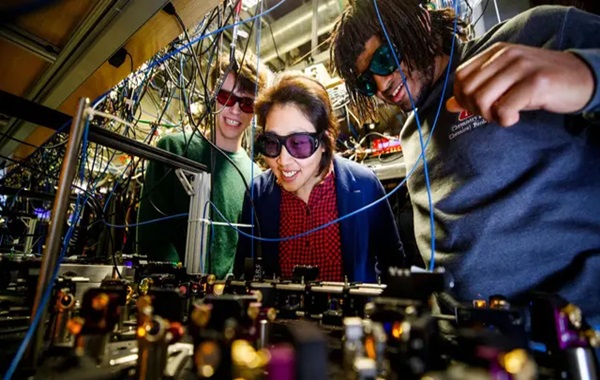
Scientists trap molecules for quantum tasks, enabling ultra-fast tech advancements
In an exciting development for the field of quantum computing, a team of scientists from Harvard University has successfully trapped molecules to perform quantum operations, marking a significant leap forward in the technology.
This development leverages the complexities of ultra-cold polar molecules as qubits, the basic units of information in quantum systems, providing remarkable potential for fast processing and groundbreaking advancements across multiple sectors, including medicine, science, and finance.
Historically, molecules were overlooked in quantum computing due to their intricate structures, which were considered too complex and delicate for reliable manipulation.
Instead, researchers have largely relied on smaller particles like ions and atoms. However, the recent findings published in the journal Nature could change the landscape.
Quantum operations using trapped molecules
“As a field, we have been trying to do this for 20 years, and we’ve finally been able to do it!” exclaimed senior co-author Kang-Kuen Ni, Theodore William Richards Professor of Chemistry and professor of physics at Harvard.
Quantum computing, which exploits the properties of quantum mechanics to perform calculations exponentially faster than classical computers, holds the promise of solving problems previously deemed unsolvable.
“Our work represents the last critical piece needed to construct a molecular quantum computer,” stated co-author and postdoctoral fellow Annie Park.
While much of the research in quantum computing has centered on trapped ions, neutral atoms, and superconducting circuits, this new approach utilizing molecules opens up a range of possibilities.
The Harvard study specifically details the complex process involving the formation of an ISWAP gate, a crucial quantum circuit responsible for creating entangled states—one feature that makes quantum computing so powerful.
To conduct their experiment, the researchers successfully trapped sodium-cesium (NaCs) molecules using optical tweezers within a stabilizing and extremely cold environment.
The team achieved a significant quantum operation by exploiting the electric dipole-dipole interactions between the molecules.
They meticulously controlled the rotation of the molecules, resulting in the creation of a two-qubit Bell state with an impressive 94 percent accuracy—an essential milestone in demonstrating the feasibility of using molecular structures in quantum computations.
In classical computing, logic gates manipulate binary bits (0s and 1s), while quantum gates operate on qubits that can exist in multiple states simultaneously, thanks to superposition.
This unique capability allows quantum computers to perform computations that would be impossible for traditional systems. Quantum gates also retain their reversibility and precision, which is crucial for maintaining the delicate nature of quantum states.
Computing
The ISWAP gate, utilized in this groundbreaking experiment, facilitates the swapping of states between two qubits while applying a phase shift—a critical procedure in generating entangled states.
As entanglement allows qubits to become correlated regardless of distance, this property is central to the formidable power of quantum computing.
While researchers have dreamed of leveraging molecular structures for quantum computations since the 1990s, earlier attempts faced challenges due to the instability of molecules, which often moved unpredictably and disrupted the coherence necessary for reliable operations.
The breakthrough achieved by the Harvard team lies in their ability to trap molecules in ultra-cold environments, significantly reducing their motion and allowing for greater control over their quantum states.
The advancement was made possible through the collaborative efforts of Ni’s lab members—Lewis R.B. Picard, Annie J. Park, Gabriel E. Patenotte, and Samuel Gebretsadkan—as well as physicists from the University of Colorado’s Center for Theory of Quantum Matter.
The research team conducted extensive evaluations of their operations by measuring the resulting two-qubit Bell state and assessing errors due to any residual motion, paving the way for improvements in the stability and accuracy of future experiments.
“There’s a lot of room for innovations and new ideas about leveraging the advantages of the molecular platform,” Ni noted, expressing excitement for these findings’ potential for advancing quantum computing technologies.
With this breakthrough, the landscape of quantum computing could transform, steering researchers closer to realizing the dream of a molecular quantum computer that capitalizes on the unique properties of molecules, thereby unlocking new horizons in computational capabilities.
Source: Interesting Engineering
You Live Inside a Simulation, Some Scientists Claim—But You Can Hack It to Transform Your Reality
Scientists trap molecules for quantum tasks, enabling ultra-fast tech advancements