Scientists discover the highest-energy light coming from the sun
Sometimes the best place to hide secrets is in broad daylight. Ask the sun.
Says Meir Un Nisa, a postdoctoral researcher at Michigan State University.” We thought we had this planet figured out, but we didn’t.”
Nisa, a soon-to-be MSU faculty member, is the lead author of a new paper published in Physical Review Letters detailing the discovery of the most energetic light ever observed from the Sun.
The international team behind this discovery also found that this type of light, known as gamma rays, is surprisingly bright. In other words, there is more light than scientists had previously expected.
Watching as the HAWC
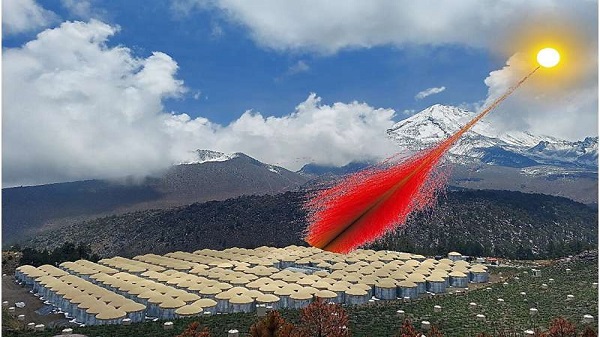
Although the high-energy light does not reach the surface, these gamma rays were detected by Nisa and her colleagues working at the High Altitude Water Cherenkov Observatory (HAWC).
HAWC plays an important role. Unlike other observatories, it operates around the clock.
Nisa, who works in the Department of Physics and Astronomy at the Faculty of Natural Sciences, says, “Observational techniques that were impossible a few years ago are now possible.” ‘In this particular energy regime, we can’t see the sun because our other ground-based telescopes only operate at night. Ours operates 24/7.”
In addition to operating differently from conventional telescopes, HAWC’s appearance is also very different from that of a typical telescope.
Instead of a tube with a glass lens attached, HAWC uses a network of 300 large water tanks, each filled with about 200 tons of water. The network is located between two dormant volcanoes in Mexico, more than 13,000 feet above sea level.
From this vantage point, one can observe the aftermath of gamma ray collisions with atmospheric air. Such collisions cause what is called an air shower, a kind of particle explosion that cannot be perceived by the naked eye.
The energy of the original gamma rays is released and redistributed into new fragments composed of lower energy particles and light; it is these particles and the new particles produced on their way down that HAWC can “see.”
When the shower particles interact with the water in HAWC’s tanks, they produce what is known as Cherenkov radiation, which can be detected by the observatory’s instruments.
Nisa and his team began collecting data in 2015. In 2021, the research team had enough data to scrutinize the sun’s gamma rays.
“After examining six years’ worth of data, this excess of gamma rays popped up. When we first saw it, we thought, ‘This is definitely a mistake.’ The sun can’t be this bright with this energy,'” he said.
The sun emits light of different energies, some more than others.
For example, the sun emits large amounts of visible light through nuclear reactions. The energy of this light is about one electron volt, a useful unit in physics.
The energy of the gamma rays observed by Nisa and his colleagues was about 1 trillion electron volts, or 1 teraelectron volt (abbreviated 1 TeV). Not only was this energy level astonishing, but the fact that so many gamma rays were observed was also surprising.
In the 1990s, scientists predicted that high-energy cosmic rays (particles accelerated by cosmic powerhouses such as black holes and supernovae) could produce gamma rays when they collided with the Sun’s protons. However, based on what is known about cosmic rays and the sun, researchers also hypothesized that these gamma rays would rarely reach the earth. At the time, however, no instrument was capable of detecting such high-energy gamma rays, and would not be for some time; in 2011, NASA’s Fermi Gamma-ray Space Telescope was the first to observe gamma rays with energies of over one billion electron volts.
Over the next several years, the Fermi mission showed that these gamma rays were not only extremely energetic, but were about seven times more abundant than scientists had originally expected. And there appeared to be a remaining possibility that even higher energy gamma rays would be discovered.
When telescopes are launched into space, there are limits to the size and performance of their detectors. The Fermi telescope’s measurements of the sun’s gamma rays were at most about 200 billion electron volts.
The theorists, led by Ohio State University professors John Beacom and Annika Peter, encouraged the HAWC collaboration.
‘They gave us a boost. We might see something,’ Nisa said.
The HAWC collaboration includes more than 30 institutions across North America, Europe, and Asia, a significant portion of which are among the nearly 100 authors of this new paper. They include Michigan State University graduate student Daniel Salazar-Gallegos, Professor Emeritus James Linnemann, and Kirsten Tollefson, professor of physics and astronomy and associate dean of the school.
For the first time, the team has shown that the energy of the sun’s rays extends into the TeV region, up to nearly 10 TeV.
At present, this discovery creates more questions than answers. How these gamma rays reach such high energies and what role the sun’s magnetic field plays in this phenomenon will leave solar scientists scratching their heads, Nisa says.
But when it comes to the universe, that’s part of the excitement. It tells us that something is wrong, or missing, or perhaps both, with respect to how we understand our nearest and dearest stars.”
Nisa said, “This shows that HAWC is adding to our knowledge of our galaxy with the highest energy, opening up questions about our own Sun.” ‘The HAWC allows us to look at things from a different angle. Literally.”
Source: Scientists discover the highest-energy light coming from the sun
Our solar system may be over a million years old.
Scientists discover the highest-energy light coming from the sun