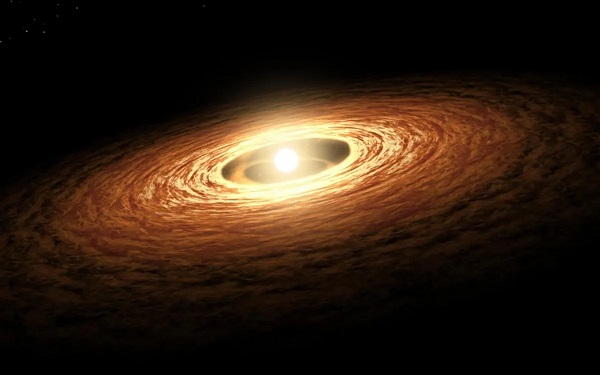
Our solar system may be over a million years old.
It appears to be not a day older than 4,568.4 million years.
The age of our solar system is an important question in science. It links the astronomical question of how stars and planets came into being with the terrestrial question of how life came to be on our planet. New measurements of meteorites suggest that the solar system may be slightly older than previously thought.
The new study puts the age of the solar system at 4,568.4 million years, plus or minus 240,000 years. Previous estimates were about 110,000 years lower at 4.563 billion years. While the change is small, a lot can happen on a planetary scale in a million years.
One might wonder how scientists can determine the age of the solar system; after all, calendars and stopwatches were not formed in the solar nebula in the same way. Calendars and stopwatches did not form in the solar nebula. The chemical composition of certain minerals in meteorites can tell us when they were formed. To understand the story of the birth of the planets and the first few million years of our solar system, we are studying meteorites that bear witness to this period.
It is especially critical to determine when the components of the meteorites were formed, when the parent planets accreted and melted, when the impacts occurred, and the relative order of these events in the context of the solar nebula.
In particular, researchers have focused on calcium-rich and aluminum-rich inclusions (CAIs) found in meteorites. Some isotopes are radioactive elements that are the same chemical element but have different numbers of neutrons in their nuclei, and they change into different elements over time. The time it takes depends on the stability of the isotope. Some exist for a few seconds, others for hours, days, or even billions of years.
By looking at specific ratios of isotopes, scientists can determine how long ago the rock in question was formed. Previous estimates were based on CAI lead isotope ratios, but aluminum ratios appear to have been more discordant, suggesting that perhaps the primordial solar nebula was diversified and not the same everywhere. This was problematic because something had to have happened to make the nebula so inhomogeneous, such as an intense solar flare or a supernova in the immediate vicinity. The team showed that the estimated age due to lead may be slightly younger than the estimated age due to aluminum, and that it depends not on differences in the solar nebula but on the heating process experienced by the CAI.
Lead author Steven Desch of Arizona State University told New Scientist magazine, “The CAI is a very young star. “We don’t need to bring up flares or supernova explosions. This is exactly what the sun was born with.”
Their findings suggest a simpler picture of how the solar system formed, albeit a slightly decrepit little corner of the universe.
Source: Our solar system may be over a million years old.
What Does 60 Years of Silence Tell Us About the Search for Extraterrestrial Life?