
Scientists Discover a Whole New Ecosystem Lurking at the Bottom of the Earth’s Seabed
Like an endless onion, scientists continue to peel back new layers about life on Earth.
Recently, underwater astronauts aboard a Schmidt Oceanographic Institute ship used underwater robots to turn over a slab of volcanic crust in the deep, dark Pacific Ocean.
Beneath the well-studied seafloor here, an international team of researchers discovered veins of subterranean fluid swimming with life unlike anything we have ever seen.
It was a whole new world we had never known.
Says Jotika Virmani, the institute’s executive director, “We’ve known for a long time that some animals live in underground cavities on land and in sand and mud under the sea, but this is the first time we’ve looked for animals living underground in hydrothermal vents.”
“This truly amazing discovery of a new ecosystem hidden beneath another provides new evidence of life in an incredible place.”
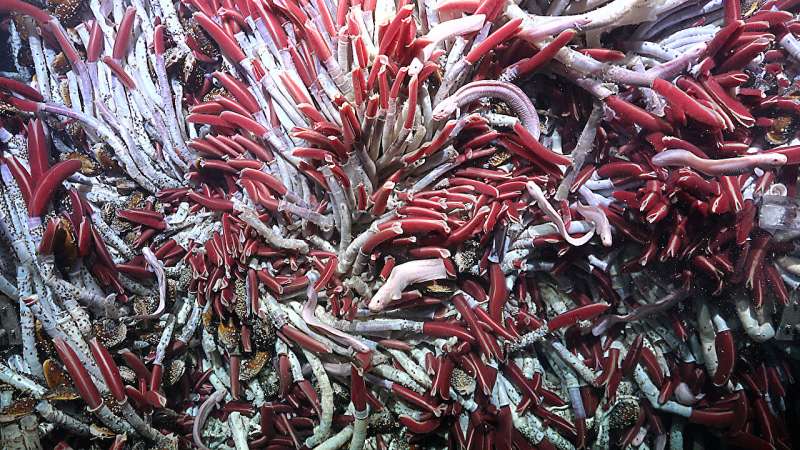
It was in the 1970s that scientists discovered hydrothermal vents spewing hot, mineral-rich fluids into the deep sea. Despite the darkness of the deep sea, life abounded around the smoky, chimney-like hydrothermal vents. But in the past 46 years of research, no one had ever thought to look beneath the ocean’s hot springs.
Stripping away the shell of the seafloor revealed a colorful ecosystem of worms, snails, and chemosynthetic bacteria, all of which use minerals rather than sunlight as their energy source.
This discovery has greatly expanded our understanding of the animal life that inhabits deep-sea hydrothermal vents,” says ecologist Monika Breit of the University of Vienna.
Hydrothermal vents have two dynamic habitats. The animals in the upper and lower hydrothermal vents thrive in unison, depending on the fluids in the hydrothermal vents from below and the oxygen in the seawater from above.”
Scientists found tubeworms particularly fascinating. These deep-sea creatures appear to move across the seafloor through volcanic fluids to explore new habitats.
This may explain why few larvae are seen congregating around volcanic fissures in the deep sea. Most may have matured on the surface.
To test this hypothesis, the researchers used a remotely operated vehicle called SuBastian to square the seafloor at a depth of about 2,500 meters on the East Pacific Ridge off the coast of Central America. The team then glued a mesh box over this lifeless area. A few days later, when the box was removed, new animals had taken up residence in its place. They must have gotten there from under the many cracks and crevices in the seafloor.
These findings will be published in the coming months, but if what the researchers say is true, future mining in the deep sea could seriously disrupt this newly discovered ecosystem.
Wendy Schmidt, co-founder of the Schmidt Ocean Institute, said, “The findings of each Schmidt Ocean Institute expedition reinforce the urgency of fully exploring the ocean to learn what exists in the deep sea.
Schmidt Ocean “The discovery of new organisms, landscapes, and now an entirely new ecosystem clearly demonstrates how much we have yet to discover about this ocean and how important it is to protect what we do not yet know and understand.” Institute co-founder Wendy Schmidt said.
Source: Scientists Discover a Whole New Ecosystem Lurking at the Bottom of the Earth’s Seabed