Scientists create world’s 1st mini-brain with working blood-brain barrier
There seems to be a new discovery in brain development.
Organoid experts at Cincinnati Children’s, Mayo Clinic and UC San Diego have brought about a significant discovery for disease research and drug development.
The human blood-brain barrier (hBBB) is one which is highly specialized and helps in regulating passage across blood and central nervous system (CNS) division. Some of the highlights from this latest study are as follows:
– Blood-brain barrier (BBB) assembloids are quite similar to the key features of the human BBB
– Neuro-vascular crosstalk plays an important role in forming BBB
– Patient-derived BBB asembloids effectively model in vivo cavermoma phenotypes
– BBB assembloids showcase SMC loss and disrupted neuro-vascular interactions in CCMs.
The study makes promises to ramp up treating a wide range of brain disorders like stroke, cerebral vascular disorders, brain cancer, Alzheimer’s disease, Huntington disease, Parkinson’s disease, and different sorts of neurodegenerative conditions.
Decoding the blood-brain barrier
According to the National Library of Medicine, “the blood-brain barrier (BBB) is a selective, semi-permeable membrane that separates the blood from the brain’s interstitial fluid. It enables cerebral blood vessels to regulate the movement of molecules and ions between the bloodstream and the brain.”
The blood vessels in the brain consist of an extra lining of tightly packed cells which limit the size of molecules passing from the bloodstream into the central nervous system (CNS).
Now, a barrier that would function properly would need to maintain brain health by preventing harmful substances from entering the brain.
At the same time, it allows essential nutrients to reach the brain. However, the glitch here is that this same barrier can prevent many potentially helpful medicines from reaching the brain. This latest discovery aims to solve that through stem cell bioengineering.
“Now, through stem cell bioengineering, we have developed an innovative platform based on human stem cells that allows us to study the intricate mechanisms governing BBB function and dysfunction. This provides unprecedented opportunities for drug discovery and therapeutic intervention,” said Ziyuan Guo, lead corresponding author and a faculty member in the Division of Developmental Biology at Cincinnati Children’s Medical Hospital.
“BBB Assembloids” – a groundbreaking discovery
Most researchers across the globe have been working hard to develop brain organoids, however, there hasn’t been too much luck as of now. This is the first time that a research center has succeeded in making a brain organoid – one which features a special barrier lining which is found in human brain blood vessels.
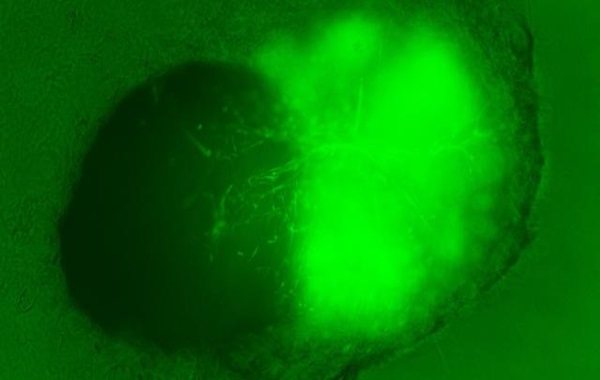
The researchers have called this new model and named it “BBB assembloids”. This name indicates this groundbreaking discovery. In the process, these assembloids combine two different types of organoids which are the brain organoids (the ones which replicate human brain tissue) and blood vessel organoids (the ones which mimic vascular structures).
Methodology
To proceed further with their experiment the researchers had made use of a line of patient-derived stem cells which make assembloids which quite efficiently replicated the key features of a rare brain condition which is known as a cerebral cavernous malformation.
It’s a genetic disorder which is characterized by dysfunctional blood-brain barrier integrity. It results in clusters of abnormal blood vessels in the brain which look like raspberries.
Guo noted that their model recapitulated the disease phenotype, which offers new insights into the underlying molecular and cellular pathology of cerebral vascular disorders.
“Overall, BBB assembloids represent a game-changing technology with broad implications for neuroscience, drug discovery, and personalized medicine,” Guo shared.
Source: Interesting Engineering
Sleepless Childhood: New Pathway to Psychosis Uncovered
Scientists create world’s 1st mini-brain with working blood-brain barrier