
Scientists ‘control’ quantum light for the first time, achieving landmark
Scientists have for the first time shown that they can control and distinguish tiny quantities of interacting photons – or packets of light energy – with high correlation, according to a study published in Nature on March 20.
This unprecedented accomplishment marks a significant turning point in the evolution of quantum technology, which could potentially advance quantum computing and medical imaging.
Harnessing quantum light for practical use
Einstein’s 1916 theory of stimulated light emission is commonly observed for many photons and inspired the laser’s development. With this latest study, stimulated emission has now been observed for single photons.
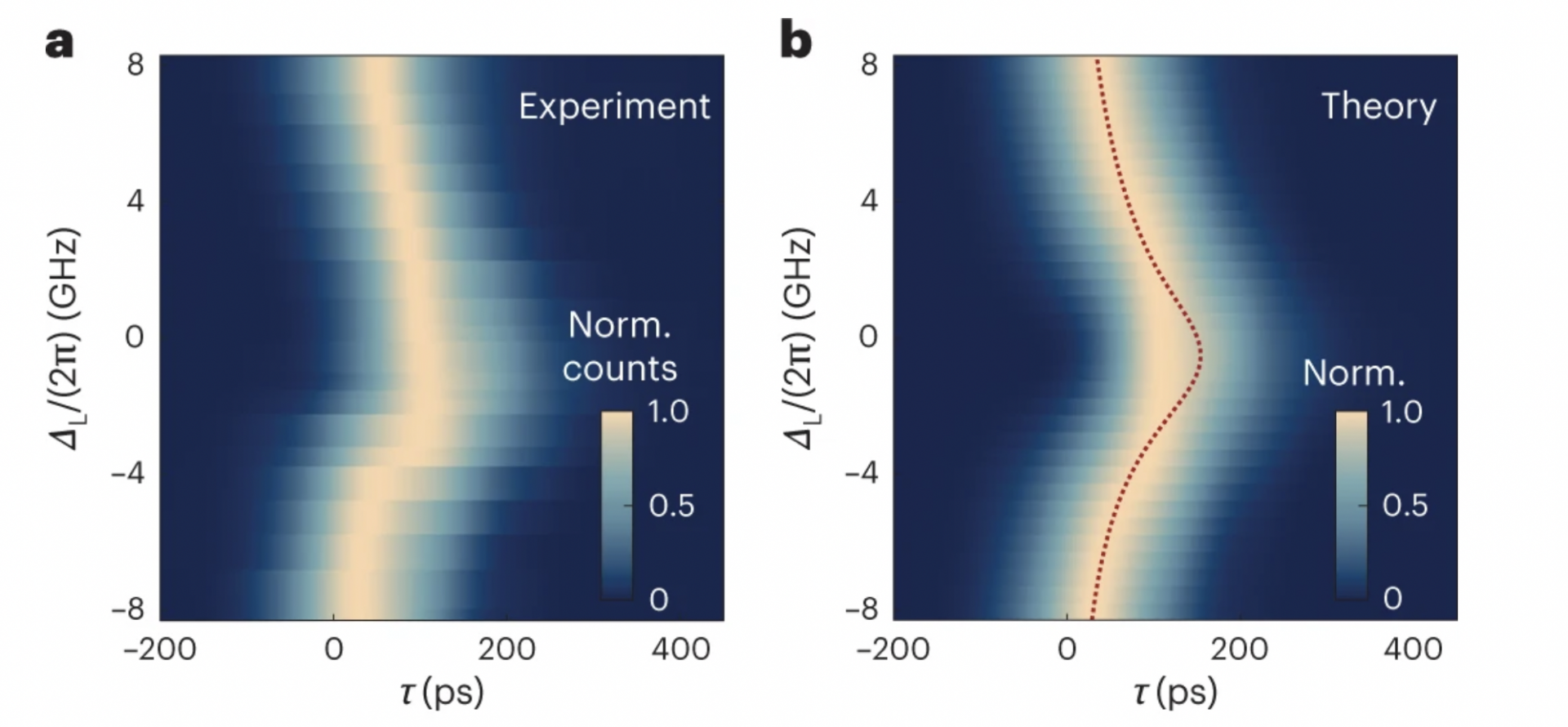
The direct time delay between a single photon and a pair of bound photons scattering off a single quantum dot, a form of an artificial atom, was measured.
“This opens the door to the manipulation of what we can call ‘quantum light’,” Dr. Sahand Mahmoodian from the University of Sydney School of Physics and joint lead author of the research said in a press release.
“The device we built induced such strong interactions between photons that we were able to observe the difference between one photon interacting with it compared to two,” explained Joint lead author Dr. Natasha Tomm.
“We observed that one photon was delayed by a longer time compared to two photons. With this really strong photon-photon interaction, the two photons become entangled in the form of what is called a two-photon bound state.”
This type of quantum light has the benefit that it can theoretically use fewer photons to do more sensitive measurements with better resolution. This can be crucial for biological microscopy applications where tiny features must be detected, and high light intensity can harm samples.
“By demonstrating that we can identify and manipulate photon-bound states, we have taken a vital first step towards harnessing quantum light for practical use,” Dr. Mahmoodian said.
“The next steps in my research are to see how this approach can be used to generate states of light that are useful for fault-tolerant quantum computing, which is being pursued by multimillion-dollar companies, such as PsiQuantum and Xanadu,” he added.
Dr. Tomm went on to say that the experiment is beautiful not only because it validates a fundamental phenomenon- stimulated emission- at its ultimate limit but also marks a significant technological advancement for future uses.
“We can apply the same principles to develop more-efficient devices that give us photon-bound states. This is very promising for applications in a wide range of areas: from biology to advanced manufacturing and quantum information processing,” she concluded.
Source: Interesting Engineering
“Strange Metal” Ytterbium Gets Even Stranger When Hit With Gamma Rays
“Strange Metal” Ytterbium Gets Even Stranger When Hit With Gamma Rays
Scientists ‘control’ quantum light for the first time, achieving landmark