New Study on Black Hole Magnetic Fields Has Thrown a Huge Surprise at Astronomers
For the first time, scientists have studied the magnetic field of a black hole inside the Milky Way in multiple wavelengths – and found that it doesn’t conform to what we previously thought.
According to researchers at the University of Florida and the University of Texas at San Antonio, the black hole called V404 Cygni’s magnetic field is much weaker than expected – a discovery that means we may have to rework our current models for black hole jets.
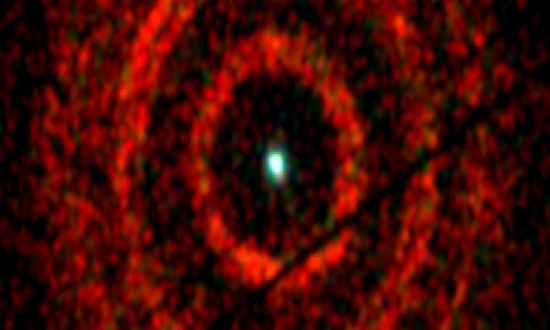
V404 Cygni, located around 7,800 light-years away in the constellation of Cygnus, is a binary microquasar system consisting of a black hole about 9 times the mass of the Sun, and its companion star, an early red giant slightly smaller than the Sun.
In 2015, the system flared into life, and, over the course of about a week, periodically flashed with activity as the black hole devoured material from its companion star.
At times, it was the brightest X-ray object in the sky; but it also showed, according to NASA-Goddard’s Eleonora Troja, “exceptional variation at all wavelengths” – offering a rare opportunity to study both V404 Cygni and black hole feeding activity.
It was this period that the team, led by Yigit Dallilar at the University of Florida, studied.
When black holes are active, they become surrounded by a brightly glowing accretion disc, lit by the gravitational and frictional forces that heat the material as it swirls towards the black hole.
Black holes themselves don’t have magnetic poles, and therefore don’t generate magnetic fields. This means that the accretion disc corona magnetic fields are somehow generated by the space around a black hole – a process that is not well understood at this point.
This result doesn’t mean that previous findings showing strong magnetic fields are incorrect, but it does suggest that the dynamics may be a little more complicated than previously thought.
The team’s research did find that synchrotron processes dominated the cooling events, but could not provide data on what caused the particles to accelerate in the first place. It is, as one has come to expect from black holes, a finding that answers one question and turns up a lot more in need of further research.
“We need to understand black holes in general,” said researcher Chris Packham of the University of Texas at San Antonio.
“If we go back to the very earliest point in our universe, just after the big bang, there seems to have always been a strong correlation between black holes and galaxies. It seems that the birth and evolution of black holes and galaxies, our cosmic island, are intimately linked.
“Our results are surprising and one that we’re still trying to puzzle out.”
The research has been published in the journal Science.
Source:http://www.sciencealert.com/black-hole-magnetic-field-weaker-than-expected-v404-cygni