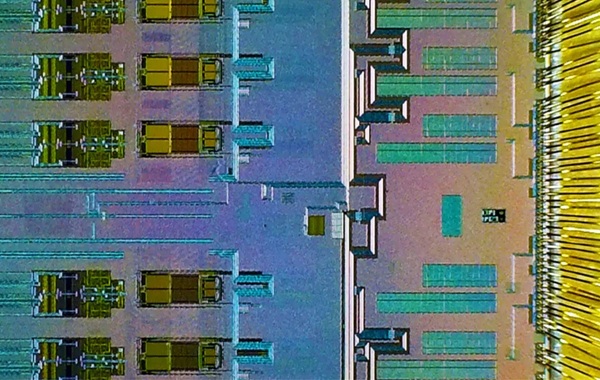
New chip captures 1.5 billion particle collisions per second at CERN
A new specialized, radiation-hardened chip has been designed for CERN’s Large Hadron Collider (LHC) upgrade.
Engineers at Columbia University have developed this analog-to-digital converter (ADC) chip.
The custom-designed chips will be used in the ATLAS detector to measure up to 1.5 billion particle collisions per second.
These chips are essential because the LHC’s high-energy particle collisions produce intense radiation that would destroy standard commercial electronics.
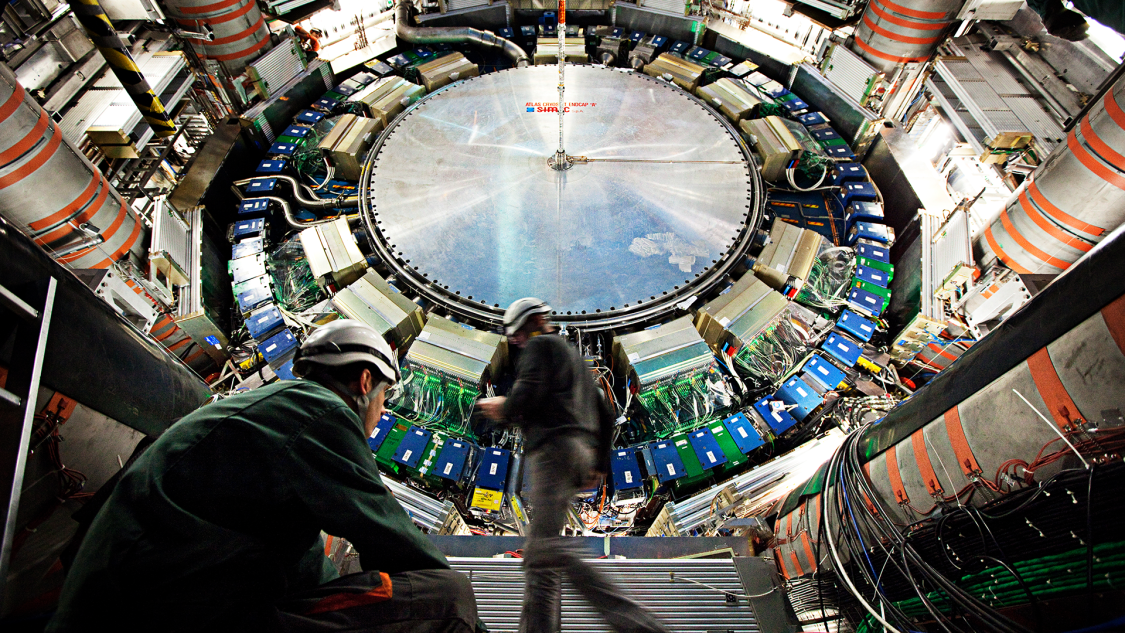
Chip for the ATLAS detector
The LHC is a huge underground facility located between France and Switzerland.
To study fundamental particles like the Higgs boson, physicists collide particles at nearly the speed of light in the Large Hadron Collider.
It is reported that approximately 400 million particle collisions occur every second.
With the upcoming upgrades to the LHC, the number of collisions will increase dramatically to 1.5 billion or more per second.
These collisions generate vast amounts of data and produce intense radiation, which is powerful enough to damage or destroy most electronic equipment.
Since the market for radiation-resistant components is too small to attract commercial investment, specialized solutions are needed to handle these extreme conditions.
“Industry just couldn’t justify the effort, so academia had to step in,” said Peter Kinget, the Bernard J. Lechner Professor of Electrical Engineering at Columbia Engineering.
They designed specialized silicon chips to collect data in an extreme particle physics environment.
These chips link the physical world of particle collisions and the digital data that scientists can analyze.
The task of the analog-to-digital converter chips is to capture electrical signals generated by particle collisions and convert them into a digital format.
The ATLAS detector uses a liquid argon calorimeter to measure the electrical pulses from particle collisions.
This device, a large container of ultra-cold argon, records an electronic trace for each passing particle.
Custom-designed ADC chips then convert these analog signals into precise digital data, capturing details that other components cannot.
Resilient design
The team couldn’t use off-the-shelf components.
“We tested standard, commercial components, and they just died. The radiation was too intense,” said Rui (Ray) Xu, a Columbia Engineering PhD student.
So, the team designed their chips. They selected and arranged components and designed digital systems that automatically correct errors.
Although they didn’t invent new manufacturing methods, they used existing circuit-level techniques to create chips.
Interestingly, this approach resulted in a resilient design that can endure the harsh conditions of the LHC for over a decade.
“The ADC ASIC was demonstrated to be robust against the effects of the intense radiation expected in the HL-LHC experimental environment,” the researchers wrote in the study.
Two of these innovative chips are now part of the ATLAS experiment.
The trigger ADC, already in use, functions as a “digital gatekeeper.” Its job is to filter through a billion collisions every second, selecting only the most scientifically promising events for further study.
Source: Interesting Engineering
World’s most powerful gamma-ray detector set to unlock nuclear secrets
New chip captures 1.5 billion particle collisions per second at CERN