
NASA’s Roman Telescope Set to Map Billions of Galaxies and Hunt Rogue Planets
NASA’s Nancy Grace Roman Space Telescope is gearing up to unlock the deepest secrets of the universe with three groundbreaking surveys.
Designed with input from over a thousand scientists worldwide, Roman’s missions will map billions of galaxies, capture the dynamic dance of cosmic phenomena like supernovae and black holes, and peer into the hidden heart of the Milky Way to find rogue planets and stellar remnants. With its panoramic vision and swift survey speeds, Roman promises to revolutionize our understanding of dark energy, dark matter, galaxy formation, and even the origins of distant worlds.
Roman’s Mission: Revolutionizing Cosmic Exploration
NASA’s Nancy Grace Roman Space Telescope team has finalized the designs for the mission’s three core surveys, which will launch a new era of cosmic exploration. These surveys are crafted to tackle some of the most profound mysteries in astrophysics, from dark energy and dark matter to the formation of distant worlds — with the goal of dramatically expanding our understanding of the universe.
“Roman’s setting out to do wide, deep surveys of the universe in a way that will help us answer questions about how dark energy and dark matter govern cosmic evolution, and the demographics of worlds beyond our solar system,” said Gail Zasowski, an associate professor at the University of Utah and co-chair of the ROTAC (Roman Observations Time Allocation Committee). “But the overarching goal is that the surveys have broad appeal and numerous science applications. They were designed by and for the astronomical community to maximize the science they’ll enable.”
A New Panoramic View of the Universe
Roman’s sharp, wide-field view of space, combined with its rapid survey speeds, will offer astronomers an unprecedented look at the cosmos. To guide the mission’s focus, the Roman team invited the scientific community to suggest research priorities for each of the surveys. Committees made up of scientists from across many institutions reviewed the ideas and helped shape three strong survey plans.
In April, the team had finalized the designs based on this community input. Together, these three surveys will account for up to 75 percent of Roman’s observation time during its five-year primary mission. The remaining time will be reserved for additional projects proposed and developed by the broader science community through future opportunities.
A Global Effort to Shape Roman’s Mission
“These survey designs are the culmination of two years of input from more than 1,000 scientists from over 350 institutions across the globe,” said Julie McEnery, Roman’s senior project scientist at NASA Goddard. “We’re thrilled that we’ve been able to hear from so many of the people who’ll use the data after launch to investigate everything from objects in our outer solar system, planets across our galaxy, dark matter and dark energy, to exploding stars, growing black holes, galaxies by the billions, and so much more.”
With all major hardware now delivered, Roman has entered its final phase of preparation for launch, undergoing integration and key environmental testing at NASA Goddard. Roman is targeted to launch by May 2027, with the team working toward a potential launch as early as October 2026.

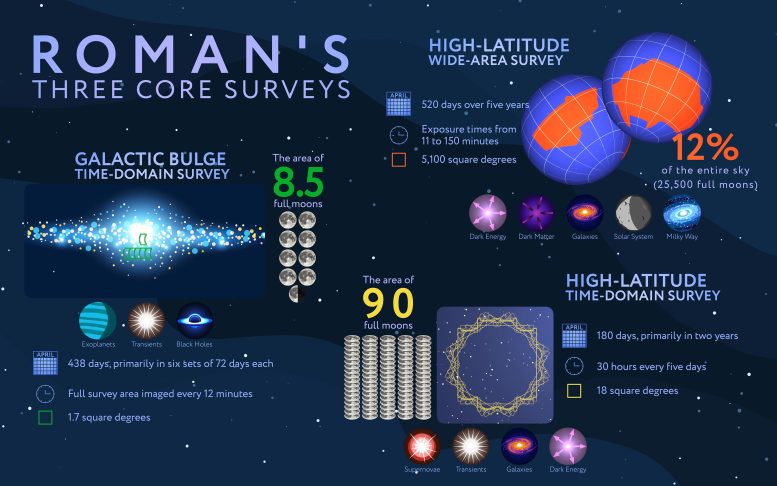
Roman’s largest survey, the High-Latitude Wide-Area Survey, combines the powers of imaging and spectroscopy to unveil more than a billion galaxies strewn across a wide swath of cosmic time. Roman can look far from the dusty plane of our Milky Way galaxy (that’s what the “high-latitude” part of the survey name means), looking up and out of the galaxy rather than through it to get the clearest view of the distant cosmos.
The distribution and shapes of galaxies in Roman’s enormous, deep images can help us understand the nature of dark energy — a pressure that seems to be speeding up the universe’s expansion — and how invisible dark matter, which Roman will detect by its gravitational effects, influences the evolution of structure in our universe.
For the last two years, researchers have been discussing ways to expand the range of scientific topics that can be studied using the same dataset. That includes studying galaxy evolution, star formation, cosmic voids, the matter between galaxies, and much more.

Roman’s High-Latitude Time-Domain Survey can probe our dynamic universe by observing the same region of the cosmos repeatedly. Stitching these observations together to create movies can allow scientists to study how celestial objects and phenomena change over time periods of days to years.
This survey can probe dark energy by finding and studying many thousands of a special type of exploding star called type Ia supernovae. These stellar cataclysms allow scientists to measure cosmic distances and trace the universe’s expansion.
“Staring at a large volume of the sky for so long will also reveal black holes being born as neutron stars merge, and tidal disruption events – flares released by stars falling into black holes,” said Saurabh Jha, a professor at Rutgers University in New Brunswick, New Jersey, and ROTAC co-chair. “It will also allow astronomers to explore variable objects, like active galaxies and binary systems. And it enables more open-ended cosmic exploration than most other space telescopes can do, offering a chance to answer questions we haven’t yet thought to ask.”

Unlike the high-latitude surveys, Roman’s Galactic Bulge Time-Domain Survey will look inward to provide one of the deepest views ever of the heart of our Milky Way galaxy. Roman’s crisp resolution and infrared view can allow astronomers to watch hundreds of millions of stars in search of microlensing signals — gravitational boosts of a background star’s light that occur when an intervening object passes nearly in front of it. While astronomers have mainly discovered star-hugging worlds, Roman’s microlensing observations can find planets in the habitable zone of their star and farther out, including analogs of every planet in our solar system except Mercury.
The same set of observations can reveal “rogue” planets that drift through the galaxy unbound to any star, brown dwarfs (“failed stars” too lightweight to power themselves by fusion the way stars do), and stellar corpses like neutron stars and white dwarfs. And scientists could discover 100,000 new worlds by seeing stars periodically get dimmer as an orbiting planet passes in front of them, events called transits. Scientists can also study the stars themselves, detecting “starquakes” on a million giant stars, the result of sound waves reverberating through their interiors that can reveal information about their structures, ages, and other properties.
Data from all of Roman’s surveys will be made public as soon as it is processed, with no periods of exclusive access.
“Roman’s unprecedented data will offer practically limitless opportunities for astronomers to explore all kinds of cosmic topics,” McEnery said. “We stand to learn a tremendous amount of new information about the universe very rapidly after the mission launches.”
Source: https://scitechdaily.com