Mass migration from France to England and Wales 3,000 years ago displaced about HALF of the ancestry of Great Britain, study claims
Researchers have conducted a DNA analysis of 793 Bronze Age-era individuals
These ancient people were found in parts of Britain and all over mainland Europe
Results suggest Euro migrants became mixed in the Southern British population
It is believed they arrived from communities in and around present-day France
British populations were not replaced by these migrants during the Bronze Age
Rather there but a peaceful ‘homogenisation’ as these diverse groups interbred
Mass migration from France to England and Wales around 3,000 years ago replaced about half of the ancestry of Great Britain, a new study claims.
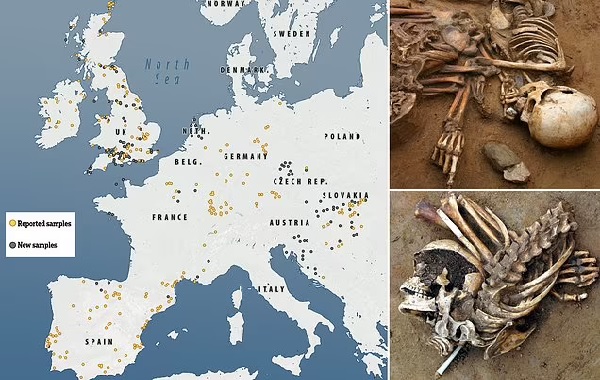
An international team of researchers examined the DNA of 793 ancient individuals from Bronze Age Britain, which began around 2,000 BC and lasted for nearly 1,500 years.
Results suggest people moving into southern Britain around 1300 BC to 800 BC were responsible for around half the genetic ancestry of subsequent populations.
These new migrants became thoroughly mixed in to the Southern British population in the period 1000 BC to 875 BC – likely a time of ‘intense and sustained contacts’ between many diverse communities, the researchers say,
Exact origins of the migrants cannot yet be established with certainty, but they are most likely to have come from communities in and around present-day France.
Researchers based their findings on newly-discovered and already-discovered ancient remains from British towns including Amesbury in Wiltshire, Lechlade in Gloucestershire, Ditchling Road in Brighton and Ulva Cave in Scotland.
DNA from these British samples were compared to ancient individuals recovered from parts of mainland Europe.
Researchers don’t know how many migrated during this time, or why they migrated.
The new study, published today in Nature, was conducted by a team of more than 200 international researchers, led by the University of York, Harvard Medical School and the University of Vienna.
‘While we may once have thought that long-distance mobility was restricted to a few individuals, such as traders or small bands of warriors, this new DNA evidence shows that considerable numbers of people were moving, across the whole spectrum of society.’
Professor Armit told MailOnline that the specific areas these migrants came from are unknown, although France is likely.
‘We can rule out the migrants into Britain deriving from any specific population that we have sampled; however there are big gaps in the sampling in France,’ he said.
‘The closest genetic relatives that we do see are all from later Iron Age populations around the periphery of France. So taking all that together, and also taking into account the archaeological links in material culture, France is the most likely area of origin.’
According to the findings, the genetic structure of our island’s population changed through sustained contacts between mainland Britain and Europe over several centuries, such as the movement of traders, intermarriage, and small scale movements of family groups.
Source: daily mail
Our Extinct Cousins Reached ‘The Roof of The World’ a Long Time Before Homo Sapiens
Our Extinct Cousins Reached ‘The Roof of The World’ a Long Time Before Homo Sapiens
Mass migration from France to England and Wales 3,000 years ago displaced about HALF of the ancestry of Great Britain, study claims