Magnificent 9,000-Year-Old Necklace Recovered from Ancient Child’s Tomb
Archaeologists have discovered the remains of a nearly 9,000-year-old child buried in what is now Jordan, along with thousands of beads.
According to an international team led by archaeologist Hala Alarashi of the University of Côte d’Azur in France, the child was probably a girl about 8 years old, based on the shape of her jaw.
The remaining bones have been damaged over time, and little can be said about the child’s lifestyle.
The beads are one of the only clues to who she was and what the culture of her society was like, suggesting that the people who once lived in this Neolithic village known as Baja took great care in burying their children.
Of the more than 2,500 beads (made of calcite, turquoise, hematite, etc.) in the grave, most were stained red and spilled down the child’s chest and neck.
Among the jumble was a faint but perceptible pattern. For every ten disk-shaped beads in a row, the researchers noticed two nearby that were shaped like tubes.
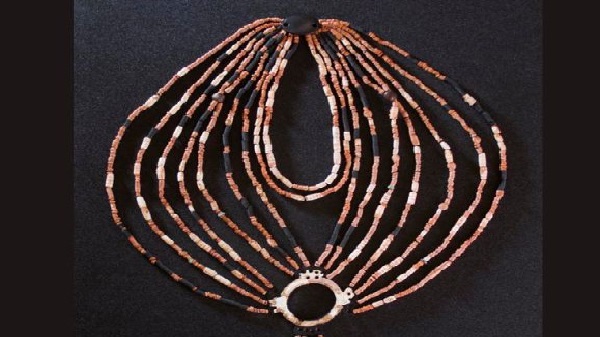
Such careful placement would have required the beads to be strung together, sewn onto the child’s clothing, or hung from a body part. On the back of the child’s neck, Ararasi and her team found the answer. They found a pearly ring and a double-holed pendant with several beads still connected.
The scientists put the magnificent ornament, made of several strands of carefully placed beads, back together bead by bead.
Baja was probably inhabited between 7400 and 6600 B.C. The village is small but dense with archaeological sites. The mountain plateau can only be reached by passing through a number of winding canyons and vertical rock formations.
Still, not all of the people who lived in this ancient village were buried here.
Only a few graves have been found beneath the houses of Baja, most of them infants and children, buried along with numerous grave goods.
In 2018, archaeologists discovered the grave of an 8-year-old girl under an ancient village room. The results of the meticulous excavation have now been published.
According to Alarasi and his colleagues, it is clear that the beads in which the child was buried were “part of the ornaments that gradually crumbled and became disordered after the decomposition of the body. Her necklace, they add, is unlike any other found in the Levant, a historic region stretching from the Eastern Mediterranean to Western Asia.
The harmony of the colors and the careful symmetry of the beads speak of great wealth and prosperity.
But according to the researchers, the true masterpiece of the ornament is the mother-of-pearl ring. It is large, extremely delicate, and probably once shone with iridescent colors. Its surface is carefully and skillfully carved with fine patterns of lace and filigree.
The authors of the study write, “The aesthetic is indisputable.”
The sheer quantity of beads, the intricate organization, and the harmony and beauty of the work are reminiscent of later decorative objects found in Mesopotamia and Egypt.
In this much older Levantine village, the necklace stands out.
Our meticulous analysis has allowed us to revisit one of the oldest and most impressive ornaments of the Neolithic period.” “Despite their elaborate design, these necklaces were not made for the purpose of exchange or trade, but rather were part of a child’s burial and are an important testimony to the cultural practices of the time.”
The necklace is now on display at the New Museum of Petra in Jordan.
Source: Magnificent 9,000-Year-Old Necklace Recovered from Ancient Child’s Tomb