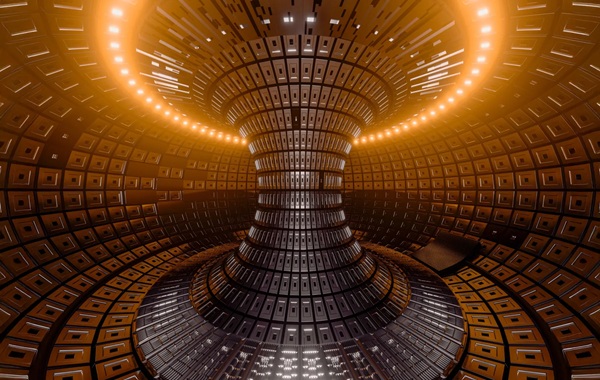
Harnessing the Stars: How Future Fusion Reactors Could Detect the Universe’s Hidden Dark Matter
While the primary goal of nuclear fusion is to provide a near-limitless source of clean energy, researchers are now uncovering a secondary, profound potential. A new study suggests that the extreme environments within these reactors could serve as high-precision laboratories for detecting axions—elusive particles that are among the top candidates for dark matter.
Bridging the Gap Between Energy and Cosmology
For years, the search for dark matter has relied on massive underground detectors or space telescopes. However, a team of physicists has demonstrated that the intense neutron activity inside a fusion tokamak provides a unique opportunity. By monitoring how neutrons interact with the reactor’s magnetic fields, scientists may be able to “see” the signature of axions, which are otherwise nearly impossible to detect.
The Science of the Invisible
The study focuses on a specific quantum phenomenon: the conversion of photons or neutrons into axions in the presence of strong electromagnetic fields. Because fusion reactors like ITER use some of the most powerful magnets on Earth, they inadvertently create a “perfect storm” for observing these rare interactions. This doesn’t mean the reactor is creating dark matter from nothing, but rather providing the specific conditions necessary to manifest and measure these theoretical particles.
From Theoretical Physics to Practical Application
Interestingly, the research solves a long-standing mathematical puzzle regarding axion-neutron coupling. By refining these calculations, the team has provided a new “search area” for experimental physicists. This means that as we build the next generation of power plants, we are simultaneously building the most sensitive dark matter sensors in history.
Why Accuracy Matters
This discovery is significant because it utilizes “dual-use” technology. We don’t need to build entirely new, multi-billion dollar experiments to hunt for axions; we can integrate detection sensors directly into the fusion infrastructure already under development.
A New Chapter in Modern Physics
We are approaching a milestone where our quest for sustainable energy aligns with our quest to understand the fundamental laws of physics. Fusion reactors may be our best bet for powering our world, but they might also be the key to finally illuminating the 85% of our universe that remains in the dark.
Source: science daily
The One-Way Street of Reality: Scientists May Have Finally Solved Why Time Never Runs Backward
Harnessing the Stars: How Future Fusion Reactors Could Detect the Universe’s Hidden Dark Matter