First ever free-floating black hole found roaming through interstellar space
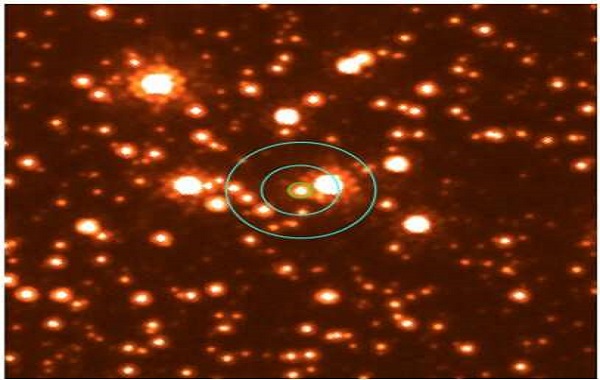
An international team of researchers has confirmed that a possible microlensing event witnessed in 2011 was due to the presence of a free-floating black hole roaming through interstellar space—the first of its kind ever observed. The group has published a paper describing their findings on the arXiv preprint server.
But finding them has meant looking for lensing effects, when light from stars is bent by the pull of the black hole. Given the great distances, the lensing effect is slight, making it nearly impossible to detect using even the best modern telescopes. But luck prevailed in 2011 when two project teams looking for such lensing spotted a star that appeared to brighten for no apparent reason. Intrigued, the researchers with this new effort began analyzing the data from Hubble. For six years, they watched as the light changed, hoping that the change was due to magnification from a black hole. Then, they found something else—the position of the star appeared to change. The researchers suggest the change could only be due to an unseen moving object exerting a force that was pulling on the light as it passed by—an interstellar black hole. The researchers continued to study the star and its light, and eventually ruled out the possibility of any light coming from the lensing and also confirmed that the magnification had a long duration, both of which are prerequisites to confirming the existence of a black hole.
Taken altogether, the evidence is strong enough to confirm the sighting of a free-floating black hole. The researchers were even able to measure its size, at seven solar masses. They also found that it is traveling at approximately 45 km/second.
Source: phys.org
Near-Earth Comet Exploded over North America about 1,500 Years Ago
Near-Earth Comet Exploded over North America about 1,500 Years Ago
First ever free-floating black hole found roaming through interstellar space