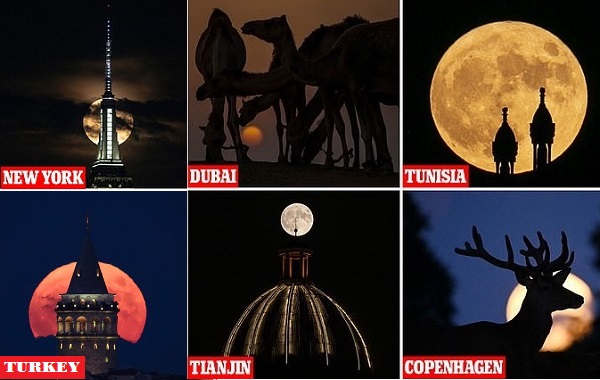
Did YOU see it? Stunning photos show last night’s SUPERMOON as it rose over London, Milan and New York – with our lunar satellite appearing 30% bigger and brighter
A stunning supermoon lit up skies around the world last night, as our lunar satellite appeared 30 per cent bigger and brighter.
The spectacular event could be seen rising over famous landmarks, including the skyline of New York, Milan’s Peace Arch and Glastonbury Tor in Somerset.
A supermoon occurs when the full moon nearly coincides with perigee – the point in the orbit of the moon at which it is nearest to the Earth.
Its proximity bolsters its brightness and size in the night sky from our planet, while on the moon it would appear the same as normal.
July’s full moon is known as the Buck Moon in a traditional naming system developed by early Native Americans, because male deer shed and regrow their antlers around this time of year.
The last supermoon was on June 14 and was called the ‘Strawberry moon’ because it’s the full moon at strawberry harvest time.
Supermoons occur because the moon orbits the Earth on an elliptical path, rather than a circular one.
This means there is a point in its 29.5-day orbit where it is closest to the Earth, known as the perigee, and it passes this point during a full moon at certain times of the year.
A full moon at perigee appears 14 per cent larger due to being closer to us, and only 30 per cent brighter than an apogee full Moon – the point when it is furthest away.
A supermoon is also only about 7 per cent larger and 15 per cent brighter than an average full Moon.
Some parts of the scientific community, including NASA, use the supermoon definition set by astrologer Richard Nolle in 1979, who classed it as a full moon that comes within 90 per cent of its perigee — the closest point to Earth in its orbit.
However, retired NASA astrophysicist Fred Espenak calculates supermoons to account for changes in the lunar orbit each lunar cycle.
The average distance of the moon from the Earth is 238,855 miles (384,400 km), but in its perigee it is only 222,089 miles (357,264 km) away.
July’s full moon reached its peak illumination at 19:38 BST (14:37 ET), however as it was daylight could not be viewed.
Skywatchers told to look in a easterly direction after sunset to see it creep up over the horizon from 21:48 BST in London , Edinburgh at 22:35 BST and Plymouth at 21:24 BST.
Its maximum apparent diameter was 33 feet and 57 inches.
July’s full moon gets its name from it being the time of year when male deer shed and regrow their antlers.
Other Native American tribes call it Salmon Moon, Raspberry Moon, and Thunder Moon.
In Celtic, this Moon was known as the Claiming Moon, Wyrt Moon, Herb Moon, and Mead Moon, while the Anglo-Saxons called it the Hay Moon.
The phrase ‘honeymoon’ may be tied to June’s full moon, possibly due to the tradition of marrying in June or because the ‘honey moon’ is the ‘sweetest’ moon of the year.
A full moon occurs when the moon appears as a complete circle in the sky, because the whole of the side of the moon facing the Earth is lit up by the sun’s rays.
If you missed last night’s full moon, the next one is on August 11, and is also likely to be classed as a supermoon.
August’s full moon is known as the ‘Sturgeon Moon’ because the giant, prehistoric-looking sturgeon fish of the Great Lakes and Lake Champlain were most readily caught during this part of summer.
Source: daily mail
The First JWST Photo Of Jupiter Has Already Been Released – With A Spectacular Detail
The First JWST Photo Of Jupiter Has Already Been Released – With A Spectacular Detail
Did YOU see it? Stunning photos show last night’s SUPERMOON as it rose over London, Milan and New York – with our lunar satellite appearing 30% bigger and brighter