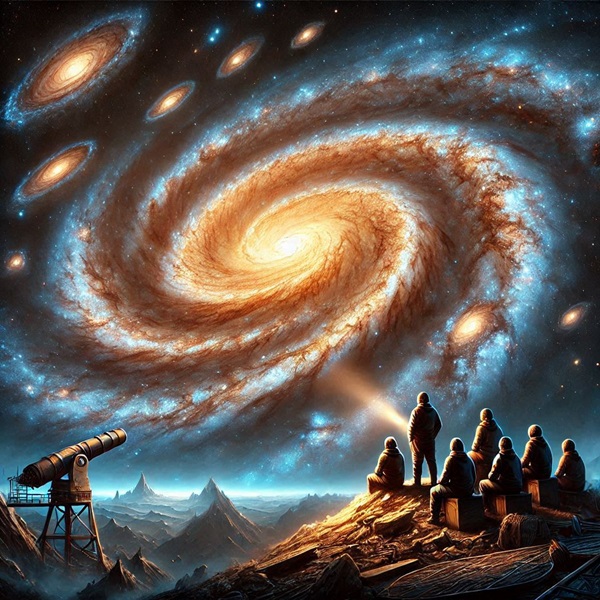
Did Mature Galaxies Like Zhúlóng Form Earlier Than We Thought?
Astronomers discover an ultra-massive grand-design spiral galaxy
An international team of astronomers has made a groundbreaking discovery: an ultra-massive grand-design spiral galaxy named Zhúlóng. Detected with the James Webb Space Telescope (JWST) as part of the PANORAMIC survey, this newly identified galaxy sets a record as the most distant spiral galaxy observed to date. The discovery, detailed in a preprint paper on arXiv published on December 17, sheds new light on the formation and evolution of spiral galaxies in the early universe.
Grand-Design Spiral Galaxies: Unique Structures in the Universe
Grand-design spiral galaxies are renowned for their distinctive, well-defined spiral arms that extend outward from a bright central core. These arms are not merely aesthetic but are regions of intense star formation. The spiral arms represent overdense areas in the galactic disk, where material compresses, triggering the birth of new stars. Despite their striking appearance, such galaxies are rare, especially at high redshifts, where their study can reveal insights into the early stages of cosmic evolution.
Zhúlóng: A Rare High-Redshift Spiral Galaxy
The discovery of Zhúlóng (coordinates α, δ [J2000] = 150.124874, 2.092919) marks a major milestone in astronomy. Named after the mythical red solar dragon from Chinese mythology, Zhúlóng was found serendipitously in the j100024p0208 association during the recent JWST PANORAMIC survey. This pure parallel extragalactic NIRCam imaging program provided the data leading to its identification.
With a photometric redshift of approximately 5.2, Zhúlóng is estimated to have formed within the first billion years following the Big Bang. Its mass, comparable to that of the Milky Way, makes it extraordinarily massive for such an early epoch, providing a rare glimpse into the dynamics of ancient galaxies.
The Structure and Properties of Zhúlóng
Detailed observations revealed Zhúlóng’s classical bulge and expansive stellar disk, which measures an impressive 62,000 light-years across. Its well-preserved spiral arms and face-on orientation offer astronomers a unique opportunity to study its structure.
Quiescent Core and Star-Forming Disk:
The core is quiescent, showing minimal star formation and high stellar mass surface density, aligning with theories of inside-out galaxy growth and quenching.
In contrast, the surrounding stellar disk remains actively star-forming, albeit at a relatively modest rate of 66 solar masses per year.
Efficiency in Star Formation:
Zhúlóng’s baryons-to-stars conversion efficiency stands at 0.3, surpassing even the most efficient galaxies at later cosmic times. This suggests a phase of intense star formation early in its life, followed by a transition toward quiescence.
Implications for Early Universe Galaxy Formation
Zhúlóng challenges long-held assumptions about the timeline of galactic evolution. The presence of a mature spiral galaxy so soon after the Big Bang suggests that complex galaxy structures emerged much earlier than previously thought. Its properties indicate a rapid transformation from star-forming to quiescent, emphasizing the importance of JWST in uncovering such phenomena.
A New Frontier in Astronomy
The discovery of Zhúlóng opens the door to further investigations into the origins and evolution of spiral galaxies in the early universe. As the most distant spiral galaxy identified to date, it not only deepens our understanding of cosmic history but also highlights the unprecedented capabilities of JWST in exploring the farthest reaches of space.
Astronomers anticipate that ongoing surveys and future observations with JWST will reveal more galaxies like Zhúlóng, each contributing to our understanding of the universe’s earliest epochs. This discovery underscores the transformative power of modern space telescopes in reshaping our cosmic perspective.
Source: Did Mature Galaxies Like Zhúlóng Form Earlier Than We Thought?