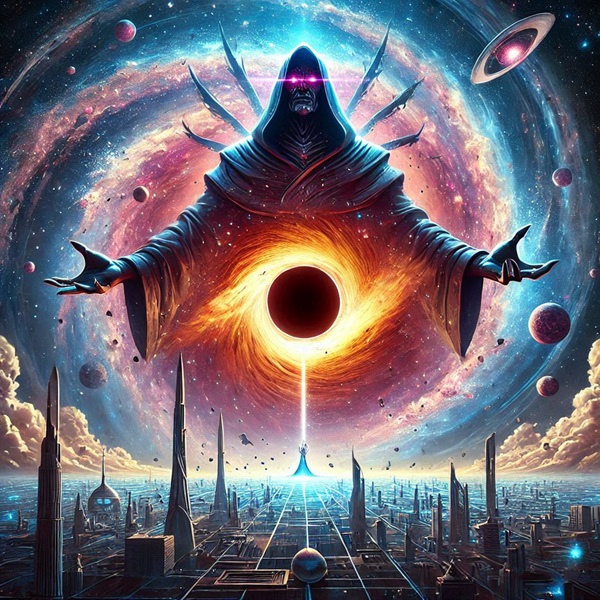
What If Space-Time Ends Inside Quantum Black Holes?
Singularities and the Limits of General Relativity
Albert Einstein’s general relativity, a cornerstone of modern physics, describes how gravity shapes the universe. However, this powerful theory predicts the existence of singularities—regions where matter collapses under its own gravity to form infinite density and curvature of space-time. Roger Penrose, a Nobel laureate, demonstrated that such singularities are an inevitable outcome of gravitational collapse.
At singularities, the laws of physics cease to function. Space, time, and matter are compressed into a state of nonexistence, rendering scientific predictions impossible. Observing a singularity directly would mean the breakdown of causality, the foundation of science itself.
Black Holes and the Cosmic Censorship Conjecture
Penrose proposed a mechanism to shield the universe from the disruptive effects of singularities: black holes. These enigmatic objects are defined by an event horizon, a one-way boundary in space-time that traps anything—including light—once crossed.
Singularities are thought to reside at the cores of black holes, safely hidden behind event horizons. Penrose’s cosmic censorship conjecture asserts that these singularities are never “naked,” or observable, ensuring the universe operates predictably outside black holes. This idea remains a crucial, though unproven, hypothesis in mathematical physics. Despite significant effort, no clear examples of violations—naked singularities—have been confirmed, leaving the conjecture robust but enigmatic.
Quantum Mechanics and the Role of Quantum Black Holes
The classical description of black holes ignores quantum mechanics, the framework governing the microcosmos. When quantum effects are considered, the resulting objects, known as quantum black holes, offer new insights into cosmic censorship.
Quantum mechanics suggests that even if classical singularities exist, they might be altered by quantum effects. A quantum theory of gravity—integrating quantum mechanics with general relativity—remains elusive, but semi-classical models offer a glimpse into this uncharted territory. These models treat space-time as classical but allow matter to exhibit quantum behavior.
Challenges in Resolving Singularities
Penrose’s singularity theorem assumes that matter always has positive energy, a property quantum mechanics can violate under certain conditions, such as in the Casimir effect. Without a complete theory of quantum gravity, scientists turn to semi-classical gravity to study the interplay between quantum matter and space-time.
Semi-classical equations are complex and difficult to solve. However, they reveal that quantum black holes also develop singularities. The expectation is that a quantum cosmic censorship principle exists, ensuring singularities remain hidden even in the quantum domain. This principle has yet to be fully formulated, though intriguing clues suggest its validity.
Developing Quantum Cosmic Censorship
Quantum effects may shroud singularities, creating a phenomenon called quantum dressing of the event horizon. A landmark example of this was demonstrated in 2002 by physicists Roberto Emparan, Alessandro Fabbri, and Nemanja Kaloper. Their work showed that quantum mechanics could obscure singularities, reinforcing the cosmic censorship conjecture.
Linked to this idea is the Penrose inequality, a mathematical relationship connecting the mass or energy of space-time to the area of black hole horizons. In the quantum realm, this inequality generalizes to include entropy—a measure of disorder—from both black holes and quantum matter. Violating this inequality could imply the existence of naked singularities.
Advancing the Quantum Penrose Inequality
In 2019, researchers proposed a quantum version of the Penrose inequality, though it proved challenging to test in regimes where quantum effects dominate. Recently, we discovered a more universal quantum Penrose inequality that applies across all known quantum black hole models, even under strong quantum influences.
This inequality limits the energy of space-time in terms of the combined entropy of black holes and quantum matter, aligning with thermodynamic principles. The second law of thermodynamics—which dictates that total entropy never decreases—naturally supports this formulation. Adding quantum matter entropy to black hole entropy ensures the inequality holds even when classical conditions fail.
Implications for Space-Time and the Universe
Our findings provide evidence that quantum mechanics reinforces the principles of cosmic censorship. By preventing violations of the Penrose inequality, quantum mechanics ensures singularities remain hidden from observation, preserving the predictability of the universe.
While our result is not a formal proof of the quantum Penrose inequality, it strengthens the case for its validity. This work suggests that quantum mechanics acts as a guardian, shielding the universe from the chaotic implications of observable singularities. Through this lens, quantum black holes reveal how the universe hides the end of space and time from view, maintaining cosmic order.
Source: What If Space-Time Ends Inside Quantum Black Holes?