Did Galactic Forces Help Create the Conditions for Life on Earth?
How the Milky Way Shapes Earth’s Geological Evolution
For decades, scientists have understood that Earth’s history was not written by internal forces alone. Extraterrestrial influences—from asteroid-delivered water to metals seeded by nearby supernovae—have left a cosmic fingerprint on our planet. But could the very structure of our galaxy, the Milky Way, also be responsible for shaping Earth’s crust?
According to new research from Curtin University and the University of Lincoln, the answer is yes. Published on September 19, 2025, in Physical Review Research, the study shows that Earth’s crust bears the marks of galactic events. Evidence for this connection has been found locked inside ancient zircon crystals beneath our feet.
Zircon Crystals: Earth’s Hidden Archive of Galactic Events
Tiny yet durable, zircon crystals hold a record of Earth’s geological and cosmic past. By analyzing their chemistry, researchers discovered patterns that matched times when the Solar System crossed the spiral arms of the Milky Way—regions crowded with stars, gas, and gravitational disturbances.
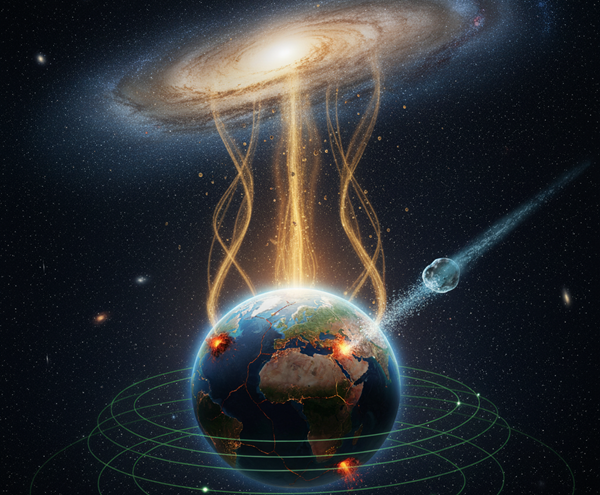
But what does this mean for Earth’s evolution? When our Solar System entered these dense galactic zones, gravitational forces may have destabilized icy comets at its edges. Some were knocked toward Earth, triggering catastrophic impacts. These impacts melted parts of the crust, interacted with water, and created complex magmas that redefined Earth’s surface.
Could it be that entire chapters of Earth’s geological history were written not by internal tectonic forces, but by its journey through the galaxy?
A Challenge to Traditional Views of Earth’s Crust
Traditional geology often portrays Earth’s crust as the product of internal dynamics—mantle convection, tectonics, and volcanism. This study, however, suggests a new perspective: astro-geological processes have played a central role.
As Prof. Christopher L. Kirkland of Curtin University explained, the zircon evidence reveals that Earth’s geology and the Milky Way’s structure are interconnected. “The rhythm of galactic movements left imprints on the continents themselves,” he noted.
This challenges long-held assumptions. If Earth’s crust evolved partly because of Milky Way dynamics, then geology is inseparable from astrophysics.
From the Cosmos to the Continents: Linking Geology with Astronomy
The implications are profound. If astrophysical processes influenced the evolution of Earth’s crust, could they also have helped set the stage for life itself? After all, impacts deliver not only destruction but also ingredients—water, volatiles, and energy—that may have been essential for life’s emergence.
This astro-geological perspective opens the door to new scientific fields where astronomy and geology merge. It invites us to ask: How much of Earth’s history is written in the stars? Could future geological discoveries unlock more cosmic secrets?
Toward a New Era of Astro-Geological Science
What began with studying crystals has now evolved into a vision of Earth as part of a cosmic ecosystem. The continents beneath our feet are not isolated relics but products of both planetary and galactic forces.
As Prof. Kirkland concluded: “It suggests that astrophysical processes on the scale of the Milky Way may have directly influenced the continents beneath our feet and the conditions that made life possible.”
If true, then every zircon crystal carries not just the story of Earth—but the echoes of the galaxy itself.
Source: Did Galactic Forces Help Create the Conditions for Life on Earth?
Are We Alone in the Universe—or About to Discover Our Cosmic Neighbors?
Are We Alone in the Universe—or About to Discover Our Cosmic Neighbors?
Did Galactic Forces Help Create the Conditions for Life on Earth?