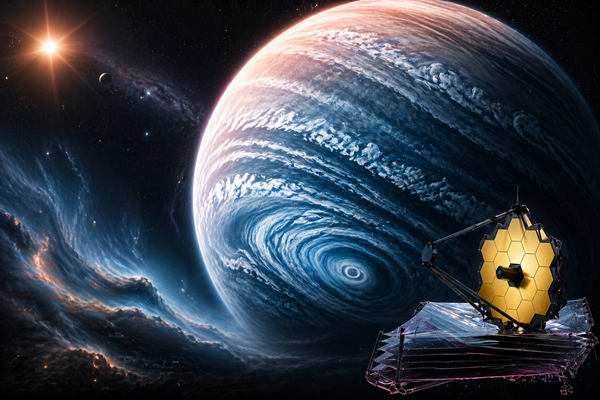
Frozen Clouds on a Giant Alien World: Did the James Webb Space Telescope Just Reveal Something Planetary Science Never Expected?
The giant planets of our solar system—Jupiter, Saturn, Uranus, and Neptune—have long shaped our understanding of how planets form and evolve. Their swirling storms, thick clouds, and complex atmospheric chemistry offer a window into the inner workings of planetary systems.
Yet an even greater mystery lies beyond our solar neighborhood. What happens when scientists look at giant planets orbiting other stars? Could these distant worlds challenge everything we believe about planetary atmospheres?
Today, astronomers are beginning to answer those questions. Thanks to the extraordinary power of the James Webb Space Telescope, researchers have detected water-ice clouds in the atmosphere of a nearby super-Jupiter exoplanet. This discovery may force scientists to rethink decades of atmospheric models.
But what exactly did Webb see—and why does it matter so much?
The Cold Super-Jupiter Exoplanet Eps Ind Ab: A Nearby Giant World
The planet at the center of this discovery is Eps Ind Ab, a massive gas giant located roughly twelve light-years from Earth. It orbits the orange dwarf star Epsilon Indi A, making it one of the closest known giant exoplanets.
Scientists classify the planet as a super-Jupiter. That means it is far more massive than our own solar system’s largest planet. Current estimates suggest a mass of about seven point six times that of Jupiter.
Interestingly, the system surrounding Epsilon Indi is more complicated than it first appears. Two brown dwarfs—
Epsilon Indi Ba and Epsilon Indi Bb—orbit each other at an enormous distance from the primary star.
These distant companions create a fascinating laboratory for studying planetary formation.
But one question immediately arises:
How does such a massive planet form and evolve in a system with multiple stellar-like objects?
James Webb Space Telescope Observations Reveal Unexpected Atmospheric Brightness
Astronomers used the infrared capabilities of the James Webb Space Telescope to analyze the atmosphere of Eps Ind Ab in unprecedented detail.
At first glance, the planet produced a surprising signal.
The atmosphere appeared brighter than predicted by current computer models. That unexpected brightness immediately raised new questions.
Why would a cold giant planet reflect or emit more infrared light than theory predicts?
What atmospheric component could cause this unusual glow?
Initially, researchers suspected ammonia clouds might be responsible. After all, ammonia is a major atmospheric component on Jupiter.
However, when scientists examined the data more carefully, something unexpected emerged.
The amount of ammonia was much lower than predicted.
This contradiction forced astronomers to search for another explanation.
Water-Ice Clouds in Exoplanet Atmospheres: A Major Scientific Discovery
The answer turned out to be remarkable.
Researchers concluded that water-ice clouds were likely responsible for the unusual brightness detected by Webb.
These clouds form when water vapor freezes at extremely low temperatures high in a planet’s atmosphere. On Earth we see ice clouds in the upper atmosphere as cirrus clouds. On gas giants, however, the physics can be dramatically different.
Detecting water-ice clouds on an exoplanet is extremely difficult. The signals are faint, distant, and often hidden by stellar light.
Yet Webb’s advanced instruments were able to detect them.
This discovery is significant because many planetary atmosphere models do not include cloud formation in sufficient detail. Scientists often simplified these models to make calculations manageable.
Now those simplifications may need to change.
Could clouds be far more important in shaping planetary atmospheres than scientists previously thought?
Why Low Ammonia Levels Puzzle Astronomers
Another intriguing mystery emerged from the observations.
Earlier research suggested that ammonia gas should be abundant in the upper atmosphere of Eps Ind Ab. After all, ammonia plays a major role in the atmospheres of giant planets like Jupiter.
Yet Webb detected less ammonia than expected.
Why would a cold giant planet lack a key chemical component predicted by atmospheric models?
Several explanations are possible.
Perhaps ammonia sinks deeper into the atmosphere.
Perhaps cloud chemistry removes it from the upper layers.
Or perhaps the atmospheric circulation behaves very differently on young super-Jupiter planets.
Each possibility raises further questions.
If ammonia behaves differently on cold exoplanets, how many atmospheric models might be missing important physics?
Understanding the Temperature of This Cold Exoplanet
Eps Ind Ab is classified as a cold giant exoplanet. Its estimated atmospheric temperature is roughly two hundred seventy-five Kelvin, or about two degrees Celsius.
That might sound mild compared with other exoplanets. However, the comparison becomes more interesting when we look at Jupiter.
The cloud tops of Jupiter have a temperature of roughly one hundred forty Kelvin. In other words, Jupiter is much colder.
Why is Eps Ind Ab warmer?
Astronomers believe the planet may still be relatively young. Giant planets slowly cool over millions or billions of years after formation.
If that interpretation is correct, scientists may be witnessing a planet still releasing leftover formation heat.
But how quickly will it cool?
And will its atmosphere evolve dramatically as temperatures change?
Astrometry and Direct Imaging: How Scientists Measured the Planet
Observing an exoplanet is never easy. Most planets orbit so close to their host stars that their light becomes lost in the star’s glare.
Earlier studies detected Eps Ind Ab through direct imaging, a technique that blocks the star’s light to reveal faint planets.
The new research also relied on astrometry, a powerful method that tracks tiny movements of a star caused by the gravitational pull of orbiting planets.
By measuring those motions precisely, astronomers can estimate a planet’s mass and orbital shape.
The results showed that Eps Ind Ab follows an orbit with an eccentricity of about zero point two four.
For comparison:
- Earth’s orbital eccentricity is roughly zero point zero one
- Jupiter’s eccentricity is about zero point zero four
That means Eps Ind Ab travels on a much more elongated orbit than the major planets in our solar system.
What might cause such an orbit?
Could gravitational interactions with distant companions be responsible?
How JWST Is Transforming Exoplanet Atmosphere Research
The discovery highlights the extraordinary capabilities of the James Webb Space Telescope.
Before Webb, studying cold exoplanets in such detail seemed almost impossible. Most atmospheric studies focused on extremely hot planets orbiting close to their stars.
Now scientists can examine cooler, more distant worlds.
This opens an entirely new field of planetary research.
Researchers can investigate:
- atmospheric chemistry
- cloud formation
- temperature structures
- planetary evolution
Each observation reveals unexpected complexity.
As one researcher involved in the study explained, discoveries like this show just how rapidly astronomy is advancing. Instruments like Webb are allowing scientists to probe atmospheric layers that were once beyond reach.
Could Other Cold Exoplanets Have Water-Ice Clouds?
The discovery raises an exciting possibility.
If Eps Ind Ab contains water-ice clouds, how common might they be across the galaxy?
Cold giant planets could host a wide variety of cloud layers:
- ammonia clouds
- water-ice clouds
- methane clouds
- exotic chemical hazes
Each cloud type affects the planet’s brightness and atmospheric chemistry.
Therefore, atmospheric clouds may hold the key to understanding many puzzling observations of distant worlds.
Future missions will likely search for similar signatures in other planetary systems.
Could some of these worlds resemble scaled-up versions of Jupiter?
Or might they possess entirely new atmospheric structures never seen in our solar system?
The Future of Cold Exoplanet Research
Astronomy is entering a remarkable era.
With powerful telescopes like the James Webb Space Telescope, scientists can now explore planetary atmospheres across vast interstellar distances.
Yet every discovery seems to raise even deeper questions.
Why does Eps Ind Ab contain so little ammonia?
How exactly do water-ice clouds form in such atmospheres?
Do other cold exoplanets show the same patterns?
And ultimately, how many atmospheric models will need to be rewritten?
The universe continues to surprise us.
Perhaps somewhere among the thousands of known exoplanets, there are worlds whose atmospheres behave in ways we have not yet imagined.
And if so, Webb may be only the beginning of the journey.
So the next time you look up at the night sky, consider this:
How many hidden clouds drift across the atmospheres of distant planets—waiting for us to discover them?
Source: Frozen Clouds on a Giant Alien World: Did the James Webb Space Telescope Just Reveal Something Planetary Science Never Expected?
One of the Universe’s Largest Stars May Be Getting Ready To Explode
One of the Universe’s Largest Stars May Be Getting Ready To Explode
Frozen Clouds on a Giant Alien World: Did the James Webb Space Telescope Just Reveal Something Planetary Science Never Expected?
Sources
Mang, J. et al. “Atmospheric Observations of Eps Ind Ab.” The Astrophysical Journal Letters.
NASA Exoplanet Exploration Program
James Webb Space Telescope mission science reports
University of Texas at Austin Department of Astronomy research summaries
Exoplanet atmospheric modeling studies published in major astrophysical journals.
Frozen Clouds on a Giant Alien World: Did the James Webb Space Telescope Just Reveal Something Planetary Science Never Expected?