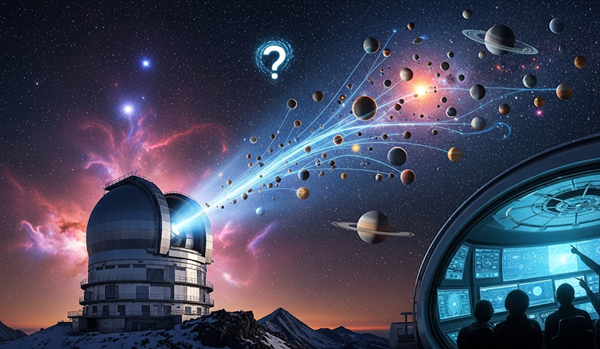
Are We Alone in the Universe—or About to Discover Our Cosmic Neighbors?
America Will Lead the Next Giant Leap: NASA Confirms 6,000 Exoplanets
NASA has announced a groundbreaking milestone in humanity’s search for other worlds: over 6,000 confirmed exoplanets. This achievement represents decades of discovery, powered by cutting-edge telescopes and the relentless drive to answer a timeless question: Are we alone in the universe?
The History of Exoplanet Discovery: From Murky Beginnings to Clear Confirmations
Humanity has gazed at the stars for millennia, yet the confirmed discovery of planets orbiting other stars is surprisingly recent. While possible detections date back as early as 1917, the first confirmed exoplanets were announced in 1992, when astronomers Aleksander Wolszczan and Dale Frail reported planet-like bodies around the pulsar PSR1257+12 using the Arecibo telescope.
A few years later, in 1995, scientists revealed the first planet orbiting a Sun-like star, 51 Pegasi b, a so-called hot Jupiter. Its discovery stunned astronomers: a gas giant orbiting far closer to its star than Mercury does to the Sun. Was this planet migrated inward over time, or stripped down from a failed brown dwarf?
These revelations opened the floodgates, but earlier tantalizing signals had already been overlooked or left unconfirmed — some dating back decades.
Forgotten Clues: The First Hints of Exoplanets in 1917
Long before modern telescopes, astronomers noticed puzzling details. In 1917, researchers studying “polluted” white dwarfs—stellar remnants showing unusual heavy-element lines—may have seen the first evidence of an exoplanet.
One of the earliest cases involved van Maanen’s Star, a faint white dwarf only 14 light-years away. Its strange spectral lines, later understood to reveal planetary debris, suggest that humanity had its first glimpse of an exoplanet over a century ago. Could it be that the exoplanet hunt unofficially began far earlier than history books claim?
NASA Reaches 6,000 Confirmed Exoplanets: A New Era of Cosmic Exploration
Fast-forward to today: NASA has confirmed 6,000 exoplanets thanks to missions like Kepler and TESS, along with Earth-based observatories. These detections range from volcanic “hellscape” worlds such as CoRoT-7b and K2-141b, where oceans of magma boil under supersonic winds, to giant puffballs like WASP-127b, as light as Styrofoam. Astronomers have even found ice giants where diamonds may rain from the sky.
“Step by step, from discovery to characterization, NASA missions have built the foundation to answering a fundamental question: Are we alone?” said Shawn Domagal-Goldman, acting director of NASA’s Astrophysics Division.
The milestone is not just a number—it is proof that humanity’s tools for exploring the universe are more powerful than ever before.
Are Rocky Planets Like Earth Common in the Galaxy?
One of the most exciting revelations is that rocky planets, not gas giants, seem to be more common around other stars. Could our Solar System, with its balance of four rocky planets and four gas giants, be the exception rather than the rule? Or are we just scratching the surface of what lies hidden?
Dawn Gelino, head of NASA’s Exoplanet Exploration Program, emphasized: “Each of the different types of planets we discover gives us information about the conditions under which planets can form and, ultimately, how common planets like Earth might be.”
This quest is no longer about numbers alone; it is about finding worlds like our own.
The Next Frontier: NASA’s Roman Space Telescope and the Hunt for Habitable Worlds
NASA’s upcoming Nancy Grace Roman Space Telescope and Habitable Worlds Observatory are poised to revolutionize exoplanet science. Unlike earlier missions, these instruments will directly observe and analyze the atmospheres of Earth-sized planets orbiting Sun-like stars—planets that may harbor the conditions for life.
Already, the James Webb Space Telescope (JWST) has studied the atmospheres of about 100 exoplanets, revealing the potential for water, methane, and even exotic chemistry. But this is just the beginning. With over 8,000 candidate exoplanets awaiting confirmation, what will the next decade reveal? Could we soon identify a world with unmistakable signs of biology?
Humanity’s Cosmic Question: Are We Truly Alone?
From the first hazy detections in 1917 to today’s 6,000 confirmed worlds, the hunt for exoplanets is a story of persistence, ingenuity, and wonder. Each discovery pushes us closer to answering one of the greatest questions in science: Is Earth unique—or one of many havens for life in the universe?
NASA promises that “America will lead the next giant leap,” but the discoveries belong to all of humanity. As new telescopes prepare to peer deeper into the cosmos, we may soon find that our night sky is not just filled with stars—but with countless other worlds waiting to be explored.
Source: Are We Alone in the Universe—or About to Discover Our Cosmic Neighbors?