Can China’s Moon Water Strategy Outshine NASA’s Artemis?
In the coming years, China and Roscosmos plan to build the International Lunar Research Station (ILRS), a permanent base in the Moon’s southern polar region. Construction is set to begin with the delivery of the first surface elements by 2030 and is expected to continue until around 2040. This base will rival NASA’s Artemis Program, which includes the creation of the Lunar Gateway in orbit around the Moon and various surface elements that will make up the Artemis Base Camp. However, there are many significant challenges to address before these facilities can be fully operational.
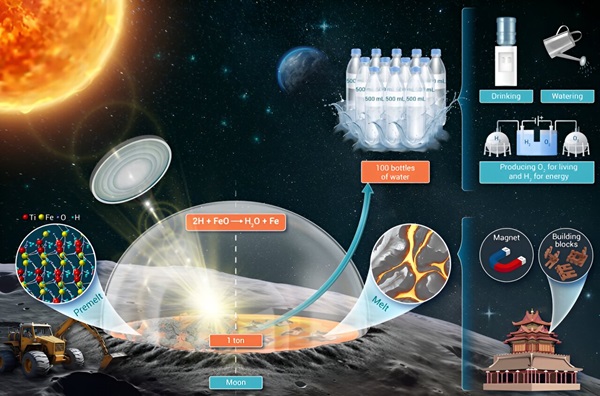
One major challenge is ensuring a steady supply of resources for crews operating on the lunar surface for extended periods. Unlike the International Space Station, which can be resupplied within hours, sending supplies to the Moon takes about three days. Therefore, NASA, China, and other space agencies are developing methods to harvest resources directly from the lunar environment – a process known as In-Situ Resource Utilization (ISRU). In a recent paper, a research team from the Chinese Academy of Sciences (CAS) announced a new method for producing large amounts of water by reacting lunar regolith with endogenous hydrogen.
The research, led by Prof. Wang Junqiang, was conducted at the CAS Ningbo Institute of Materials Technology and Engineering’s (NIMTE) Key Laboratory of Magnetic Materials and Devices. The team collaborated with colleagues from the Center of Materials Science and Optoelectronics Engineering at the University of Chinese Academy of Sciences in Beijing. Their paper, titled “Massive Water Production from Lunar Ilmenite through Reaction with Endogenous Hydrogen,” was recently published in the Chinese journal The Innovation.
Since the Apollo missions returned samples of lunar rocks and soil to Earth, scientists have known that there is abundant water on the Moon. These findings have been confirmed by several subsequent robotic sample-return missions, including China’s Chang’e-5 mission. However, much of this water exists as hydroxyl (OH), formed by the interaction of solar wind (ionized hydrogen) with elemental oxygen in the regolith. There is also water in the form of ice in permanently shadowed regions (PSRs) such as the craters covering the South Pole-Aitken Basin.
Unfortunately, lunar regolith contains very little hydroxyl that can be converted into water, ranging from just 0.0001% to 0.02%. Additionally, the ice found in cratered regions is mixed with regolith, forming layers that extend beneath the surface, making extraction difficult. After examining samples returned by the Chang’e-5 mission, Wang’s team discovered that the highest concentrations of water were found in ilmenite (FeTiO3), a titanium-iron oxide mineral present in lunar regolith.
According to the research team, ilmenite’s unique lattice structure, with its sub-nanometer tunnels, is key. They conducted a series of in-situ heating experiments, revealing that hydrogen in lunar minerals could be used to produce water on the Moon. Their study found that heating lunar regolith to temperatures exceeding 1,200 K (~930°C; 1700°F) with concave mirrors resulted in the formation of iron crystals and water bubbles in the material, with the latter being released as water vapor. The chemical process is described mathematically as:
FeO/Fe2O3 + H –> Fe + H2O.
The water vapor produced is then reclaimed at a rate of 51-76 mg of water for every gram of lunar soil. This translates to about 50 liters (13.2 gallons) of water per ton of processed regolith – enough to sustain 50 people daily. As the team noted in their paper, this amount is roughly 10,000 times the naturally occurring hydroxyl (OH) and H2O on the Moon. In addition to drinking water, this process could also provide the necessary irrigation water for growing crops, a crucial task for future lunar settlements to reduce dependence on Earth.
This process could also be used to chemically separate hydrogen and oxygen gas from regolith, which could then be used to create propellant – liquid hydrogen (LH2) and liquid oxygen (LOX) – or to maintain breathable oxygen supplies. “Our findings suggest that the hydrogen retained in lunar regolith is a significant resource for obtaining H2O on the Moon, which is helpful for establishing scientific research stations on the Moon,” the researchers concluded.
Another advantage is that this process is driven almost entirely by focused sunlight, while solar arrays can provide additional power for the retention process. The only limiting factor is that this process is only possible during a lunar day in the southern polar region (where China, NASA, and the ESA plan to build their bases). This means that the facility could operate for two weeks straight, followed by a two-week break.
However, this issue could be mitigated by placing processing facilities away from the polar regions or creating a network of solar mirrors or satellites to direct light toward the southern polar region. In any case, this method offers a cost-effective way to harvest water on the Moon compared to heating regolith in industrial furnaces and could be combined with ice extraction and processing to ensure future lunar settlements have plenty of water.
Source: Can China’s Moon Water Strategy Outshine NASA’s Artemis?
Nasa to announce whether stranded astronauts can return on Starliner
Nasa to announce whether stranded astronauts can return on Starliner
Can China’s Moon Water Strategy Outshine NASA’s Artemis?