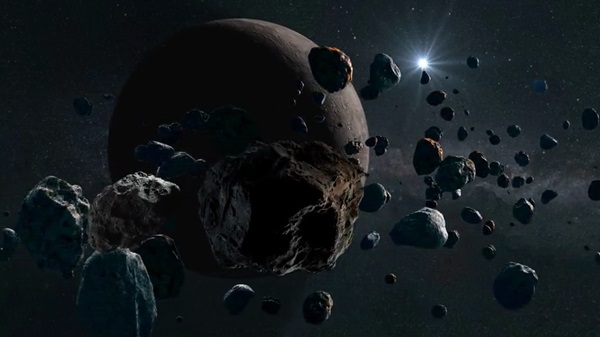
Can a New Telescope Finally Prove Planet 9 Is Real?
Planet 9: The Decade-Long Debate Over a Hidden World
For over a decade, scientists have speculated about the existence of an unseen giant, dubbed “Planet 9,” lurking in the far reaches of our solar system. This hypothetical planet, often referred to as “Planet X,” is thought to be influencing the orbits of distant trans-Neptunian objects (TNOs). If confirmed, its discovery could redefine our understanding of the solar system.
Evidence for Planet 9
The intrigue surrounding Planet 9 began with unusual orbital patterns among distant icy bodies in the Kuiper Belt. Astronomers like Konstantin Batygin and Mike Brown of Caltech proposed that these anomalies result from a massive, unseen planet — a “super-Earth” five to seven times the mass of our planet.
Recent studies have strengthened the case. For instance, simulations suggest that only the gravitational pull of a hidden planet can explain why some TNOs are nudged into Neptune’s orbit before exiting the solar system. This “smoking gun” evidence has sparked optimism among supporters like Brown and Batygin.
Competing Theories and Skepticism
Not everyone is convinced. Critics argue that the observed clustering of TNO orbits may be due to observational bias, as only a fraction of the sky has been thoroughly examined. Researchers like Scott Sheppard and Renu Malhotra stress the need for more data, as fewer than 20 extreme TNOs have been identified to date.
Alternative hypotheses challenge the super-Earth model. Some suggest that the anomalies could stem from a smaller “Kuiper Belt planet” or even a primordial black hole captured by the solar system. Others question whether our current understanding of gravity might need revision.
The Path Forward
Despite extensive searches using powerful telescopes like Hawaii’s Pan-STARRS and Chile’s Atacama Cosmology Telescope, Planet 9 remains elusive. Observing such a dim, distant object requires pinpoint accuracy, akin to locating a needle in a cosmic haystack.
A breakthrough may come with the upcoming Vera C. Rubin Observatory, set to begin operations in 2025. This telescope’s ability to survey the sky every few nights could finally unveil the planet’s location — or put the mystery to rest.
Why It Matters
Finding Planet 9 would be a monumental discovery, reshaping our understanding of planetary formation and the solar system’s evolution. As Malena Rice of Yale University notes, “It could completely reshape our understanding of the solar system…and how we fit into that context.”
Until then, the search for Planet 9 continues to captivate scientists and the public alike, offering a tantalizing glimpse of the unknown just beyond our cosmic backyard.
Source: Can a New Telescope Finally Prove Planet 9 Is Real?