Could TRAPPIST-1b Be More Alive Than We Thought?
TRAPPIST-1b: From Airless to Atmospheric Possibilities
Previously regarded as an airless, barren rock, TRAPPIST-1b, an Earth-sized exoplanet located approximately 40 light-years from Earth, may in fact possess an atmosphere. This revelation comes from new observations made by the James Webb Space Telescope (JWST), which suggest a more complex planetary environment than initially thought.
While an earlier study in 2023 concluded that TRAPPIST-1b was likely devoid of an atmosphere, the latest data presents a compelling case for the existence of either geological activity or a dense, carbon dioxide-rich atmosphere. According to astronomer Jeroen Bouwman of the Max Planck Institute for Astronomy, “The idea of a rocky planet with a heavily weathered surface without an atmosphere is inconsistent with the current measurement.”
Evidence of Geological Activity and a Young Surface
TRAPPIST-1b’s surface appears to be surprisingly young—less than 1,000 years old—indicating active geological processes, such as magmatic resurfacing. This type of activity points to a molten interior, potentially driven by gravitational interactions with its host star and neighboring planets.
Unlike heavily weathered rocky bodies in the Solar System, TRAPPIST-1b’s surface composition remains relatively unchanged, suggesting a dynamic environment that resists the erosive effects of stellar and space weathering.
Understanding the TRAPPIST-1 System: A Gateway to Exoplanet Science
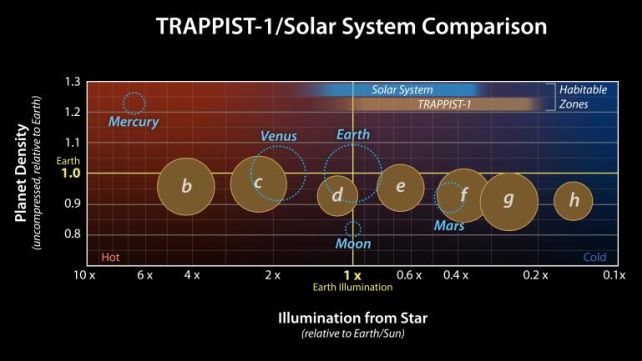
The TRAPPIST-1 system, first identified in 2017, consists of seven Earth-sized planets orbiting a red dwarf star. While these planets lie closer to their star than the planets in our Solar System, the star’s cooler, dimmer nature means its habitable zone—the region where liquid water could exist—is much nearer.
Although TRAPPIST-1b is situated too close to the star for habitability, studying it can offer insights into planetary formation, evolution, and the potential habitability of other worlds. “Planets orbiting red dwarfs are our best chance of studying the atmospheres of temperate rocky planets,” explains astronomer Elsa Ducrot of the French Alternative Energies and Atomic Energy Commission.
Atmospheric Evidence from JWST Observations
Initial JWST data focused on the infrared 15-micron wavelength, a key indicator of carbon dioxide absorption. Earlier observations indicated a lack of carbon dioxide absorption, suggesting a bare surface. However, follow-up observations at the 12.8-micron wavelength revealed temperature variations across TRAPPIST-1b’s surface during its orbit, hinting at a complex interplay of factors.
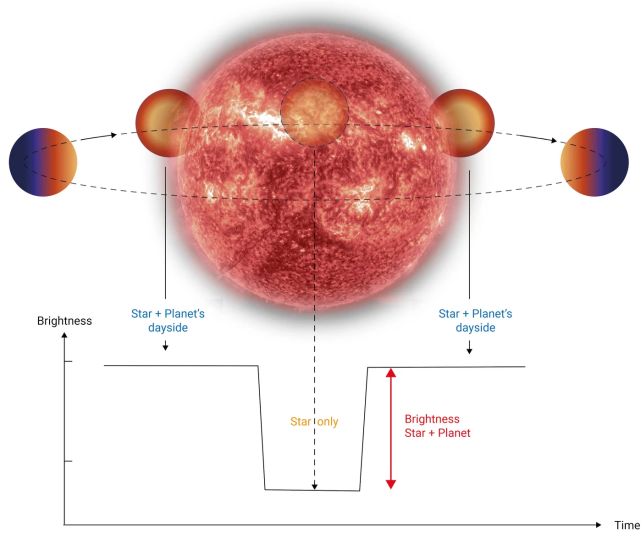
These findings were more consistent with either:
A bare, volcanic rock surface with high mineral content, indicating ongoing tectonic or volcanic activity.
A carbon dioxide-rich atmosphere, potentially exhibiting a phenomenon known as thermal inversion.
A Unique Atmospheric Phenomenon?
Thermal inversion occurs when a planet’s atmosphere emits rather than absorbs specific infrared wavelengths, creating an effect similar to the hazy atmosphere of Saturn’s moon Titan. However, as astronomer Michiel Min of the Netherlands Institute for Space Research notes, “The chemistry in the atmosphere of TRAPPIST-1b is expected to be very different from Titan or any of the Solar System’s rocky bodies.”
If confirmed, this could represent a previously unseen type of atmosphere, opening new frontiers in exoplanetary science.
Ongoing Mysteries and Future Prospects
Unraveling the true nature of TRAPPIST-1b’s environment will require more detailed observations and innovative models. Whether it is geological activity, a unique atmospheric composition, or a combination of both, the exoplanet challenges our understanding of planetary systems beyond the Solar System.
This study underscores the difficulty and excitement of exploring distant worlds and the need for advanced tools like JWST to unlock their secrets. As researchers delve deeper, TRAPPIST-1b continues to be a key subject in the quest to understand the diversity of planetary environments.
Source: Could TRAPPIST-1b Be More Alive Than We Thought?
What Would It Take to Build an Antimatter-Powered Spaceship?
What Would It Take to Build an Antimatter-Powered Spaceship?