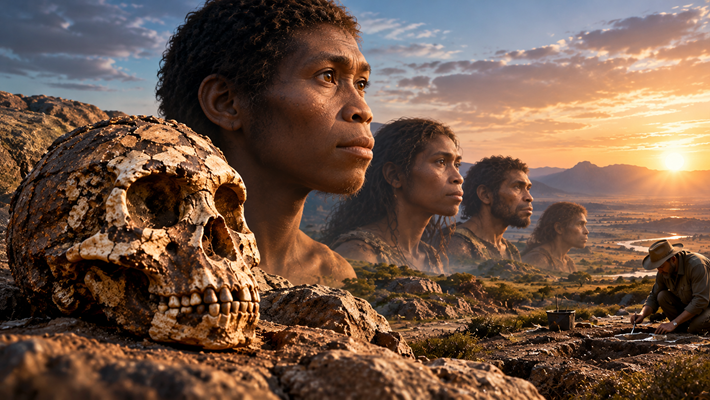
A Three-Million-Year-Old Discovery Raises a Startling Question: How Many Human Ancestors Existed?
A century after its discovery, one of the most important fossils in the history of human evolution is revealing new secrets. Scientists have now established that the famous Taung Child fossil is approximately three million years old. However, its age is only part of the story. The latest research also raises a fascinating possibility: several different hominin species may have inhabited southern Africa during the same period.
Published in the prestigious journal Nature, the study places the Taung Child between two million nine hundred and sixty thousand and three million thirty thousand years old. This finding provides a more precise chronological framework for understanding the early stages of human evolution.
More importantly, the researchers suggest that the evolutionary history of southern Africa may have been considerably more complex than previously believed. What if the region was not home to a single dominant human ancestor, but instead supported several closely related hominin species that evolved, interacted and sometimes encountered one another?
The discovery could change how scientists interpret some of the most famous fossils ever recovered from South Africa.
The Taung Child Discovery: How a Small Fossil Changed the History of Human Evolution
The story began in November nineteen twenty-four at a limestone quarry near Taung, in South Africa’s North West Province. Workers recovered an unusual fossil from the surrounding rock and eventually brought it to the attention of Australian-born anatomist Raymond Dart, who was working at the University of the Witwatersrand in Johannesburg.
Dart immediately recognised that the specimen was extraordinary. It consisted of a remarkably preserved child’s skull, including much of the face, jaw and a natural cast of the brain cavity. The fossil offered something that scientists had not previously encountered in quite the same way: a combination of anatomical characteristics associated with both humans and other primates.
In nineteen twenty-five, Dart formally described the specimen and introduced a new species, Australopithecus africanus, meaning the southern ape of Africa.
At the time, many prominent scientists believed that humanity’s evolutionary origins were more likely to be found in Europe or Asia. Consequently, Dart’s interpretation faced considerable opposition. Researchers struggled to accept that a creature with a relatively small brain could belong so close to the human evolutionary lineage.
Nevertheless, subsequent discoveries in South Africa gradually strengthened his argument. The Taung Child became a landmark in palaeoanthropology because it helped establish Africa as a crucial region in the search for humanity’s origins.
But what made this fossil so convincing?
One particularly important clue was the position of the foramen magnum, the large opening at the base of the skull through which the spinal cord connects to the brain. Its relatively forward position suggested that the individual’s head was balanced above a body adapted to upright, two-legged movement.
This was a significant observation. Although the Taung Child did not possess a modern human brain or body, its anatomy indicated that important elements of human-like locomotion had already emerged millions of years ago.
In other words, walking upright did not require the evolution of a large human brain first. The fossil helped demonstrate that different characteristics associated with humanity evolved at different times.
The New Taung Child Fossil Dating: Why Three Million Years Matters
For decades, scientists have debated the precise age of the Taung Child. Establishing its chronology has been particularly difficult because mining operations destroyed much of the original geological context in which the skull was discovered.
Without a securely documented original excavation location, researchers could not simply examine the surrounding sediment and establish the fossil’s age using conventional geological methods.
This uncertainty has affected more than the dating of one famous skull. It has also complicated comparisons between Taung and other early hominin discoveries from southern Africa.
The new investigation, led by Gabriele A. Macho of Vrije Universiteit Brussel, addresses this problem using geological, palaeontological and anatomical evidence.
The researchers place the Taung Child between two million nine hundred and sixty thousand and three million thirty thousand years old. This considerably narrows the chronological framework for interpreting the fossil.
Why is this important?
Because even a difference of a few hundred thousand years can fundamentally change how scientists reconstruct evolutionary relationships. If two fossil populations lived during overlapping periods, they might represent neighbouring groups, competing species or populations that occasionally interacted.
Conversely, if one population existed considerably earlier than another, some apparent anatomical similarities might reflect shared ancestry rather than direct interaction.
The revised age therefore provides an important reference point for examining the evolutionary landscape of southern Africa during the late Pliocene.
And this is where the research becomes particularly intriguing: the Taung Child may not represent an isolated evolutionary story.
Australopithecus africanus: Was the Human Family Tree More Diverse Than We Thought?
One of the most important questions raised by the new research concerns the classification of fossils traditionally assigned to Australopithecus africanus.
In palaeoanthropology, scientists often use a particular fossil as the reference specimen, or holotype, when defining a species. Other fossils are then compared with this specimen to determine whether they belong to the same species.
The Taung Child serves precisely this purpose. However, there is a problem: many adult fossils previously classified as Australopithecus africanus do not appear to follow the same developmental patterns.
This distinction is particularly important because the Taung specimen represents a young individual. Comparing a child’s skull directly with an adult skull can produce misleading conclusions. Bones, teeth and the brain undergo substantial changes during growth, and these changes do not necessarily occur at the same rate in different species.
To investigate this problem, the research team examined dental development, brain growth and the internal structure of teeth.
Their analysis included comparisons with modern humans, chimpanzees and gorillas. These living primates provided developmental reference points that helped researchers investigate how the ancient hominins might have changed as they matured.
The results raised serious questions about the traditional classification of several South African fossils.
For example, some adult specimens from Sterkfontein display brain-development patterns that cannot easily be reconciled with the developmental trajectory suggested by the Taung Child. The researchers therefore argue that at least some fossils traditionally grouped under Australopithecus africanus may actually represent different hominin species.
This is a particularly significant possibility because it challenges the assumption that the anatomical differences among these fossils simply represent variations within one species.
Could the differences instead reflect several evolutionary lineages living in the same broad geographical region?
The study does not establish a definitive new classification for every fossil. Nevertheless, it highlights the possibility that southern Africa supported a more diverse hominin population than conventional interpretations have suggested.
Ancient Human Ancestors: What Teeth and Brain Development Reveal About Evolution
Why did the researchers concentrate so heavily on teeth and brain development?
The answer lies in the extraordinary amount of evolutionary information preserved in these structures.
Teeth are particularly valuable to palaeoanthropologists because their development follows relatively structured biological processes. Once dental enamel has formed, its original structure preserves information that is generally resistant to the changes affecting bones after burial.
The team examined the dentino-enamel junction, a boundary between the inner dentine and outer enamel layers of a tooth. This microscopic structure preserves aspects of the tooth’s original developmental architecture.
Unlike many external skeletal features, it is not substantially remodelled throughout an individual’s life. Consequently, it can provide useful evidence when comparing evolutionary relationships between fossil populations.
The researchers also examined the relationship between the development of the first and second permanent molars.
These teeth offer important clues about biological maturation. Their formation and eruption can help scientists estimate developmental stages and investigate differences in life-history patterns.
Brain development provides another important dimension.
The team reconstructed and compared the internal brain-cavity shapes of several fossil specimens. They also considered how these structures change during the growth of modern chimpanzees and gorillas.
Why is this comparison important?
Because the size of a fossil brain alone cannot reveal the complete evolutionary story. Its shape, developmental trajectory and relationship with other anatomical characteristics can be equally informative.
The Taung Child had an estimated endocranial capacity of approximately four hundred and two to four hundred and ten millilitres. This is considerably smaller than the brain of a modern human.
However, the fossil’s significance does not depend on possessing a large brain. Instead, it preserves evidence of an early stage in the evolutionary development of the human lineage.
The new study suggests that some adult fossils traditionally assigned to Australopithecus africanus could not have developed from an individual with the same brain-growth pattern as the Taung Child.
This raises an important evolutionary question: were scientists previously combining fossils from different species simply because they shared certain physical characteristics?
The distinction could have major consequences for reconstructing the evolutionary relationships among early African hominins.
Climate Change in Ancient Africa: How Wet and Dry Cycles May Have Shaped Human Evolution
The researchers did not limit their investigation to fossil anatomy. They also examined the environmental conditions that may have influenced the evolution of early hominins.
Their central argument is that southern Africa experienced repeated climatic fluctuations during the period when these populations existed.
Alternating wet and dry conditions could have transformed landscapes, altered vegetation patterns and changed the availability of water and food.
Consider what happens when a previously continuous habitat becomes fragmented.
A population that once occupied a large geographical area may become divided into smaller groups. Some communities could remain near rivers and wetlands, while others might move towards more open woodland or grassland environments.
As geographical separation continues, these populations may experience different ecological pressures.
Over many generations, genetic drift and natural selection can contribute to increasing differences between isolated groups.
However, environmental changes do not always separate populations permanently.
When wetter conditions return, habitats may expand and previously isolated groups may encounter one another again. Such encounters could create opportunities for interaction and, potentially, interbreeding.
The researchers suggest that these repeated cycles of isolation and reconnection may help explain the remarkable anatomical diversity found among southern African hominin fossils.
In this interpretation, climate was not simply a background condition. It may have influenced where populations lived, how they interacted and how evolutionary differences developed.
Southern Africa’s Unique Geographical Position
Another important element of the research concerns the geographical position of southern Africa.
The region lies near a major biogeographical transition between tropical and more temperate ecosystems. The study focuses particularly on the boundary between the Zambezian and Natal/Kalahari biogeographical zones.
Such transition areas, known as ecotones, can support complex ecological communities because different habitats meet within relatively limited geographical spaces.
When climatic conditions change, these boundaries can shift.
Consequently, animal and plant populations may expand into new territories, retreat from unsuitable environments or encounter species they previously rarely interacted with.
The researchers propose that similar processes could have influenced early hominin populations.
If different groups repeatedly entered one another’s territories, opportunities for genetic exchange may have emerged.
The possibility of hybridisation is especially interesting because it offers one potential explanation for the mixture of anatomical characteristics observed in some southern African fossils.
Nevertheless, this is an evolutionary hypothesis rather than direct evidence that particular hominin populations interbred. The study does not recover ancient DNA demonstrating such encounters.
Three-Million-Year-Old Taung Child: What Ancient Pollen Reveals About Africa’s Lost Forests
Perhaps one of the most fascinating aspects of the research comes from something much smaller than a fossil skull: ancient pollen.
Pollen grains can survive in geological deposits for millions of years. When preserved under suitable conditions, they provide clues about the plants that once grew in an area.
By examining pollen from the Taung deposits, the researchers investigated what the surrounding environment might have looked like when the ancient hominin lived.
The findings suggest that the landscape was considerably wetter and more wooded than the semi-arid environment found around Taung today.
The pollen evidence included plant groups associated with freshwater environments, open vegetation and woody habitats.
Particularly interesting were pollen types associated with trees such as Searsia, Sclerocarya and Burkea. Their presence suggests that the ancient landscape contained more substantial woody vegetation than might be expected from the modern environment.
The researchers also identified Podocarpus pollen, an especially noteworthy finding because it points towards a more extensively wooded environment.
Some of the relevant tree species are now associated with regions hundreds of kilometres to the north-east of Taung.
This geographical difference provides an indication of how dramatically vegetation distributions may have shifted over geological time.
Imagine the landscape approximately three million years ago: freshwater wetlands, wooded corridors and more open savanna environments existing within a changing ecological system.
Such habitats would have created different opportunities for early hominins to obtain food, find shelter and move across the landscape.
However, the pollen evidence should be interpreted carefully. The analysis was exploratory and based on a limited number of samples. It does not provide a complete reconstruction of the entire region’s vegetation.
Even so, it adds an important environmental dimension to the discussion.
Could the changing distribution of forests, wetlands and open habitats have influenced which hominin populations survived in particular areas?
The researchers believe this is an important possibility worth investigating further.
A New Perspective on Human Origins: Did Several Hominin Species Coexist in Africa?
The implications of this research extend beyond the classification of one fossil species.
For decades, scientists have attempted to reconstruct early human evolution by arranging fossil discoveries into an evolutionary sequence. However, evolution rarely follows a simple, straight line.
Different populations can exist simultaneously, develop different anatomical characteristics and follow separate evolutionary trajectories. Some may disappear, while others survive and potentially exchange genetic material.
The new Taung Child research encourages scientists to consider precisely this kind of complex evolutionary history.
Rather than viewing southern Africa as a region occupied by one relatively uniform ancestral population, the researchers propose a more dynamic model involving multiple populations, changing habitats and potentially interacting evolutionary lineages.
This interpretation could help explain why fossils from Sterkfontein, Makapansgat and other South African locations display such considerable anatomical variation.
It also raises a larger question about the emergence of the genus Homo, which includes modern humans and several extinct human relatives.
If southern Africa contained greater hominin diversity than previously recognised, could some of the evolutionary processes that eventually contributed to our own lineage have taken place within this complex ecological environment?
The available evidence does not answer that question conclusively. Nevertheless, it provides a stronger reason to investigate the relationships between these ancient populations.
What the Taung Child Fossil Still Cannot Tell Us
Despite the importance of the findings, the study does not resolve every mystery surrounding the origins of humanity.
The researchers acknowledge several limitations.
First, the number of fossil specimens suitable for detailed developmental comparisons remains relatively small. Second, many fossils are incomplete or have been distorted during geological processes. Finally, the specimens do not all come from precisely the same period or geographical location.
These limitations make it difficult to establish exactly how many hominin species existed in southern Africa or whether particular populations lived alongside one another.
The proposed role of hybridisation also requires further investigation. Although changing habitats could have brought different populations into contact, the available evidence does not directly demonstrate that interbreeding occurred.
Nevertheless, these uncertainties do not diminish the importance of the research. Instead, they reveal how much remains unknown about the evolutionary history of our ancestors.
The Taung Child has already transformed our understanding of human origins once. Nearly one hundred years after its discovery, it is once again challenging established assumptions.
Perhaps the most important lesson is that human evolution was not a simple journey from an ancient ape-like ancestor to modern humanity.
It was a much more complicated biological story, shaped by changing environments, diverging populations and evolutionary experiments that unfolded over millions of years.
And somewhere within that ancient story, a small child lived approximately three million years ago, leaving behind a fossil that would eventually change how humanity understood its own beginnings.
If several different hominin species inhabited Africa during the same period, how many branches of our evolutionary family tree have we yet to discover?
Source: A Three-Million-Year-Old Discovery Raises a Startling Question: How Many Human Ancestors Existed?
A 4000-Year-Old DNA Mystery Is Rewriting the Origins of the English Language
A 4000-Year-Old DNA Mystery Is Rewriting the Origins of the English Language
A Three-Million-Year-Old Discovery Raises a Startling Question: How Many Human Ancestors Existed?