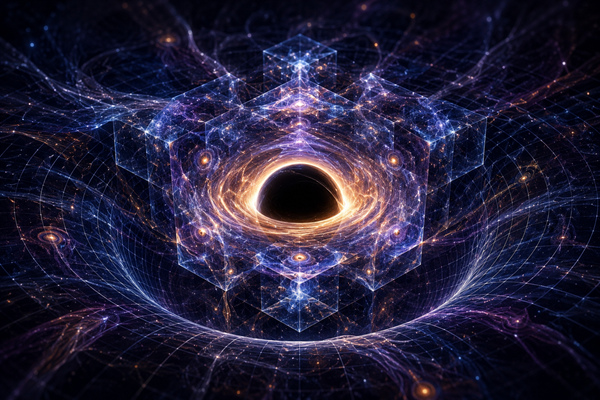
What If Black Holes Don’t Begin With Stars at All… But With Hidden “Crystals” Forming Inside Spacetime Itself?
What if gravity, pushed to its absolute limit, stopped behaving like a smooth cosmic fabric and instead transformed into something structured, rhythmic, and almost alive?
A new theoretical study suggests exactly that. Physicists now believe that, under the extreme conditions that exist right before a black hole forms, spacetime may organize itself into repeating geometric structures resembling “time crystals.” Even more astonishingly, these bizarre structures may suddenly collapse into microscopic black holes with only the slightest injection of energy.
The idea sounds like science fiction. Yet the mathematics behind it may reveal one of the deepest truths ever discovered about gravity, black holes, and the hidden architecture of the Universe itself.
Could the fabric of reality secretly contain crystalline states?
And if so, what else might spacetime be capable of becoming?
Spacetime Crystal Black Hole Physics Begins at the Edge of Collapse
Throughout most of the cosmos, gravity behaves predictably. Planets orbit stars. Galaxies collide over billions of years. Light bends around massive objects exactly as Albert Einstein’s theory of general relativity predicts.
However, everything changes near the threshold of black hole formation.
At this boundary — known in theoretical physics as critical collapse — gravity enters a regime so extreme that the equations of spacetime become extraordinarily difficult to solve. Physicists often describe this region as one of the strangest frontiers in modern science.
Here, matter and energy balance on a razor’s edge.
A collapsing system can either disperse harmlessly into ordinary spacetime or suddenly implode into a black hole. The outcome depends on tiny fluctuations so small they almost seem insignificant. Yet those microscopic differences can trigger dramatically different cosmic futures.
Physicist Daniel Grumiller of the Technical University of Vienna compares this phenomenon to water freezing into ice.
A liquid sitting exactly at zero degrees Celsius appears stable. Nevertheless, a tiny disturbance can suddenly force the water molecules into an organized crystal structure. Likewise, spacetime near critical collapse may spontaneously reorganize itself into repeating geometric patterns.
But what exactly are those patterns?
And why do they resemble crystals?
How Spacetime “Time Crystals” Form During Black Hole Creation
The newly described structures resemble what physicists call “time crystals,” exotic states of matter first proposed in quantum physics.
Ordinary crystals repeat patterns through space. Ice crystals, salt crystals, and diamonds all contain atoms arranged in highly ordered geometric structures.
Time crystals are different.
Instead of repeating through space alone, they repeat through time itself. Their internal structure oscillates rhythmically, almost like a cosmic heartbeat.
Now researchers believe spacetime curvature may exhibit a similar repeating behavior during gravitational collapse.
As matter compresses under immense gravitational pressure, spacetime itself begins developing self-repeating fractal-like structures. These patterns echo across smaller and smaller scales, creating what researchers describe as a highly ordered intermediate state.
This state is neither a stable black hole nor ordinary empty spacetime.
Instead, it exists in between.
It is unstable. Temporary. Suspended on the edge of transformation.
And perhaps most unsettling of all, a tiny amount of additional energy may cause the entire structure to collapse instantly into a microscopic black hole.
Could the Universe truly contain hidden geometric states buried inside gravity itself?
Could black holes emerge not only from collapsing stars, but also from delicate crystalline structures woven directly into spacetime?
The implications are staggering.
Matthew Choptuik’s Critical Collapse Discovery Changed Black Hole Theory Forever
The foundations of this discovery trace back to nineteen ninety-three, when theoretical physicist Matthew Choptuik made a revolutionary breakthrough using computer simulations.
While studying black hole formation, Choptuik discovered something extraordinary.
At the precise threshold where black holes begin to form, spacetime developed repeating patterns that reproduced themselves at progressively smaller scales. Physicists call this phenomenon discrete self-similarity.
The structures appeared almost fractal in nature.
Patterns repeated. Then repeated again. Then repeated inside themselves endlessly.
For decades, researchers could observe these strange behaviors only through numerical simulations because Einstein’s equations became nearly impossible to solve analytically in such extreme conditions.
Scientists knew the patterns existed.
Yet nobody fully understood why.
That mystery remained unsolved for more than thirty years.
Until now.
Higher-Dimensional Gravity Mathematics Reveals Hidden Spacetime Structures
To solve the problem, researchers turned toward an unexpected idea: higher dimensions.
Our everyday Universe appears to contain four dimensions — three dimensions of space and one dimension of time. However, mathematically speaking, Einstein’s equations can exist in any number of dimensions.
Five dimensions.
Ten dimensions.
Forty-two dimensions.
Even infinitely many.
At first glance, the approach sounds absurd.
Why would pretending the Universe has hundreds of dimensions help explain black holes?
Surprisingly, the mathematics becomes easier.
In extremely high-dimensional models, gravity behaves differently. Instead of spreading broadly across spacetime, gravitational effects become more concentrated near the collapsing region itself. This simplification allows physicists to isolate critical behaviors that would otherwise remain hidden inside impossibly complicated equations.
By imagining universes containing enormous numbers of dimensions, the researchers successfully derived analytical formulas describing the repeating crystal-like structures that emerge during black hole collapse.
Even more fascinating, the same mathematical behavior persisted when researchers reduced the number of dimensions back toward the familiar four-dimensional Universe we actually inhabit.
That discovery hints at something profound.
These spacetime crystals may not merely be mathematical illusions created by exotic geometry. Instead, they could reflect a fundamental property of gravity itself.
Microscopic Black Holes and Fractal Spacetime Could Rewrite Modern Physics
If these findings are correct, the consequences extend far beyond theoretical curiosity.
Microscopic black holes have long fascinated physicists because they may reveal how gravity interacts with quantum mechanics — the elusive goal behind every attempt to develop a unified “theory of everything.”
General relativity explains gravity on enormous scales. Quantum physics explains the microscopic world with astonishing precision. Yet the two theories refuse to fully cooperate.
Black holes sit directly at the collision point between them.
That is why critical collapse matters so deeply.
The repeating fractal structures observed in spacetime may represent clues about how gravity behaves at the smallest possible scales. Some physicists even suspect these phenomena could help reveal hidden symmetries within the Universe.
Could spacetime itself possess phases, transitions, and structural states similar to ordinary matter?
Could black holes emerge through mechanisms more subtle than the violent collapse of stars?
And perhaps most hauntingly of all: if spacetime can crystallize, what prevents the Universe from harboring entirely unknown geometric states that humanity has never imagined?
Why Black Hole Threshold Physics May Transform Future Cosmology
The researchers emphasize that their mathematical method is unusually stable and adaptable. By refining approximation techniques, scientists may now explore black-hole-related phenomena that previously existed beyond analytical reach.
This opens the door to entirely new branches of gravitational research.
Future studies could investigate whether these spacetime crystal states influence gravitational waves, early-Universe cosmology, or quantum gravity itself. Some researchers even speculate that similar mathematical structures may emerge in neutron stars, cosmic strings, or other extreme astrophysical environments.
Moreover, the work demonstrates something deeply important about modern theoretical physics:
Sometimes the best way to understand reality is to imagine impossible worlds.
A Universe with hundreds of dimensions may never physically exist. Nevertheless, by exploring such bizarre mathematical landscapes, scientists uncover truths about the real cosmos hiding beneath ordinary perception.
The strangest part is that these discoveries often begin as pure abstraction.
Then, slowly, mathematics reveals that nature may actually behave that way.
Could Spacetime Itself Be Alive With Hidden Structure?
For centuries, humans viewed space as empty.
Then Einstein revealed spacetime as dynamic and flexible.
Now modern physics suggests it may become something even stranger — a medium capable of organizing itself into repeating structures resembling crystals, fractals, and unstable geometric echoes.
The closer scientists look at black holes, the less reality resembles common intuition.
At the edge of gravitational collapse, spacetime no longer appears smooth or passive. Instead, it seems restless, structured, and capable of dramatic transformation.
A tiny fluctuation may decide whether a region of spacetime dissolves harmlessly into emptiness or collapses into a black hole from which nothing can escape.
Could our Universe be filled with hidden critical thresholds we have not yet discovered?
Could reality itself possess invisible architectures waiting to emerge under extreme conditions?
And if spacetime can crystallize under gravity’s pressure, what other secret states might exist beyond the limits of human perception?
The deeper science travels into the heart of black holes, the more the Universe begins to resemble something far stranger than anyone expected.
Source: What If Black Holes Don’t Begin With Stars at All… But With Hidden “Crystals” Forming Inside Spacetime Itself?
What If Black Holes Don’t Begin With Stars at All… But With Hidden “Crystals” Forming Inside Spacetime Itself?
Sources and Scientific References
ScienceAlert
Technical University of Vienna
Goethe University Frankfurt Institute for Theoretical Physics
Physical Review Letters
Albert Einstein’s General Relativity Overview at NASA
What If Black Holes Don’t Begin With Stars at All… But With Hidden “Crystals” Forming Inside Spacetime Itself?