
Are Extraterrestrial Civilizations Exploiting Stars in Ways We Never Imagined?
The study of extraterrestrial civilizations is challenging due to the limited reference points available. We have only Earth as an example of a life-bearing planet, and humanity as our sole model for technological advancement. This limited scope guides scientists in the Search for Extraterrestrial Intelligence (SETI) toward projections based on human development, though they also stretch their perspectives to imagine extraterrestrial possibilities.
Reinterpreting the Kardashev Scale: Upper Limits on Energy Consumption
In recent research from the Blue Marble Space Institute of Science (BMSIS), scientists have proposed a novel interpretation of the Kardashev Scale, traditionally used to classify civilizations based on their energy usage: planetary, stellar, and galactic. The BMSIS team, led by Jacob Haqq-Misra, suggests that rather than aiming to expand energy consumption exponentially, a civilization might face a “luminosity limit” on the amount of stellar energy it can harness. To transcend this limit, civilizations might tap into stellar mass directly—an approach that would push them beyond Kardashev’s original framework.
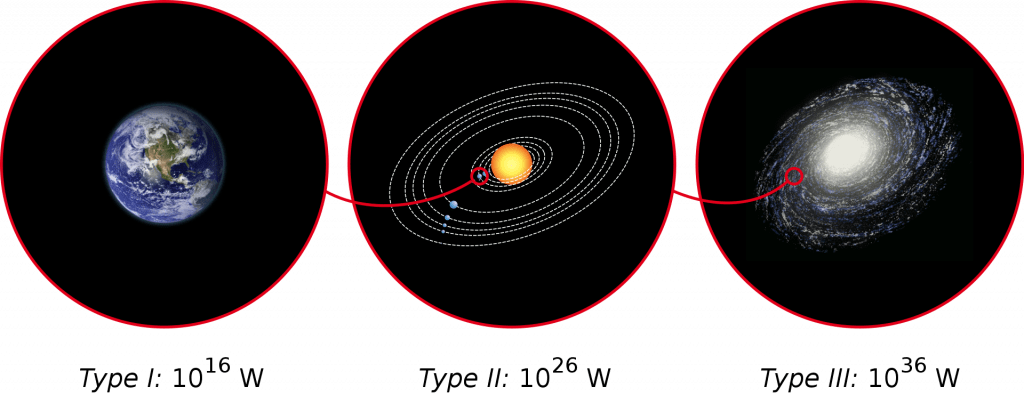
Kardashev’s Vision: From Planetary to Galactic Civilizations
First proposed in 1964 by Soviet astrophysicist Nikolai Kardashev, the Kardashev Scale categorized extraterrestrial civilizations based on energy use:
Type I: Able to harness all energy from their home planet.
Type II: Capable of capturing the energy output of their host star.
Type III: Able to harness energy across an entire galaxy.
The scale suggests civilizations would exponentially increase energy consumption, evolving from utilizing planetary energy to harnessing entire stars and galaxies. However, this reflects human assumptions about technological growth, largely based on the exponential trajectory of Earth’s “technosphere”—a term encompassing all technology-related aspects of human civilization.
Beyond the Kardashev Scale: Balancing Exploration and Exploitation
The BMSIS study challenges the assumption that advanced civilizations must follow an exponential growth pattern in energy use. Instead, civilizations might balance two main priorities: exploration and exploitation. For example:
Some civilizations may prioritize exploring new regions without increasing energy usage to Type I or Type II levels.
Others may focus on maximizing local energy resources without expanding spatially.
This reinterpretation of the Kardashev Scale suggests it represents theoretical limits rather than a strict trajectory. Advanced civilizations may never fully realize these limits due to thermodynamic inefficiencies, implying that the scale sets an upper bound rather than a necessary progression.

The Rise of “Stellarvores”: Civilizations Consuming Stellar Mass
One fascinating idea emerging from this study is the concept of “stellivores”—civilizations that could harvest stars by consuming their mass. Haqq-Misra and his colleagues propose that a civilization at this level would exceed the luminosity limits defined by the Kardashev Scale. This would involve converting stellar mass into energy in ways that surpass merely capturing a star’s emitted light.
Implications for SETI: Searching for Accreting Binaries and Technosignatures
This study encourages SETI researchers to consider nontraditional indicators of advanced civilizations. For instance, “accreting binaries,” or closely orbiting binary stars where mass flows from one to the other, may present unusual behaviors. According to Haqq-Misra, such anomalies might indicate technological activity, potentially hinting at stellivorous civilizations. While not every accreting binary would signal a civilization, scientists are urged to keep an open mind and explore these phenomena.

Looking to the Future: What Could Humanity Learn?
This study not only redefines SETI’s search parameters but also offers a glimpse into humanity’s possible future. Should Earth ever reach the limits of solar energy, might we also turn to more drastic methods, such as harvesting mass? The journey from technosphere to potentially stellarvorous states stretches our imagination, inviting us to contemplate what limits—if any—may ultimately constrain humanity’s technological evolution.
This reimagined Kardashev framework enriches the search for extraterrestrial life and the future of human development. By exploring both the limits and potential of technology, we open pathways for understanding what it means to be an advanced civilization in the universe.
Source: Are Extraterrestrial Civilizations Exploiting Stars in Ways We Never Imagined?
Juno’s Latest Flyby Of Jupiter Shows Amazing Swirling Storms
Juno’s Latest Flyby Of Jupiter Shows Amazing Swirling Storms