A Four-Thousand-Year-Old Egyptian Stone That Looks Like a Modern Control Panel—Did Ancient Priests Build a Sacred Device We Still Don’t Fully Understand?
Every year, the deserts of Egypt reveal new fragments of humanity’s distant past. Archaeologists carefully brush sand from artifacts that have remained hidden for thousands of years. Most discoveries reinforce what historians already understand about ancient civilizations. Yet occasionally an object emerges that challenges our assumptions and ignites intense debate.
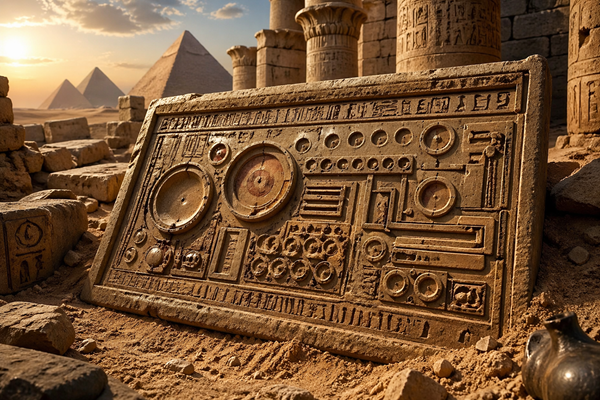
One such artifact is the mysterious Egyptian tablet known as the Offering Table of Defdji. At first glance, it resembles something astonishingly modern. Circular depressions look like gauges. Raised shapes resemble buttons. Grooves appear to function like channels in a mechanical device.
Could this elaborate stone carving truly represent ritual equipment from ancient Egypt? Or might it suggest a forgotten technology—or something even more extraordinary?
This question has fueled decades of fascination among archaeologists, historians, and proponents of alternative history.
The Discovery of the Mysterious Egyptian Tablet and the Offering Table of Defdji
The artifact commonly referred to as the Defdji Offering Table originates from ancient Egypt, although the exact location of its discovery remains uncertain. Nevertheless, its physical characteristics are remarkably well documented.
The tablet is carved from a single block of luminous white alabaster, a material widely admired in ancient Egyptian craftsmanship. The stone measures approximately half a meter in length and about one third of a meter in width. Moreover, its thickness—more than ten centimeters—gives it an unusually solid presence.
However, the most striking feature is not its size. Instead, it is the tablet’s elaborate surface design.
Unlike typical offering tables found in ancient tombs, this artifact is circular rather than rectangular. Across its surface, artisans carved a series of geometric depressions, raised nodes, and narrow channels that intersect at precise angles.
At first glance, the layout seems strangely familiar to modern eyes. Many observers immediately compare the arrangement to the dashboard of an aircraft cockpit or a sophisticated control panel.
Why would artisans working more than four thousand years ago create a surface that resembles modern technology?
Why the Ancient Egyptian Tablet Looks Like a Modern Aircraft Control Panel
Photographs of the mysterious Egyptian tablet circulate widely on the internet. When the artifact appears without archaeological context, its design becomes even more puzzling.
The circular depressions appear similar to instrument dials or gauges. Meanwhile, the rectangular raised sections resemble mechanical switches waiting to be activated. Even the spacing between the shapes appears ergonomic, almost as if designed for human interaction.
Furthermore, the precision of the stone carving raises another intriguing question.
How could ancient craftsmen achieve such accuracy using only copper tools and stone implements?
To modern viewers, the tablet sometimes appears less like a ritual object and more like a fossilized interface of advanced technology.
This visual resemblance has sparked endless speculation.
Ancient Astronaut Theory and the “Extraterrestrial Technology” Hypothesis
Within the field of alternative history—often called forbidden archaeology—the Defdji tablet has become a famous example of an alleged out-of-place artifact, sometimes referred to as an OOPArt.
Supporters of ancient astronaut theory propose several possible explanations.
First, they suggest the tablet might represent a petrified control panel from a forgotten technological civilization. According to this interpretation, advanced technology may have existed long before recorded history.
Second, another hypothesis proposes the artifact could be a cargo cult replica. In this scenario, ancient Egyptians witnessed powerful beings—perhaps extraterrestrials—operating advanced machines.
Inspired by these encounters, artisans might have attempted to reproduce the mysterious devices using sacred stone.
Although speculative, the idea raises provocative questions:
- Did ancient cultures witness technologies they could not explain?
- Could symbolic carvings preserve memories of forgotten machines?
- Or are modern observers projecting contemporary imagery onto ancient art?
These questions continue to fascinate audiences around the world.
Other Ancient Egyptian Artifacts That Fuel the Ancient Technology Debate
Supporters of the ancient technology theory often cite additional Egyptian artifacts that appear unusual.
One example frequently mentioned is the so-called “helicopter hieroglyphs” found at the Temple of Seti I in Abydos. Certain overlapping carvings resemble modern aircraft shapes when viewed from specific angles.
Another object frequently discussed is the Saqqara Bird, a wooden artifact discovered in a tomb near Saqqara. Some researchers believe its shape resembles a glider or early flying machine.
However, mainstream archaeologists generally interpret these objects differently. In most cases, unusual appearances result from overlapping carvings, symbolic art, or misinterpretation of ancient design conventions.
Nevertheless, the discussion continues. Each unusual artifact invites us to reconsider how we interpret the past.
The Archaeological Explanation: The Ancient Egyptian Seven Sacred Oils Offering Table
Despite the dramatic technological interpretations, professional Egyptologists provide a very different explanation.
According to mainstream archaeology, the mysterious Egyptian tablet is an elaborate ritual object used during burial ceremonies of Egypt’s Old Kingdom, roughly between twenty-six eighty-six and twenty-one eighty-one BC.
More specifically, it represents a Seven Sacred Oils offering table.
These ceremonial tables played a crucial role in funerary rituals intended to assist the deceased in their journey to the afterlife.
Rather than operating machinery, priests used the tablet as part of a sacred process designed to restore the spiritual senses of the dead.
The Opening of the Mouth Ceremony and the Ritual Function of the Egyptian Tablet
Ancient Egyptian religion centered heavily on the belief in life after death. For the soul to survive, the deceased required the ability to see, breathe, eat, and speak in the next world.
To restore these abilities, priests performed a powerful ritual known as the Opening of the Mouth ceremony.
During this ceremony, sacred oils and perfumes were applied to the mummy or statue of the deceased. Each oil carried symbolic significance and magical properties.
The circular depressions carved into the Defdji offering table served as small reservoirs for these precious liquids.
As priests poured or applied the oils, the grooves and channels carved into the stone helped guide and separate the substances.
Therefore, what appears to be a control panel may actually be a carefully designed ritual surface for sacred liquids.
The Hetep Symbol and the Sacred Layout of the Defdji Offering Table
At the center of the tablet lies one of the most important symbols in Egyptian religious art: the hetep sign.
The hetep hieroglyph represents peace, offering, and spiritual satisfaction. Visually, it depicts a reed mat with a loaf of bread placed upon it.
On the Defdji table, this symbol anchors the entire design. Around it, artisans carved numerous rectangular compartments containing hieroglyphic inscriptions.
These inscriptions identify various offerings intended for the deceased. Remarkably, the table lists more than ninety different foods, drinks, and ritual substances.
Each item is dedicated specifically “for Defdji,” the individual for whom the tomb and offering table were prepared.
Thus, the tablet functioned not merely as a container but as a symbolic eternal menu for the afterlife.
The Seven Sacred Oils of Ancient Egyptian Burial Rituals
Perhaps the most visually striking feature of the tablet is the row of seven circular cavities carved across its upper section.
These cavities once held the sacred oils used in funerary ceremonies.
Hieroglyphic inscriptions identify each oil:
- Setji-beb – festive ointment
- Hekenu – laudation oil
- Seftji – sacred balm
- Nekhenem oil
- Twat oil
- Hatet-ash – fine pine or cedar oil
- Hatet-tjehenu – premium Libyan oil
These substances were extremely valuable in ancient Egypt. Many came from distant regions through long trade networks.
Consequently, the presence of such oils within a burial ritual demonstrated wealth, status, and devotion to religious tradition.
Precision Stone Craftsmanship in Ancient Egypt
Although the tablet’s appearance may look futuristic, its craftsmanship reflects a well-documented Egyptian mastery of stone carving.
Ancient artisans possessed remarkable skill. Using copper tools, abrasives such as quartz sand, and immense patience, they produced sculptures and relief carvings of astonishing precision.
Indeed, monuments such as the pyramids and temples demonstrate that Egyptian craftsmen could achieve geometric accuracy that still impresses modern engineers.
Therefore, the refined carvings of the Defdji tablet should not be viewed as impossible achievements. Instead, they represent the peak of Old Kingdom stoneworking techniques.
Why the Mysterious Egyptian Tablet Still Fascinates Modern Researchers
Even after archaeologists explained its ritual purpose, the Defdji tablet continues to captivate the imagination.
Why?
Part of the fascination lies in the human tendency to interpret unfamiliar objects through modern experiences. When we see circles, switches, and panels, we instinctively think of machines.
Yet ancient cultures used geometric symbolism long before modern technology existed.
Still, the artifact raises enduring questions:
What other misunderstood artifacts might exist within museum collections?
How often do modern perspectives distort our interpretation of ancient art?
And could there still be undiscovered objects that truly challenge our understanding of history?
The mystery remains part of the artifact’s appeal.
The Real “Advanced Technology” of Ancient Egypt
Although ancient Egyptians did not fly airplanes, they possessed a different kind of advanced knowledge.
Their technology was spiritual, symbolic, and architectural.
They mastered large-scale engineering, developed intricate religious systems, and produced works of art that have survived for thousands of years.
The Defdji offering table is not evidence of aircraft instrumentation. Instead, it is a sophisticated ritual device designed to guide a human soul through eternity.
In that sense, it represents a different type of technology—one aimed not at conquering the sky, but at understanding life, death, and the universe beyond.
Perhaps that achievement is even more remarkable.
Conclusion: Ancient Mystery, Modern Curiosity
The mysterious Egyptian tablet reminds us that artifacts often reveal as much about modern imagination as they do about ancient cultures.
While alternative theories may capture public attention, the true story behind the Defdji offering table is equally compelling.
It tells us about belief systems, ritual practices, and the extraordinary craftsmanship of ancient Egypt.
Yet even today, the artifact continues to provoke curiosity.
Could future discoveries reshape our understanding of the ancient world?
Are there still secrets hidden beneath the sands of Egypt waiting to challenge what we think we know?
One thing is certain: the conversation surrounding artifacts like this one is far from over.
Source: A Four-Thousand-Year-Old Egyptian Stone That Looks Like a Modern Control Panel—Did Ancient Priests Build a Sacred Device We Still Don’t Fully Understand?
Sources
- Mark Lehner – The Complete Pyramids
- Barry Kemp – Ancient Egypt: Anatomy of a Civilization
- Ian Shaw – The Oxford History of Ancient Egypt
- Egyptian Museum Collection Catalogues
- Journal of Egyptian Archaeology
- Archaeological Institute of America publications
A Four-Thousand-Year-Old Egyptian Stone That Looks Like a Modern Control Panel—Did Ancient Priests Build a Sacred Device We Still Don’t Fully Understand?