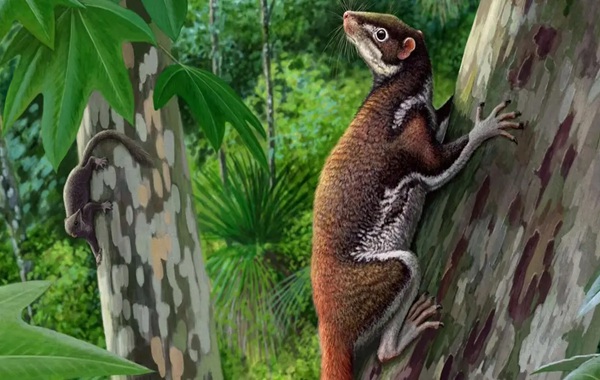
62-million-year-old fossil solves century-old mystery of mammal linked to humans
Studying ancient mammals helps scientists understand how life evolved and adapted over millions of years.
Fossil discoveries provide valuable insights into extinct species, revealing their behaviors, environments, and relationships to modern animals.
One such mystery surrounded Mixodectes pungens, a small mammal from the early Paleocene, which lived in western North America around 62 million years ago.
For over 140 years, scientists have known little about it.
A recent study analyzing the most complete skeleton ever found of Mixodectes has finally provided crucial insights into its size, lifestyle, diet, and evolutionary relationships.
A tree-dwelling mammal with a unique diet
According to the study, Mixodectes was an arboreal (tree-dwelling) mammal that primarily ate leaves.
It weighed about 3 pounds (1.3 kg) and had limb and claw structures that suggest it could cling to tree trunks and branches.
The animal’s molar teeth featured crests that helped break down tough plant materials, confirming its leaf-based diet.
While it was omnivorous, leaves comprised most of its food intake.
“This fossil skeleton provides new evidence concerning how placental mammals diversified ecologically following the extinction of the dinosaurs,” said Stephen Chester, lead author of the study and an associate professor of anthropology at Brooklyn College, City University of New York.
A close relative of humans?
The study, co-authored by Yale anthropologist Eric Sargis, reveals that Mixodectes was closely related to primates and colugos (also known as flying lemurs from Southeast Asia).
Both primates and colugos belong to a mammal group called Euarchonta. This connection means Mixodectes is a distant but relatively close evolutionary cousin of humans.
“A 62-million-year-old skeleton of this quality and completeness offers novel insights into mixodectids, including a much clearer picture of their evolutionary relationships,” said Sargis.
“Our findings show that they are close relatives of primates and colugos, making them fairly close relatives of humans.”
A special ecological niche in the Paleocene
Mixodectes was considered a large tree-dwelling mammal in North America during the early Paleocene.
Its skeleton was found alongside Torrejonia wilsoni, another early primate relative.
However, Torrejonia was smaller and primarily ate fruit, while Mixodectes thrived on leaves. These differences suggest that mixodectids occupied a distinct ecological niche at the time, separate from other arboreal mammals.
Scientists performed two phylogenetic analyses to determine its place in the evolutionary tree further.
One suggested that mixodectids were archaic primates, while the other did not. However, both confirmed that mixodectids were primatomorphans, a subgroup of Euarchonta that includes primates and colugos but not treeshrews.
“While the study doesn’t entirely resolve the debate over where mixodectids belong on the evolutionary tree, it significantly narrows it,” Sargis added.
This groundbreaking study, published in Scientific Reports, brings scientists one step closer to understanding the diversity of mammals that thrived after the extinction of the dinosaurs.
By analyzing this remarkable fossil, researchers now have a clearer picture of how early mammals adapted to their environments and evolved into the diverse species we see today.
Source: Interesting Engineering
Woman Found Buried in Chains in Jerusalem was Byzantine Nun
62-million-year-old fossil solves century-old mystery of mammal linked to humans