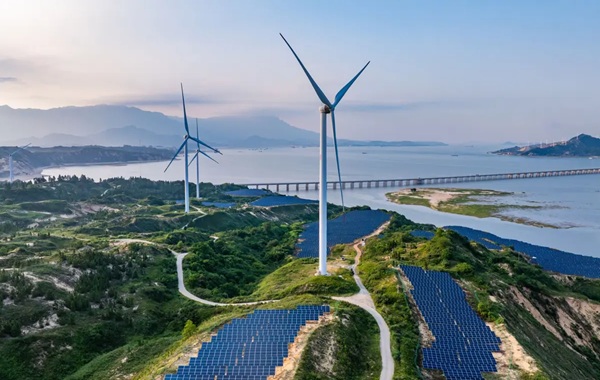
Wind and solar generate more power than coal globally for the first time ever
Renewable energy has generated more electricity than coal for the first time in history, signaling a major global shift toward clean energy. According to a report by climate think tank Ember, wind and solar power together outpaced coal generation in the first half of 2025, driven largely by record solar expansion and steady wind growth across key economies such as China and India.
The Ember report found that renewable sources not only met the world’s increasing electricity demand but also led to a slight decline in coal and gas use. Global electricity demand rose by 2.6 percent, or 369 terawatt-hours (TWh), in the first half of 2025.
This growth was entirely covered by increases in solar and wind generation, which added 306 TWh (up 31 percent) and 97 TWh (up 7.7 percent) respectively. Solar energy alone accounted for 83 percent of the increase in electricity demand, helping push renewables ahead of coal for the first time on record.
“Solar and wind are now growing fast enough to meet the world’s growing appetite for electricity,” said Małgorzata Wiatros-Motyka, senior electricity analyst at Ember and author of the report. “This marks the beginning of a shift where clean power is keeping pace with demand growth.”
Solar power leads the clean energy surge
The first half of 2025 saw record-breaking solar growth, expanding its share of the global electricity mix from 6.9 percent to 8.8 percent.
China led the surge, contributing 55 percent of global solar generation growth, followed by the United States (14 percent), the European Union (12 percent), India (5.6 percent), and Brazil (3.2 percent).
A growing number of nations crossed key thresholds in solar generation; four countries now derive more than a quarter of their electricity from solar, and 29 countries surpassed 10 percent, up from 22 last year.
As a result of these developments, renewables’ total generation climbed to 5,072 TWh in the first half of 2025, an increase of 7.7 percent from the previous year.
Coal generation, on the other hand, declined by 31 TWh to 4,896 TWh. Consequently, renewables now account for 34.3 percent of global electricity production, overtaking coal’s 33.1 percent share.
According to Ember, this shift was pushed primarily by Asia’s two largest economies. China and India both saw clean energy growth surpass their electricity demand, leading to a fall in fossil fuel generation. China’s use of coal and gas dropped by 2 percent compared with the same period in 2024, while India reduced its coal and gas use by 3.1 percent and a steep 34 percent respectively.
Mixed trends in the US and Europe
While Asia led the global transition, the trend was uneven across regions. In the United States, electricity demand rose faster than renewable output, causing coal generation to increase by 17 percent in the first half of 2025.
Similarly, the European Union faced a weather-induced dip in wind and hydro generation. Despite strong solar growth, gas and coal generation in the EU rose by 14 percent and 1.1 percent respectively to compensate for reduced renewable output.
A report by the Guardian quotes Fatih Birol, Executive Director of the International Energy Agency (IEA), saying that solar photovoltaic (PV) systems will continue to dominate global clean energy expansion. “The growth in global renewable capacity in the coming years will be dominated by solar PV – but with wind, hydropower, bioenergy, and geothermal all contributing, too,” he said.
The IEA projects that renewables could more than double by the end of the decade, with 80 percent of new capacity coming from solar.
A historic shift, but challenges remain
Experts view this milestone as both symbolic and structural, reflecting accelerating global investment in clean energy infrastructure. However, sustaining this lead over fossil fuels will depend on continued policy support, investment in battery storage, and expansion of transmission infrastructure.
Sonia Dunlop, CEO of the Global Solar Council, emphasized the importance of maintaining momentum. “This analysis confirms what we are witnessing on the ground: solar and wind are no longer marginal technologies. They are driving the global power system forward. The fact that renewables have overtaken coal for the first time marks a historic shift. But to lock in this progress, governments and industry must accelerate investment in solar, wind, and battery storage, ensuring that clean, affordable, and reliable electricity reaches communities everywhere.”
The Ember report also indicated a modest decline in global power sector emissions, down by 12 million tonnes of CO₂, largely due to reductions in China and India.
Despite regional fluctuations, analysts agree that 2025 marks a defining moment in the world’s energy transition. One where renewables have moved from the margins to the mainstream of global power generation.
Source: Science Alert
Rare earth goldmine: Top 10 nations controlling critical metals for global tech
Wind and solar generate more power than coal globally for the first time ever/Wind and solar generate more power than coal globally for the first time ever