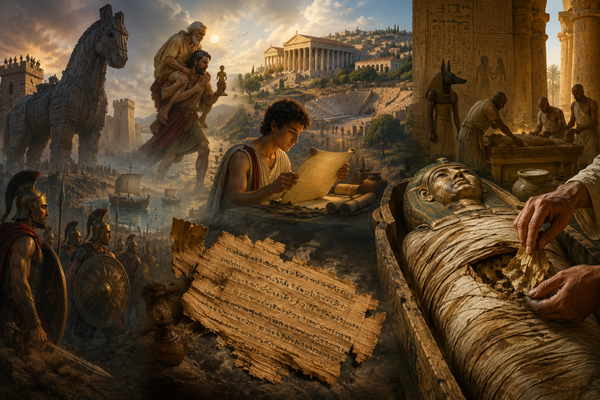
Why Was a Fragment of Homer’s Iliad Hidden Inside an Egyptian Mummy for One Thousand Six Hundred Years?
What happens when one of humanity’s greatest literary masterpieces ends up inside a mummy’s body cavity?
Archaeologists examining a Roman-era Egyptian mummy made a discovery that stunned historians and classicists alike. Hidden deep inside the abdomen of the deceased was a fragment of Homer’s Iliad—the legendary Greek epic that shaped ancient literature for centuries.
At first glance, the finding seemed mysterious. Was the text placed there as a sacred object? Did the deceased treasure Homer’s poetry during life? Or was something even stranger taking place inside Roman Egypt’s burial traditions?
The truth may be far more revealing than anyone expected.
Because this single scrap of papyrus opens a window into a forgotten world where Greek literature, Roman identity, Egyptian burial customs and imperial power all collided together.
And perhaps the most haunting question remains:
How did one of the ancient world’s most revered texts become stuffing for the dead?
Homer’s Iliad and the Trojan War That Shaped Civilization
The Iliad was composed around the eighth century BC and became one of the foundational texts of the ancient Mediterranean world.
The poem tells the story of the Trojan War. However, it does not celebrate victory in the way many modern audiences expect. Instead, the Iliad focuses on rage, suffering, mortality and destruction.
The city of Troy stands on the edge of annihilation throughout the epic. Heroes die brutally. Families collapse. Glory becomes inseparable from grief.
Even Achilles, the greatest warrior in Greek mythology, cannot escape tragedy.
Yet the most important detail is this: the Iliad never truly ends the story.
The poem closes before the final destruction of Troy. Consequently, later generations expanded the narrative themselves. Over time, the Trojan War evolved into something much larger than a Greek legend.
It became the mythological foundation of Rome itself.
The Roman Empire Reimagined Troy as Its Own Origin Story
Centuries after Homer, Roman writers transformed the meaning of the Trojan War.
According to Roman tradition, one Trojan prince survived the catastrophe. His name was Aeneas, son of Anchises and the goddess Aphrodite. As Troy burned behind him, Aeneas supposedly escaped carrying his father on his shoulders and the sacred household gods in his hands.
This legend later became central to Aeneid, written by Virgil during the reign of Augustus.
In the Roman version of history, Aeneas traveled west across the Mediterranean and eventually became the ancestor of the Roman people.
This transformation changed everything.
Suddenly, Troy was no longer merely a defeated city from Greek poetry. Instead, it became the birthplace of Roman destiny.
Defeat had been rewritten into triumph.
But why did this matter so deeply to Rome?
Because empires survive through stories as much as armies.
Why Homer’s Iliad Became Essential Across the Roman Empire
Throughout the Roman Empire, Homer’s poetry functioned almost like a shared cultural language.
Educated elites studied the Iliad in schools from childhood onward. Teachers analyzed its verses. Politicians quoted Homer during speeches. Scholars debated the meanings hidden inside its lines.
To understand Homer was to belong to the educated world of the empire.
A student in Egypt, a senator in Rome or a teacher in Asia Minor could all recognize the same characters and references instantly.
Therefore, the Iliad became much more than literature.
It became cultural currency.
This widespread influence explains why Homeric texts circulated so heavily throughout Roman territories, especially in Egypt.
And this is where the mystery of the mummy begins to deepen.
Ancient Troy Became a Tourist Destination in the Roman World
Troy was not merely a mythical location to Roman audiences. It became a physical place of memory and imperial identity.
Roman emperors invested heavily in developing the ancient site. Under Augustus, Troy gained symbolic political importance because of Rome’s claimed Trojan ancestry.
Later, during the reign of Hadrian, the city became part of a growing culture of historical tourism.
Visitors traveled there to stand where legendary battles were believed to have occurred.
Baths, performance halls and public buildings transformed the ruins into a curated historical landscape. A small theater known as the Odeion was even built directly into the ancient citadel.
Imagine standing in that theater nearly two thousand years ago.
Behind you rose the remains of Bronze Age Troy. Before you unfolded performances inspired by Homeric legends.
The past no longer felt distant.
It felt alive.
Why Was Homer So Popular in Roman Egypt?
Roman Egypt became one of the empire’s most important intellectual centers.
Greek culture flourished strongly there, especially among urban elites. In cities such as Oxyrhynchus, massive quantities of papyrus texts circulated through schools, libraries and households.
Archaeologists have discovered countless fragments of classical literature in the region. Among them, Homer appears more frequently than almost any other author.
This was not accidental.
The Iliad represented education, sophistication and social prestige. Reading Homer connected Egyptian elites to the broader Roman world.
However, Egypt also possessed its own ancient traditions.
For many Romans, Egypt seemed like a land where the distant past remained physically preserved through temples, tombs and burial rituals. Greek, Roman and Egyptian customs mixed together there in unusually complex ways.
As a result, Homeric literature entered an environment already deeply fascinated with memory, ancestry and death.
Could this cultural mixture explain why a fragment of the Iliad ended up inside a mummy?
Possibly.
But the answer may be even more practical.
Was the Iliad Fragment Inside the Mummy Sacred or Simply Recycled?
When news of the discovery first spread, many assumed the text had spiritual meaning.
Perhaps the deceased admired Homer during life. Perhaps the fragment served as protection for the afterlife. Maybe it symbolized education, status or Greek identity.
Those theories certainly sound compelling.
Yet archaeologists increasingly suspect a simpler explanation.
Papyrus was expensive to produce, but damaged manuscripts often became reusable material. Old literary fragments could be recycled for entirely ordinary purposes.
In this case, the Homeric text may have been nothing more than stuffing inserted into the mummy’s abdominal cavity during embalming.
At first, that explanation feels disappointing.
How could one of history’s greatest poems become disposable filler?
Yet this possibility may actually reveal something far more extraordinary.
The Iliad had become so widespread in Roman Egypt that fragments of Homer existed almost everywhere. Copies circulated so heavily that damaged pages eventually lost their sacred status and entered everyday practical use.
That level of cultural penetration is astonishing.
It means Homer was no longer confined to elite libraries or philosophical schools.
He had become part of ordinary life itself.
The Hidden Meaning Behind the Egyptian Mummy and Homer Discovery
The discovery forces historians to reconsider how ancient societies interacted with literature.
Modern audiences often treat classical texts as untouchable masterpieces preserved carefully through time. However, the ancient world did not always separate “high culture” from everyday life so rigidly.
Texts moved constantly between sacred, educational and practical functions.
A manuscript could begin as school material, later become scrap papyrus and finally end up inside a mummy.
That journey tells us something profound about the Roman world.
The past was not static.
It was continuously rewritten, reused and reinterpreted.
Stories traveled across continents. Myths became political tools. Ruins transformed into tourist attractions. Literary masterpieces turned into burial materials.
Everything remained in motion.
And perhaps that is why this discovery feels so haunting today.
Inside the silence of a sealed mummy rested a fragment of a story about war, destruction, survival and memory—a story that had already survived for more than a thousand years before the mummy itself was created.
Now, centuries later, it survives again.
Did Ancient Egyptians Believe Homer’s Stories Were True?
This question continues to fascinate historians.
For educated Greek-speaking elites in Egypt, Homer’s works carried enormous authority. They were treated as cultural foundations and educational essentials.
However, not everyone in Egypt understood the Trojan War through Homer alone.
Earlier traditions recorded by Herodotus suggested alternative versions of the story. Some Egyptian priests reportedly claimed Helen and Paris stayed in Egypt during the war rather than in Troy.
Therefore, multiple Trojan War traditions circulated simultaneously.
This diversity reminds us that ancient people debated history and mythology just as intensely as modern societies do today.
Whose version of the past becomes dominant?
Who controls collective memory?
And how much of identity depends on stories repeated across generations?
These questions shaped the Roman Empire just as they shape modern civilizations.
Homer’s Iliad in an Egyptian Mummy Reveals How the Ancient World Preserved Memory
The discovery of a Homeric fragment inside a mummy is not merely an archaeological curiosity.
It is evidence of how interconnected the ancient Mediterranean world truly was.
Greek poetry traveled into Egypt. Roman political identity reshaped Trojan mythology. Egyptian burial practices absorbed recycled literary material. Imperial culture linked distant peoples through shared narratives.
Every layer of the discovery reveals another connection.
A scrap of papyrus became a bridge between civilizations.
And perhaps the strangest part is this:
The fragment survived precisely because it was discarded.
Had it remained an ordinary manuscript, it might have vanished long ago. Instead, hidden inside a mummy for nearly one thousand six hundred years, it endured silently through centuries of collapse, conquest and change.
What other forgotten stories remain sealed inside the ancient dead, still waiting to reshape what we think we know about history?
Source: Why Was a Fragment of Homer’s Iliad Hidden Inside an Egyptian Mummy for One Thousand Six Hundred Years?
Did Dante Alighieri Secretly Describe an Asteroid Impact Five Hundred Years Before Science?
Did Dante Alighieri Secretly Describe an Asteroid Impact Five Hundred Years Before Science?
Why Was a Fragment of Homer’s Iliad Hidden Inside an Egyptian Mummy for One Thousand Six Hundred Years?
Sources
The Conversation – Original Academic Discussion
Encyclopaedia Britannica – Homer and the Iliad
Encyclopaedia Britannica – Virgil and the Aeneid
UNESCO – Ancient Troy Archaeological Site
Oxford Classical Dictionary – Roman Egypt and Homeric Tradition
Why Was a Fragment of Homer’s Iliad Hidden Inside an Egyptian Mummy for One Thousand Six Hundred Years?