What Secrets Lie Behind a Type 1a Explosion?
A Massive Type 1a Supernova Is Brewing Just 150 Light-Years from Earth
A Type 1a supernova represents one of the universe’s most powerful and consistent stellar explosions. These remarkable cosmic events occur when a white dwarf star — the dense, carbon-oxygen core left behind by a sun-like star — accumulates enough mass to exceed the Chandrasekhar limit (about 1.4 times the mass of our Sun).
What makes these supernovae especially valuable to astronomers is their predictable peak brightness. This consistency allows scientists to use them as “standard candles” to measure vast distances across the cosmos. By comparing their known luminosity with how bright they appear from Earth, researchers can accurately calculate their distance.
But what does it take to spark such an explosion — and could it really happen so close to home?
White Dwarfs on a Collision Course: A Rare Binary System Discovered
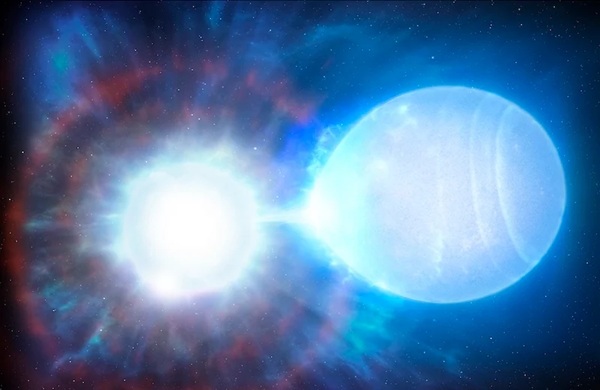
Astronomers at the University of Warwick have identified an extraordinary discovery just 150 light-years from Earth: a high-mass white dwarf binary system that is almost guaranteed to end in a spectacular Type 1a supernova. This rare system features two white dwarfs locked in a tight orbit, destined to collide.
What sets this pair apart? Their combined mass of 1.56 solar masses makes them the most massive binary white dwarf system ever confirmed. This is no minor detail — it’s the key that seals their explosive fate.

“For years a local and massive double white dwarf binary has been anticipated,” said James Munday, PhD researcher at Warwick University. “So when I first spotted this system with a very high total mass on our Galactic doorstep, I was immediately excited.”
Why Do Type 1a Supernovae Happen — And Why Is This One Inevitable?
In many cases, a white dwarf pulls matter from a companion star or merges with another white dwarf. Once its mass surpasses the critical threshold, a runaway thermonuclear reaction is triggered. This catastrophic reaction releases enormous energy in seconds — completely obliterating the star.
The newly discovered system meets all the conditions. As the two white dwarfs orbit each other in just over 14 hours, they emit gravitational waves, gradually pulling them closer together. In roughly 23 billion years, these stars will finally merge — and when they do, the result will be a quadruple detonation supernova unlike anything we’ve ever witnessed.
But how exactly does such a cosmic chain reaction unfold?
The Quadruple Detonation: A Chain Reaction in the Making
This upcoming supernova won’t be a single blast — it will be a sequence of detonations. First, the surface of the larger white dwarf explodes due to accumulating material. That initial detonation triggers a second one deep in its core. The resulting explosion sends debris into the companion star, setting off two more detonations.
Altogether, this sequence will release an amount of energy so staggering it’s hard to fathom: a thousand trillion trillion times more powerful than the most powerful nuclear weapon ever built on Earth.
Imagine the scale. How can something so small — a white dwarf is roughly the size of Earth — unleash such immense energy?
A Supernova Light Show: What Will Earthlings See?
Despite the looming explosion, there’s no danger to Earth. By the time this supernova goes off, our own Sun will have long since burned out — humanity may not even exist. But if our planet is still around, the sight will be unforgettable.
The supernova will likely appear ten times brighter than the full Moon in our night sky and up to 200,000 times brighter than Jupiter at its peak. It will become one of the brightest objects ever visible from Earth — a beacon of cosmic violence and beauty.

Does that make you wonder: what other ticking time bombs might be hidden just beyond our cosmic neighborhood?
A Record-Breaking Binary System with a Fiery Future
This local white dwarf pair isn’t just a scientific curiosity — it’s a cosmic milestone. It represents the most massive nearby binary system of its kind ever found, offering an unprecedented opportunity to study the future of stellar evolution, gravitational wave emissions, and the mechanics of supernovae.
While it won’t go off in our lifetime — or even the lifetime of our species — its discovery gives us a front-row seat to the slow dance of death that will one day end in fire.
What Does This Mean for the Future of Astronomy?
As telescopes become more powerful and space observatories continue to scan the skies, astronomers may uncover more ticking time bombs like this one. These discoveries not only help us understand the future of stars but also refine our measurements of the expanding universe.
So here’s a question to ponder: If a star explodes in the future, and no one is around to see it… does it still illuminate the universe?
Source: What Secrets Lie Behind a Type 1a Explosion?
Could a “No-Detection” Outcome Reveal the Truth About Alien Life?
Could a “No-Detection” Outcome Reveal the Truth About Alien Life?
What Secrets Lie Behind a Type 1a Explosion?