Were Earth’s First “Animals” Never Animals at All… After Five Hundred Forty Million Years of Evolution?
For decades, scientists believed strange microscopic markings preserved inside ancient Brazilian rocks represented some of the earliest animals ever to inhabit Earth’s oceans. These tiny traces appeared to support a dramatic idea: that primitive wormlike creatures already crawled across the seafloor long before the famous Cambrian explosion transformed life on the planet.
But what if that entire interpretation was wrong?
What if those supposed animal traces were not left behind by early invertebrates at all? What if Earth’s ancient seas were still dominated by enormous microbial communities rather than complex animals?
A groundbreaking new study now suggests exactly that.
Researchers examining fossils dating back roughly five hundred forty million years have discovered that some of the oldest “animal evidence” on Earth may actually belong to giant bacteria and algae communities. The revelation is forcing scientists to reconsider what life truly looked like during the mysterious Ediacaran period — a world suspended between microbial dominance and the rise of complex animals.
The discovery does not merely correct an old fossil interpretation. Instead, it reshapes humanity’s understanding of how complex life emerged and raises unsettling questions about whether Earth was truly ready for animal evolution at that time.
Could the oceans have lacked enough oxygen to support early animal ecosystems?
Did microbial worlds dominate Earth far longer than scientists imagined?
And could many other “animal traces” hidden in ancient rocks also be misunderstood?
Ancient Fossils in Brazil Rewrite the Story of Early Animal Evolution
The fossils at the center of the debate were discovered in Brazil’s Tamengo geological formation in Mato Grosso do Sul. For years, researchers interpreted the strange microscopic structures as traces left by tiny seafloor animals known as meiofauna.
These organisms are incredibly small invertebrates, usually measuring less than one millimeter long. Modern examples include microscopic worms and other soft-bodied marine creatures that move through sediment on the ocean floor.
If the Brazilian fossils truly represented meiofauna, they would rank among the oldest known evidence of animal activity on Earth.
That idea carried enormous scientific importance.
The Ediacaran period occurred immediately before the Cambrian explosion, the extraordinary evolutionary event during which complex animal life rapidly diversified across the planet. Scientists long suspected that early forms of animal ecosystems may have already existed before this biological revolution began.
However, the new research paints a dramatically different picture.
According to the study, the fossils contain preserved cellular structures and chemical signatures far more consistent with bacteria and algae than with animal traces. Rather than recording the movement of primitive creatures, the rocks may preserve entire ancient microbial communities.
The implications are profound.
If these fossils are microbial instead of animal in origin, then some scientists may have overestimated how early complex life evolved in Earth’s oceans.
Advanced Fossil Imaging Technology Reveals Hidden Cellular Structures
Why did scientists reinterpret the fossils now?
The answer lies in revolutionary imaging technology that earlier researchers simply did not possess.
The research team used advanced microtomography and nanotomography techniques at the Sirius particle accelerator facility in Campinas, Brazil. These powerful scanning systems allowed scientists to investigate the fossils without destroying them.
Unlike older methods, the technology could zoom deep inside the samples at microscopic and even nanoscopic scales.
Suddenly, hidden structures became visible.
Researchers identified preserved cells, layered wall divisions, coiled filaments, organic material, and complex microscopic partitions embedded within the fossils. These features strongly resemble microbial organisms rather than animal burrows or movement traces.
Even more importantly, scientists discovered chemical evidence supporting biological preservation.
Using Raman spectroscopy, the team detected organic compounds preserved within the fossilized cell walls. Such compounds are expected in ancient microbial remains but would not normally appear in simple sediment disturbances caused by passing animals.
This changed everything.
The structures were no longer vague impressions open to interpretation. Instead, they displayed unmistakable biological architecture.
According to lead researcher Bruno Becker-Kerber, the fossils align far more closely with bacteria and algae communities than with primitive marine animals.
That conclusion could force paleontologists to reevaluate other controversial Ediacaran fossils around the world.
How many ancient “animal traces” might actually belong to microbial ecosystems?
Could scientists be underestimating the true dominance of microbes in Earth’s early oceans?
Giant Ancient Bacteria May Have Thrived Before Complex Animals Appeared
One of the most astonishing discoveries involves the possible identity of these organisms.
Some fossils contain pyrite, an iron-sulfur mineral often associated with sulfur-based microbial metabolism. Based on their shapes and chemistry, researchers suspect several specimens may represent sulfur-oxidizing bacteria.
At first glance, that may not sound extraordinary.
However, certain sulfur bacteria can grow surprisingly large — large enough to become visible to the naked eye. Some modern species exceed the thickness of a human hair.
This challenges the common perception that bacteria are always tiny and invisible.
During the Ediacaran period, giant microbial colonies may have formed sprawling mats across shallow marine environments. These ecosystems likely played a major role in shaping Earth’s chemistry before animals became ecologically dominant.
The fossils also appear in three distinct size groups, suggesting multiple microbial species coexisted together.
Some larger forms resemble ancient green or red algae. Meanwhile, the smaller structures may represent cyanobacteria or sulfur-oxidizing microbes.
Together, they paint a picture of prehistoric oceans still ruled by microbial life.
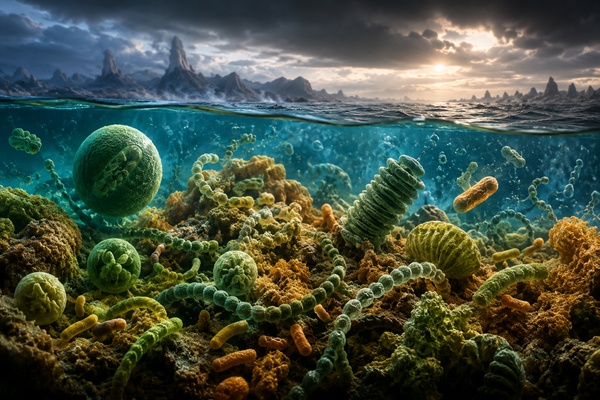
Instead of bustling animal ecosystems, Earth’s shallow seas may have resembled alien microbial landscapes stretching across continental shelves.
That realization transforms the Ediacaran world into something far stranger than scientists previously imagined.
Did Low Oxygen Levels Delay the Rise of Complex Life on Earth?
The study also strengthens another growing scientific theory: Earth’s oceans may not yet have contained enough oxygen to sustain widespread animal ecosystems during the late Ediacaran period.
Today, oxygen-rich oceans support extraordinarily complex marine food webs. Yet conditions were far different more than five hundred forty million years ago.
Researchers increasingly believe oxygen levels fluctuated dramatically before the Cambrian explosion.
Certain regions may have remained chemically unstable or oxygen-poor for millions of years. Under those harsh conditions, microbial communities would have thrived while more complex animals struggled to survive.
This possibility could explain why convincing evidence for widespread animal ecosystems remains rare in rocks from that era.
The Cambrian explosion may not have been a sudden evolutionary accident after all.
Instead, it may have reflected a planetary environmental shift. Once oxygen levels increased sufficiently, animal life rapidly diversified and expanded into ecological niches previously dominated by microbes.
If true, oxygen did not merely support animal evolution.
It may have unlocked it.
That raises another fascinating question.
Could complex life have emerged earlier if Earth’s oceans had become oxygen-rich sooner?
Or was microbial dominance an unavoidable evolutionary stage every complex biosphere must experience?
The Ancient Supercontinent Gondwana Preserved a Lost World
The fossils were collected from Corumbá and Bonito in Brazil’s Serra da Bodoquena region, both located within the Tamengo formation.
Hundreds of millions of years ago, this environment looked completely different from modern South America.
At the time, the region formed part of a shallow marine continental shelf along the edges of the supercontinent Gondwana. Long before Africa and South America separated, warm prehistoric seas covered the landscape.
Those waters preserved delicate microbial communities inside sediment layers that later fossilized into rock.
Today, scientists can examine these ancient remains like biological time capsules.
Every microscopic structure offers clues about a vanished world standing at the threshold of animal evolution.
Remarkably, the same research group previously identified what may be the oldest known lichen fossil in the region as well.
Together, these discoveries suggest that Brazil’s ancient geological formations could contain some of the most important records of pre-Cambrian ecosystems ever found.
Why This Fossil Discovery Could Change the Search for Earth’s Earliest Animals
The discovery reaches far beyond Brazil.
For decades, paleontologists have struggled to interpret mysterious Ediacaran fossils scattered across the world. Many ancient structures are difficult to classify because soft-bodied organisms rarely fossilize clearly.
This new research demonstrates how modern imaging technology can completely overturn long-standing assumptions.
Fossils once considered evidence of primitive animals may actually belong to microbial organisms instead.
That possibility matters enormously because the timing of animal evolution remains one of science’s greatest unanswered questions.
When exactly did complex animals first appear?
How rapidly did they evolve?
And what environmental conditions made their emergence possible?
Every revised fossil interpretation changes the evolutionary timeline.
Moreover, the findings reveal how fragile scientific certainty can be. A structure interpreted one way for decades may suddenly tell an entirely different story once new technology becomes available.
Science advances not by protecting old ideas, but by challenging them.
And sometimes, the rocks themselves hold secrets far stranger than scientists ever expected.
A New Vision of Earth Before the Cambrian Explosion
The late Ediacaran world now appears increasingly unfamiliar.
Rather than oceans filled with primitive animals preparing for evolutionary expansion, Earth may still have been largely controlled by vast microbial ecosystems.
Giant bacteria, algae colonies, sulfur-driven metabolisms, unstable oxygen conditions, and strange shallow seas may have dominated the planet just before complex life emerged.
Then something changed.
Environmental conditions shifted.
Oxygen levels rose.
And the Cambrian explosion transformed Earth forever.
Yet this new discovery reminds us that the transition was not simple, sudden, or fully understood.
Even now, scientists continue uncovering evidence that rewrites humanity’s earliest biological history.
Perhaps the greatest surprise is not that researchers misidentified ancient fossils.
The greatest surprise is how much of Earth’s earliest story still remains hidden inside stone.
And if these supposed “first animals” turned out to be microbes instead…
What other ancient assumptions are waiting to collapse?
Source: Were Earth’s First “Animals” Never Animals at All… After Five Hundred Forty Million Years of Evolution?
Were Earth’s First “Animals” Never Animals at All… After Five Hundred Forty Million Years of Evolution?
Sources
Gondwana Research Journal
University of São Paulo (USP)
Brazilian Center for Research in Energy and Materials (CNPEM)
Sirius Particle Accelerator Facility
Harvard University
Were Earth’s First “Animals” Never Animals at All… After Five Hundred Forty Million Years of Evolution?