What Is a Rogue Black Hole Doing 2,600 Light-Years from Home?
A Fast-Evolving Cosmic Event Redefines What We Know About Supermassive Black Holes
During the mid-twentieth century, astronomy experienced a revolution. The birth of radio astronomy in the 1950s opened a new window to the universe. Astronomers began detecting brilliant radio sources they called “quasi-stellar objects” (quasars)—the blazing hearts of distant galaxies powered by supermassive black holes (SMBHs). These cosmic giants rip apart anything that strays too close, producing what scientists call tidal disruption events (TDEs)—explosions of radiation that briefly outshine entire galaxies.
But what happens when such a cataclysm occurs outside a galaxy’s core? Could black holes roam freely beyond their usual domains?
Recent research may have just answered that question.
Discovery of an Unusual Tidal Disruption Event Far from a Galactic Core
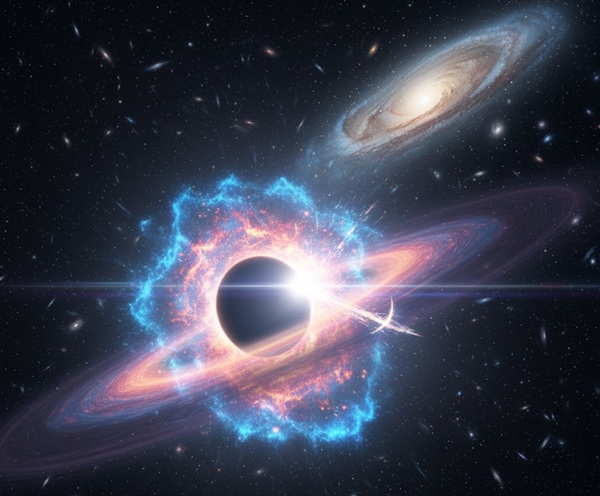
In a groundbreaking study, an international team led by Dr. Itai Sfaradi and Prof. Raffaella Margutti from UC Berkeley observed a black hole shredding a star in a galaxy located 600 million light-years away. The event, designated AT 2024tvd, stands apart from every previously recorded TDE for one key reason: it occurred 2,600 light-years from the galaxy’s center—far beyond where supermassive black holes are normally found.
Even more astonishingly, this event produced the fastest-evolving radio emission ever observed from a tidal disruption. It wasn’t just another stellar death—it was a cosmic first.
The Power Behind the Phenomenon: How a Star Meets Its End
When a star ventures too close to a black hole, gravitational forces stretch and tear it apart in a process known as spaghettification. The torn stellar material spirals around the black hole, forming an accretion disk that heats up and emits energy across the electromagnetic spectrum—from X-rays to radio waves.
These TDEs have been observed before, often at the centers of galaxies housing SMBHs like our own Sagittarius A*. Yet, AT 2024tvd shows something new: such violent cosmic interactions can happen well beyond galactic nuclei, suggesting black holes may wander through space after being flung from their original homes—perhaps during past galaxy mergers or gravitational interactions.
Could this mean there are rogue supermassive black holes drifting silently between the stars?
Radio Telescopes Unite: How Scientists Captured the Event
The discovery was made possible by a global collaboration using some of the most advanced radio observatories on Earth. Data came from:
The Very Large Array (VLA) in New Mexico
The Atacama Large Millimeter-submillimeter Array (ALMA) in Chile
The Allen Telescope Array (ATA) in California
The Submillimeter Array (SMA) in Hawaii
And the Arcminute Microkelvin Imager Large Array (AMI-LA) in the United Kingdom
Under the leadership of Prof. Assaf Horesh from the Racah Institute of Physics, the AMI-LA observations played a vital role in revealing how rapidly the radio emissions evolved.
The data showed a double-peaked radio signal—two distinct bursts separated by months, suggesting multiple ejection events. Computer models revealed that these outflows of material didn’t occur right away but were delayed by several months after the star was destroyed.
Why would a black hole wait before unleashing its fury?
What the Double-Peaked Emission Reveals About Black Hole Behavior
Such delayed and complex radio activity implies that black holes might not react instantly to disruption events. Instead, they could “reawaken” periodically, releasing powerful bursts of energy long after the initial stellar destruction.
As Dr. Itai Sfaradi explained,
“This is truly extraordinary. Never before have we seen such bright radio emission from a black hole tearing apart a star, far from a galaxy’s center, and evolving this fast. It changes how we think about black holes and their behavior.”
His former advisor, Prof. Assaf Horesh, added,
“This is one of the most fascinating discoveries I’ve been part of. The fact that it was led by my former student makes it even more meaningful. It’s another achievement that places Israel at the forefront of international astrophysics.”
Redefining the Cosmic Map: Are There More Roaming Black Holes?
The implications of AT 2024tvd reach far beyond a single observation. It challenges the long-held assumption that supermassive black holes live exclusively in galactic centers. Instead, it suggests a more dynamic universe—one where black holes may drift through interstellar space, occasionally encountering and destroying unlucky stars.
Could our own galaxy harbor such wanderers—silent, invisible, waiting to be discovered?
Each new TDE, especially those like AT 2024tvd, offers vital clues about how black holes evolve, migrate, and interact with their surroundings. The universe, it seems, still hides many of its darkest secrets in plain sight.
Source: What Is a Rogue Black Hole Doing 2,600 Light-Years from Home?
Inside the “Einstein-Rosen Caterpillar”: Are Two Black Holes Secretly Connected by a Wormhole?
Inside the “Einstein-Rosen Caterpillar”: Are Two Black Holes Secretly Connected by a Wormhole?