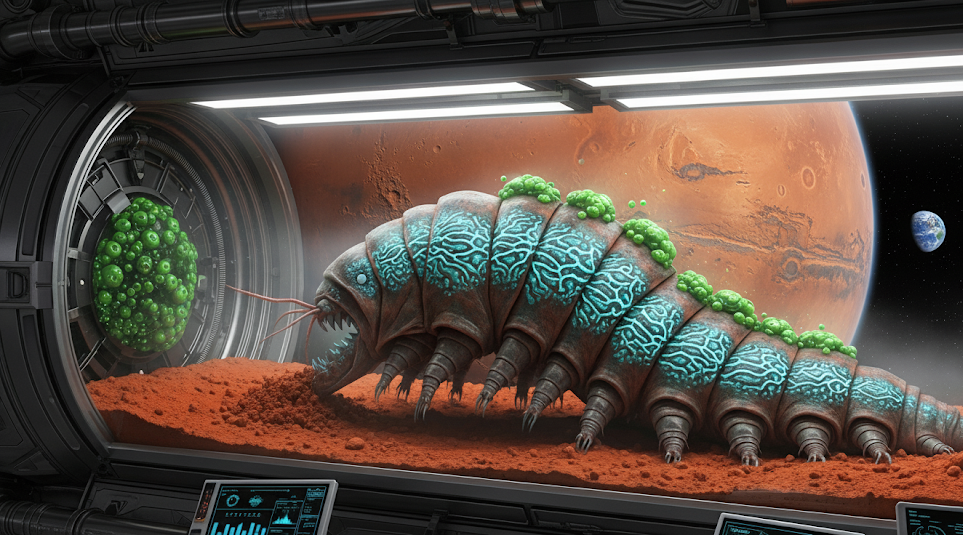
What If the Secret to Colonizing Space Lies in a Desert-Dwelling Microbe?
One Extremophile Eats Martian Dirt, Survives Space, and Creates Oxygen for Colonies.
Extremophiles and the Search for Alien Life.
Why do astrobiologists love extremophiles so much? These tiny survivors don’t just reveal how life endures in harsh environments—they can also serve as tools to help humans thrive in space. A recent study by Daniella Billi of the University of Rome Tor Vergata, published in Acta Astronautica, explores how one desert-dwelling extremophile may do both: survive, adapt, and even supply oxygen for future colonies on Mars or the Moon.
Meet Chroococcidiopsis: The Desert Super-Cyanobacteria
The star of this story is Chroococcidiopsis, mercifully shortened here to Chroo. Found in deserts from Asia to North America, and even Antarctica, Chroo is no ordinary microbe. Its desert roots have trained it to handle desiccation, extreme temperatures, and high radiation levels—conditions that mimic the challenges of space and alien worlds. Could this make it the perfect test subject for extraterrestrial survival?
Space Survival: From BIOMEX to BOSS Experiments
To test Chroo’s resilience, scientists exposed it to the vacuum of space using the Exposing Organisms to a Space Environment (EXPOSE) module on the ISS. Two missions stand out:
BIOMEX (Biology and Mars Experiment): Focused on single cells shielded by thin layers of Martian-like regolith.
BOSS (Biofilm Organisms Surfing Space): Examined biofilms, where the outer cells sacrificed themselves to protect inner layers from deadly UV rays.
Both lasted around a year and a half, and both showed that Chroo could withstand the brutality of space with only minimal protection. Even more remarkable, when brought back to Earth, rehydrated cells repaired their DNA damage with stunning efficiency—showing no lasting mutations across generations. How many organisms on Earth could survive such a cosmic ordeal?
Radiation Resistance: The Bacterial Hulk Test
On Earth, researchers subjected Chroo to extreme trials worthy of science fiction. One experiment blasted it with 24 kGy of gamma radiation—2,400 times a lethal human dose. Chroo survived. Another test went even further, eventually killing the cells, but their molecular biomarkers—such as carotenoids—remained intact. This means even in death, Chroo leaves behind detectable signatures, making it a valuable candidate for searching for extinct life on Mars.
Frozen Survival: Lessons for Europa and Enceladus
Could Chroo endure the icy moons of Jupiter or Saturn? At temperatures as low as –80°C, the microbe vitrified into a dormant, glass-like state. Once warmed, it returned to life. This survival strategy mirrors conditions beneath Europa’s or Enceladus’s icy crusts—raising the question: could similar organisms exist there today?
Thriving on Martian Soil: Oxygen Factories for Colonies
Perhaps the most tantalizing discovery is that Chroo can grow directly on Martian and Lunar regolith, surviving high levels of toxic perchlorates that would kill most Earth microbes. Even more, it can photosynthesize and produce oxygen—a critical resource for future space settlements. By up-regulating its DNA repair genes, it adapts to perchlorate stress, turning Martian “poison” into manageable conditions. Could this make Chroo humanity’s biological partner in colonizing Mars?
Future Missions: BIOSIGN and CyanoTechRider
The story doesn’t end here. Upcoming missions will push Chroo further:
CyanoTechRider will investigate how microgravity influences its DNA repair processes.
BIOSIGN will test whether Chroo can photosynthesize using far-infrared light, a rare ability that could reveal how life might survive around red dwarf stars—common hosts of exoplanets.
A Tiny Microbe With Cosmic Potential
From deserts on Earth to the vacuum of space, from gamma radiation blasts to Martian soil, Chroo has proven itself to be a survivor and a resource. It is no longer just a test subject—it may become an active player in humanity’s future beyond Earth.
So here’s the lingering question: Will this unassuming cyanobacterium help humans build the first sustainable colonies on Mars—or even show us what alien life might look like?
Source: What If the Secret to Colonizing Space Lies in a Desert-Dwelling Microbe?
Scientists find ‘something extraordinary’ in famous supernova’s troubled heart
Scientists find ‘something extraordinary’ in famous supernova’s troubled heart