What If the Color of an Exoplanet’s Clouds Reveals Life Above the Surface?
Cloud-Based Alien Life: Revisiting Carl Sagan’s Vision for Extraterrestrial Habitats
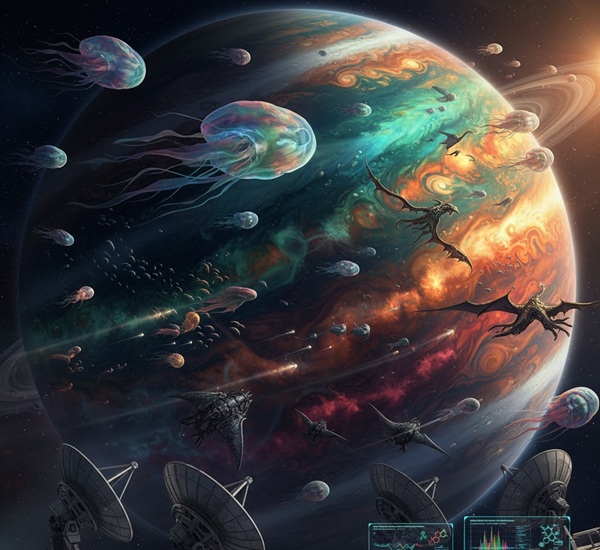
For decades, clouds were treated as the enemy of exoplanet science—obscuring surfaces, distorting atmospheric readings, and frustrating the hunt for biosignatures. Yet Carl Sagan, long before modern telescopes, imagined the possibility that life might thrive within an atmosphere itself. In the 1970s, Sagan and Edwin Salpeter proposed a visionary concept: that Jupiter’s clouds could host exotic “sinkers, floaters, and hunters”—organisms drifting in the planet’s turbulent skies.
Sagan also famously noted how Venus’s permanent cloud cover once inspired speculation about a lush, hidden world. Though Venus proved hostile rather than habitable, these ideas highlight a powerful truth: clouds don’t just obscure life—they can shape it.
Now, researchers at the Carl Sagan Institute, led by Ligia Coelho of Cornell University, argue that clouds should be treated as potential habitats on exoplanets. But how do we detect life suspended in alien skies?
Searching for Life Through Atmospheric Spectra: Why Clouds Have Been Overlooked
So far, astronomers have focused on two main strategies in the search for life beyond Earth.
Atmospheric biosignatures, such as oxygen, methane, or combinations difficult to produce without biology.
Surface “red-edge” signatures, caused by the way vegetation reflects infrared light.
Clouds, however, typically block these signals. They mask gases and flatten spectral features—leading astrobiologists to treat them as noise instead of opportunity. But what if clouds hold their own clues? What if the atmosphere, rather than the surface, is where alien life prefers to live?
This question may reshape future exploration.
Atmospheric Microbes on Earth: How Pink and Yellow Pigments Create Detectable Signatures
Earth already hosts microorganisms far above the ground. Species such as Modestobacter, Roseomonas, and Micrococcus can survive at altitudes of 21–29 km. At those heights, radiation is intense, so these microbes shield themselves with bright carotenoid pigments—often vivid pinks and yellows.
These pigments aren’t just striking—they’re spectroscopically loud. They reflect light in very specific ways, creating signals that even a distant telescope could detect. If similar microbes lived in alien clouds, their pigments might reveal their presence across light-years.
But how strong would these signals be? And would our telescopes notice?
Spectral Simulations of Cloud Life: Modeling Pink and Yellow Biosignatures on Exoplanets
To test this idea, Coelho’s team cultivated atmospheric microbes under two conditions—wet and dry—to capture pigment behavior in differing environments. They then measured the microbes’ spectral fingerprints, mimicking what a space telescope like JWST or the upcoming Habitable Worlds Observatory (HWO) would see.
Next, they used Exo-Prime II, an advanced exoplanet spectral simulator, to test various Earth-like worlds:
a snowball world, cold and dry
an ocean world, warm and water-saturated
planets with differing cloud cover
In each scenario, researchers added a cloud layer and seeded it with colonies of these microbes. The goal? Determine whether their pigments would stand out against the planet’s natural reflectivity.
The result: cloud-dwelling microbes produce distinct and detectable differences.
Wet microbes generate sharper spectral lines.
Dry microbes reflect more light overall.
Both differ clearly from microbe-free clouds.
But there’s a catch.
How Much Life Would We Need to See? The Challenge of Detecting Cloud Biosignatures
Detectability relies heavily on microbial abundance. The simulations revealed a threshold: at least 50% colonization of the cloud layer—even if the clouds themselves cover only half the planet.
That level of atmospheric saturation is far beyond what Earth hosts today. But could an exoplanet with unique atmospheric circulation or evolutionary pressures support denser airborne ecosystems? Could life on another world evolve almost entirely above the surface?
These questions open new possibilities—and new challenges.
A New Spectral Library for the Future: Tools for the Habitable Worlds Observatory
Perhaps the most valuable outcome of the study is the spectral database it provides. When next-generation telescopes launch—especially HWO—they will require reference signatures to interpret what they see. This new dataset offers precisely that: a map of the spectral fingerprints produced by carotenoid-rich cloud life.
And if even one exoplanet among thousands reveals these pink or yellow atmospheric signals? It would be a milestone that echoes Sagan’s early visions—life floating in alien skies.
Could Pink Clouds Be the First Sign of Life Beyond Earth?
As we refine the techniques to detect atmospheric biosignatures, cloud life becomes more than a speculative idea—it becomes a testable hypothesis. After all:
What if the first life we detect isn’t on a surface, but suspended in shimmering layers of color?
What if an exoplanet’s clouds glow just a little too brightly?
And what if the signature of life is not green vegetation—but pink and yellow clouds drifting across an alien sky?
If that day comes, one thing is certain: Carl Sagan would smile.
Source: What If the Color of an Exoplanet’s Clouds Reveals Life Above the Surface?