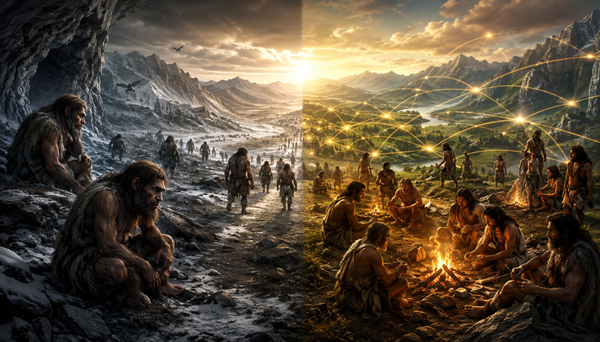
What If Neanderthals Didn’t Lose to Nature… But to a Hidden Human Secret No One Saw Coming Until Now?
For decades, scientists have asked one haunting question: why did the Neanderthals vanish while modern humans survived and spread across the planet? Was it climate change? Competition? Disease? Violence? Or was there an invisible advantage hidden deep within human society itself?
A groundbreaking new study now offers a fascinating answer. According to researchers, Homo sapiens may have survived because they built stronger social networks, wider connections, and more resilient communities than the more isolated Neanderthals. In other words, the fate of humanity may not have been decided by strength alone, but by connection.
The study, led by anthropologist Ariane Burke and her team at the Université de Montréal, explores how interconnected human populations adapted to rapidly changing Ice Age environments while Neanderthal groups gradually became vulnerable and fragmented.
Could the secret to survival really have been social cooperation? And if so, what does that reveal about humanity today?
Why Did the Neanderthals Disappear While Homo Sapiens Survived?
The disappearance of the Neanderthals remains one of the greatest mysteries in human evolution. Neanderthals inhabited Europe and parts of Asia for hundreds of thousands of years. They survived brutal Ice Age climates, hunted large animals, created tools, and even buried their dead.
Yet around forty thousand years ago, they disappeared forever.
At nearly the same time, Homo sapiens began expanding across Europe. Modern humans eventually became the dominant human species on Earth. This timing has long fueled debate among scientists. Did Homo sapiens replace Neanderthals through competition? Did climate destroy Neanderthal populations? Or did both species simply evolve under different pressures?
The new research suggests the answer is far more complicated than any single explanation.
Instead of focusing only on warfare or environmental disaster, the researchers investigated how ancient populations were connected across landscapes. They wanted to understand whether stronger regional networks gave Homo sapiens an edge during times of instability.
Their conclusion introduces a powerful idea: survival may have depended less on individual intelligence and more on collective resilience.
Ancient Climate Change and Neanderthal Extinction Created a Deadly Challenge
The researchers focused on Europe during the last glacial cycle, between sixty thousand and thirty-five thousand years ago. During this era, the climate changed dramatically and often unpredictably.
Cold periods known as stadials alternated with warmer interstadials. Temperatures fluctuated. Ecosystems shifted. Animal migration routes changed repeatedly. Resources that once supported human groups could suddenly disappear.
For small hunter-gatherer populations, these environmental swings created enormous pressure.
However, scientists emphasize an important point: Neanderthals had already survived previous Ice Age periods. Therefore, climate change alone cannot fully explain their extinction.
Instead, rapid climate variability appears to have been especially dangerous. Sudden environmental shifts may have disrupted food supplies, isolated populations, and increased competition over territory.
This distinction matters greatly. Stable cold conditions were not necessarily fatal. Yet unpredictable environmental chaos may have pushed already vulnerable groups toward collapse.
Could Neanderthals adapt quickly enough to survive a world that changed faster and faster around them?
That question lies at the heart of the study.
Scientists Used Digital Ecology Models to Reconstruct Ancient Human Survival
To investigate the mystery, the research team borrowed methods normally used in conservation biology and digital ecology. These techniques help scientists predict where animals and plants can survive based on environmental conditions.
Instead of tracking living species, however, the team analyzed archaeological evidence from ancient human settlements.
Stone tools, habitation sites, and other remains became clues that allowed researchers to map where Neanderthals and Homo sapiens once lived.
The scientists then built habitat suitability models for both species. These models combined archaeological records with climate data, geography, and environmental variability.
The goal was to identify “core regions.” These were areas large and productive enough to sustain stable populations over long periods while remaining connected to neighboring groups.
Because direct demographic data from prehistoric humans does not exist, the researchers relied on ethnographic evidence from ancient hunter-gatherer societies.
For example, studies suggest that a small community of roughly twenty-five to fifty individuals might have occupied seasonal territories covering approximately two thousand five hundred square kilometers while maintaining contact with neighboring groups.
At first glance, both species appeared capable of surviving in Europe’s harsh environments. Yet deeper analysis revealed a critical difference.
Homo Sapiens Social Networks May Have Been the Hidden Survival Advantage
The study discovered that regions occupied by Homo sapiens were significantly more interconnected than those associated with Neanderthals.
This finding may explain everything.
Human populations formed broader social networks that stretched across multiple territories. These networks allowed groups to exchange information, share resources, and maintain alliances during difficult periods.
If food became scarce in one region, people could move temporarily into allied territories. If animal migration patterns shifted, information could spread quickly between groups.
These connections acted like an ancient survival system.
Researchers describe them as a “safety net” that reduced the risk of total isolation.
Meanwhile, Neanderthal groups appear to have been more fragmented, especially in Central and Eastern Europe. Although archaeological evidence shows that Neanderthals also maintained connections and exchanged materials, their networks may not have been as extensive or resilient.
That difference may have become catastrophic during times of rapid climate instability.
What happens when isolated groups face environmental collapse without strong external support?
Eventually, even small demographic losses can spiral into irreversible decline.
Neanderthal Isolation in Europe May Have Accelerated Their Decline
The study also revealed important regional differences in Neanderthal survival.
In Eastern Europe, populations appear to have been especially vulnerable because their core regions were weakly connected. As environmental conditions deteriorated, these isolated groups may have lost contact with one another entirely.
Without strong migration pathways or social alliances, recovery would have become increasingly difficult.
However, the situation on the Iberian Peninsula was different.
There, stronger regional connections may have helped Neanderthal groups survive longer than populations elsewhere in Europe. Some scientists believe isolated western refuges delayed their final disappearance for thousands of years.
This suggests that social connectivity mattered enormously.
Neanderthal extinction was therefore not a single event occurring everywhere at once. Instead, it was likely a slow and uneven process shaped by geography, climate pressure, population density, and intergroup relationships.
Some groups adapted longer. Others disappeared quickly.
The collapse of the Neanderthals may have unfolded region by region, community by community, across generations.
Did Homo Sapiens and Neanderthals Compete, Cooperate, or Interbreed?
The relationship between Homo sapiens and Neanderthals was probably far more complicated than simple conflict.
Scientists already know that the two species interbred. In fact, many modern humans still carry small percentages of Neanderthal DNA today.
This means the groups did not merely encounter each other as enemies.
They interacted. They exchanged genes. They may even have shared technologies, territories, and survival knowledge.
Nevertheless, the arrival of Homo sapiens may still have created enormous pressure on vulnerable Neanderthal populations.
Modern humans often occupied broader social territories and maintained stronger mobility networks. As a result, they may have adapted more effectively when climates shifted or resources became scarce.
Meanwhile, Neanderthal populations were likely smaller and less connected. Even limited competition for food, shelter, or migration routes could therefore have intensified demographic stress.
Could interbreeding itself have contributed to the gradual absorption of smaller Neanderthal populations into larger Homo sapiens communities?
Some scientists believe this possibility deserves serious consideration.
Instead of a sudden extinction, Neanderthals may have experienced a long process of fragmentation, assimilation, and population decline.
What the Neanderthal Extinction Reveals About Human Survival Today
Perhaps the most fascinating part of the research is what it suggests about humanity itself.
The study argues that survival has always depended not only on intelligence or technology, but also on social cooperation.
Humans succeeded because they remained connected.
Migration networks, alliances, information exchange, and mutual support systems may have helped Homo sapiens overcome environmental crises that isolated groups could not survive alone.
Remarkably, these same patterns still shape the modern world.
People continue to migrate toward opportunity, safety, family connections, and stronger support systems. Communities survive disasters more effectively when they cooperate. Information sharing remains essential during crises.
In many ways, the ancient story of Neanderthals and Homo sapiens reflects a timeless truth about civilization.
When environments become unstable, isolation can become dangerous.
Connection becomes survival.
Could the Fate of the Neanderthals Happen Again in a Changing World?
The disappearance of the Neanderthals forces humanity to confront uncomfortable questions.
What happens when climate instability accelerates faster than societies can adapt? How important are social cooperation and global networks during periods of environmental stress? Could modern civilizations face similar pressures if fragmentation replaces collaboration?
The Neanderthals were not primitive failures. They were intelligent, adaptable humans who survived for hundreds of thousands of years in some of the harshest environments on Earth.
Yet even they may not have overcome isolation during an age of rapid change.
That possibility transforms the story from ancient history into a warning that still echoes today.
Perhaps the true advantage of Homo sapiens was never simply intelligence.
Perhaps it was the ability to remain connected when the world began falling apart.
Source: What If Neanderthals Didn’t Lose to Nature… But to a Hidden Human Secret No One Saw Coming Until Now?
What If Neanderthals Didn’t Lose to Nature… But to a Hidden Human Secret No One Saw Coming Until Now?
Sources
Université de Montréal
Nature Communications
Smithsonian Magazine
What If Neanderthals Didn’t Lose to Nature… But to a Hidden Human Secret No One Saw Coming Until Now?
Scientific American
National Geographic
What If Neanderthals Didn’t Lose to Nature… But to a Hidden Human Secret No One Saw Coming Until Now?