A Hidden Island Beneath the Water… Built 5,000 Years Ago? Who Created It—and What Secret Was Worth Sinking an Entire World for?
What if an ordinary-looking island concealed a structure older than some of humanity’s most iconic monuments? At first glance, the small stone-covered formation in a remote Scottish loch appears unremarkable. However, beneath its surface, archaeologists have uncovered a complex, human-made structure dating back more than five thousand years.
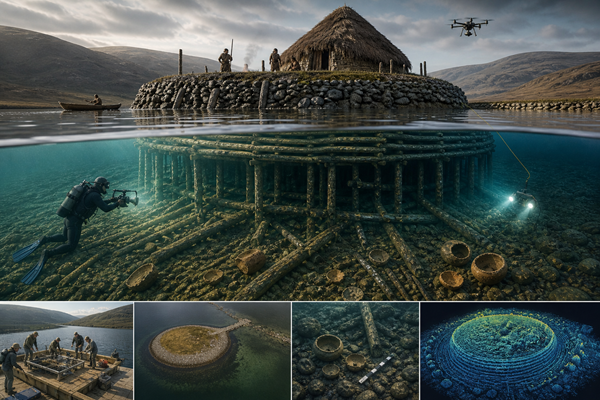
Researchers from the University of Southampton, working alongside the University of Reading, have revealed that this so-called “crannog” is not merely a pile of stones. Instead, it is a layered construction of timber, brushwood, and stone—carefully engineered by prehistoric communities.
So, why would ancient people invest such effort in building an island in the middle of a lake? And what purpose could justify such an undertaking?
Crannog Structures Explained: Ancient Engineering or Ritual Landscapes?
Crannogs, as these artificial islands are known, have long been associated with later historical periods. Traditionally, they were believed to belong mainly to the Iron Age or even post-medieval times. However, new findings challenge that assumption.
Now, evidence suggests that some crannogs were first constructed during the Neolithic period, between three thousand eight hundred and three thousand three hundred BC. This pushes their origins far deeper into prehistory than previously thought.
Moreover, hundreds of these structures are scattered across Scotland’s lochs. Yet many remain unexplored. Could there be more hidden beneath the water, waiting to reshape our understanding of early human societies?
Older Than Stonehenge: A Timeline of Construction and Transformation
Over several years, archaeologists conducted detailed fieldwork at Loch Bhorgastail on the Isle of Lewis. They used excavation, coring, and radiocarbon dating to reconstruct the site’s development.
Initially, the structure began as a circular wooden platform, roughly twenty-three meters in diameter. Brushwood covered its surface, forming a stable base. Then, about two thousand years later, during the Middle Bronze Age, additional layers of brushwood and stone were added.
Later still, during the Iron Age, further modifications took place. A stone causeway—now submerged—once connected the island to the shore.
This timeline raises an important question: why did successive generations return to this site? Was it practical, symbolic, or something else entirely?
Neolithic Pottery Evidence: Feasting, Rituals, or Daily Life?
Archaeologists discovered hundreds of pottery fragments scattered in the surrounding المياه. These fragments include jars and bowls, some still containing traces of food residue.
This finding suggests communal activities such as cooking or feasting. However, the context raises deeper questions. Why were these objects deliberately placed—or perhaps discarded—into the water?
In many ancient cultures, water held symbolic meaning. It often served as a boundary between worlds. Therefore, could these deposits represent ritual offerings rather than simple waste?
If so, the crannog might not have been just a dwelling. Instead, it may have functioned as a ceremonial space, where communities gathered for events that carried both social and spiritual significance.
Stereophotogrammetry Technology in Archaeology: Seeing What Was Once Invisible
To better understand the site, researchers developed an innovative method using stereophotogrammetry. This technique captures overlapping images to create precise three-dimensional models.
Importantly, the team adapted this method for shallow المياه environments. They used two waterproof cameras fixed at a set distance apart. A diver then guided the system with remarkable precision.
As a result, archaeologists could map the crannog both above and below the waterline as a continuous structure. This approach provided insights that traditional methods could not achieve.
So, how many other submerged sites remain hidden simply because we have not yet looked at them in the right way?
Shallow Water Archaeology Breakthrough: A New Era of Exploration
The success of this technique marks a turning point in archaeological research. By combining drone data, underwater imaging, and advanced processing, the team created a method that is both portable and cost-effective.
Consequently, this approach could be applied to countless other المواقع. Many crannogs remain unstudied, and some may still be undiscovered.
This raises an exciting possibility: are we standing at the beginning of a new wave of discoveries that will redefine prehistoric archaeology?
Why Build a Prehistoric Human-Made Island? The Enduring Mystery
Despite these breakthroughs, one central question remains unanswered: why were these islands built in the first place?
The resources required were immense. Timber had to be gathered. Stones had to be transported. Labor had to be organized. Such efforts suggest a society capable of planning and cooperation.
However, the purpose remains elusive. Were these islands defensive structures? Social gathering places? Sacred sites?
Or could they have served multiple roles over time, evolving as the needs and beliefs of their builders changed?
A Window Into Prehistoric Minds: What Can We Truly Know?
Each discovery adds another piece to the puzzle. Yet, at the same time, it reveals how much remains unknown.
The crannog at Loch Bhorgastail is not just an archaeological site. It is a testament to human ingenuity, adaptation, and perhaps even spirituality.
As researchers continue their work, one thought lingers: how many stories lie hidden beneath the surface of our world, waiting for the right moment—and the right tools—to be uncovered?
Conclusion: A Discovery That Raises More Questions Than Answers
This prehistoric human-made island challenges long-held assumptions about early societies. It shows that complex construction and communal effort existed far earlier than once believed.
However, the deeper significance of these structures remains uncertain. And perhaps that is what makes them so compelling.
After all, isn’t it the unanswered questions that drive discovery forward?
Source: A Hidden Island Beneath the Water… Built 5,000 Years Ago? Who Created It—and What Secret Was Worth Sinking an Entire World for?
Sources
University of Southampton – Centre for Coastal and Inland Waters Heritage Science
University of Reading – Centre for Archaeological Research
Journal: Advances in Archaeological Practice
Radiocarbon dating and fieldwork reports from the Loch Bhorgastail excavations
A Hidden Island Beneath the Water… Built 5,000 Years Ago? Who Created It—and What Secret Was Worth Sinking an Entire World for?