What If Lucy Wasn’t Humanity’s Mother—Is 50 Years of Evolutionary Theory About to Collapse?
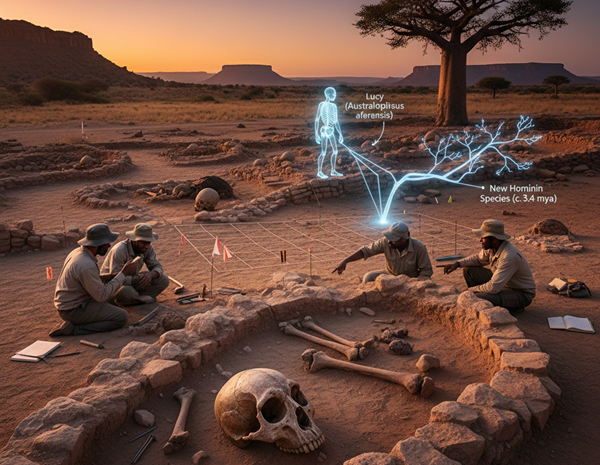
For decades, Lucy, the iconic fossil of Australopithecus afarensis, stood at the center of human evolution. She symbolized a clear ancestral bridge between early apelike hominins and modern humans. However, new fossil discoveries from Ethiopia now challenge that long-standing narrative. Could it be that Lucy represents only one evolutionary experiment rather than our direct ancestor?
Recent findings published in Nature suggest that early human evolution was far more complex than once believed. Instead of a single ancestral path, researchers now see multiple hominin species evolving side by side, each adapting to its own ecological niche. What does this mean for our understanding of where we come from?
Revolutionary Fossil Evidence Reshapes the Human Evolution Timeline
Paleoanthropologists working in Ethiopia’s Afar Rift have uncovered fossil evidence that disrupts decades of scientific consensus. These discoveries reveal that at least two distinct hominin species lived in the same region around 3.4 million years ago.
Lucy’s species, Australopithecus afarensis, was once thought to dominate this period. Now, evidence shows she shared her environment with another hominin lineage that followed a very different evolutionary path. Rather than a straight line, human evolution appears increasingly bush-like, branching in multiple directions at once.
Could our evolutionary story have always been this tangled?
Australopithecus afarensis and Lucy: A Privileged Position Reconsidered
Since Lucy’s discovery in 1974, A. afarensis has occupied a privileged place in human origins research. Her remarkably complete skeleton suggested upright walking, transitional anatomy, and a direct link to the genus Homo.
Yet, new analysis paints a more nuanced picture. While A. afarensis thrived across eastern Africa and adapted well to mixed environments, it may not have been the sole—or even primary—ancestor of modern humans.
Instead, Lucy may represent one successful branch, not the trunk of the human family tree. If so, how many other branches existed—and vanished?
The Burtele Foot Fossil: A Key Clue in Early Human Diversity
One of the most compelling pieces of evidence comes from the Burtele foot, a partial fossil discovered in 2012 in the Woranso-Mille region. At first, scientists struggled to classify it.
Unlike Lucy’s foot, which reflects efficient upright walking, the Burtele foot retained an opposable big toe, ideal for grasping branches. This anatomy suggests a creature still deeply tied to life in the trees.
Why would two such different locomotor strategies exist in the same landscape at the same time?
Australopithecus deyiremeda: A Distinct Hominin Species Emerges
New fossil discoveries finally solved the Burtele mystery. Researchers uncovered additional jaw and tooth fossils from the same geological layer, including a juvenile mandible labeled BRT-VP-2/135.
These remains match the diagnostic features of Australopithecus deyiremeda, a species first identified in 2015. This confirmation proves that A. deyiremeda was not a variant of Lucy’s species but a separate hominin lineage.
The evidence is now clear: Lucy was not alone.
Diet, Teeth, and Trees: How Early Hominins Shared the Landscape
Chemical analysis of tooth enamel reveals striking differences between these species. A. deyiremeda relied heavily on forest-based C3 plants, such as fruits and leaves. Its dental structure reflects this specialized diet.
In contrast, A. afarensis consumed a broader range of foods, including grasses and sedges. This dietary flexibility likely supported a more terrestrial lifestyle.
These differences show how ecological specialization allowed multiple hominin species to coexist. Was competition driving diversification rather than extinction?
Australopithecus anamensis and the Roots of Human Ancestry
Perhaps the most provocative implication involves Australopithecus anamensis, a species dating back over 4 million years. Traditionally viewed as Lucy’s direct ancestor, A. anamensis may now occupy a deeper, more foundational position.
The new research suggests it could have given rise to multiple later hominin branches, including both A. afarensis and A. deyiremeda. If true, Lucy’s lineage becomes just one of several evolutionary outcomes.
Does this rewrite the very base of the human family tree?
Human Evolution as an Evolutionary Bush, Not a Straight Line
Between 3.5 and 3.3 million years ago, eastern Africa hosted a surprising diversity of hominins. Some walked confidently on the ground. Others still climbed trees. Each tested different strategies for survival.
This growing body of evidence replaces the old linear model with an evolutionary bush, dense with branches, experiments, and dead ends. Some paths led closer to modern humans. Others faded into extinction.
Which traits truly defined evolutionary success?
The Scientific Debate Over Lucy’s Ancestral Status Continues
Not all scientists agree on the implications. Many researchers still argue that A. afarensis remains the strongest candidate for direct ancestry to Homo, citing its anatomy, timeline, and wide distribution.
Others counter that the fossil record will never allow certainty. What matters more, they argue, is recognizing the true diversity of early human evolution.
Lucy’s importance remains unquestioned—but her role may be different than we once thought.
What Lucy Still Teaches Us About Human Origins
Lucy may not be our direct ancestor, but her legacy endures. She reminds us that human evolution is complex, dynamic, and unfinished as a story. Each new fossil reshapes our understanding and challenges comfortable assumptions.
As researchers continue to excavate Ethiopia’s ancient landscapes, more surprises surely await. How many hominin stories remain buried beneath the soil? And which one, ultimately, leads to us?
The search for our origins is far from over—and Lucy still stands at the heart of that quest, inviting us to keep asking questions.
Source: What If Lucy Wasn’t Humanity’s Mother—Is 50 Years of Evolutionary Theory About to Collapse?
Could Particle Physics Uncover Maya Secrets? Science and the Ancient World Meet Beneath El Castillo
Could Particle Physics Uncover Maya Secrets? Science and the Ancient World Meet Beneath El Castillo
What If Lucy Wasn’t Humanity’s Mother—Is 50 Years of Evolutionary Theory About to Collapse?