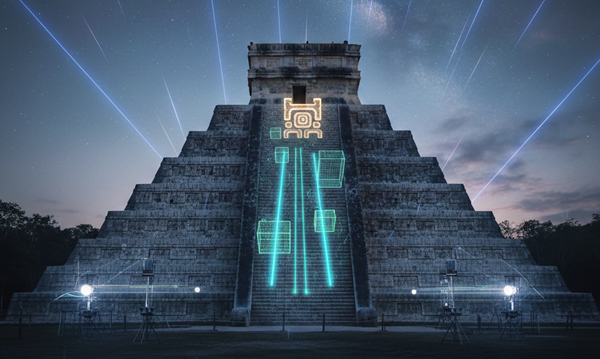
Could Particle Physics Uncover Maya Secrets? Science and the Ancient World Meet Beneath El Castillo
Science and the ancient world are converging at Chichén Itzá. Here, researchers use particle physics to reveal long-hidden Maya secrets. By blending archaeology with muography and cosmic rays, they aim to explore the interior of El Castillo without any excavation. Consequently, questions about hidden chambers, royal tombs, and sacred ritual spaces may finally find answers.
Using Particle Physics to Explore Maya Architecture
First, an international research team will deploy muography. This imaging method tracks cosmic-ray muons as they pass through stone. Because muons behave differently in empty spaces, scientists can identify hidden voids. Initially, researchers will scan two chambers discovered in the 1930s. If these known spaces are detected, the team will expand the study to map the entire pyramid.
Non-Invasive Research at the Temple of Kukulcan
El Castillo, also known as the Temple of Kukulcan, was built between the 8th and 12th centuries. It served as a ceremonial center and a cosmological symbol. Currently, Mexico’s National Institute of Anthropology and History leads the project alongside UNAM and U.S. physics laboratories. Their shared objective is preservation. Instead of drilling or cutting stone, scientists rely on physics to reveal what lies within.
How Muography Maps Hidden Voids
Muography is based on fundamental particle physics. Muons form when cosmic rays strike the Earth’s atmosphere. These particles pass through rock and soil constantly. However, when muons encounter dense material, their paths change. By measuring these variations, scientists generate a three-dimensional density map. As a result, the pyramid can be examined like a natural X-ray without damage.
Protecting UNESCO Heritage Sites
Importantly, Chichén Itzá is a UNESCO World Heritage Site. Because of this status, invasive archaeological methods are restricted. For this reason, muography is ideal. Detectors placed around the pyramid collect data from multiple angles. Over time, corridors and chambers become visible. This approach may redefine how protected monuments are studied worldwide.
Cenotes and the Maya Underworld
Earlier research found a water-filled cenote roughly 70 feet beneath El Castillo. To the Maya, cenotes represented entrances to Xibalba, the underworld.
Thus, the pyramid’s placement seems intentional. It acts as a symbolic link between the living and the gods. This raises a compelling question: Was El Castillo a gateway to the cosmos?
The Quest for Royal Tombs
Archaeologists know that El Castillo contains nested pyramids within its outer shell. This architectural style often reflected dynastic continuity and power.
Therefore, scholars suspect a royal burial chamber may hide deep inside. Muography offers a safe way to test this theory. If confirmed, the discovery would reshape our understanding of Maya political life.
Source:Could Particle Physics Uncover Maya Secrets at El Castillo?