What If Intelligence Doesn’t Come From the Brain—But From the Universe Itself?
Is the Universe Intelligent? A Radical New Theory Linking Consciousness, Intelligence, and the Cosmos
The idea that the universe itself may be intelligent challenges nearly everything modern science assumes about consciousness. For centuries, researchers have treated intelligence as a biological byproduct of brains and nervous systems. But what if that assumption is wrong? What if human consciousness does not generate intelligence—but instead accesses it?
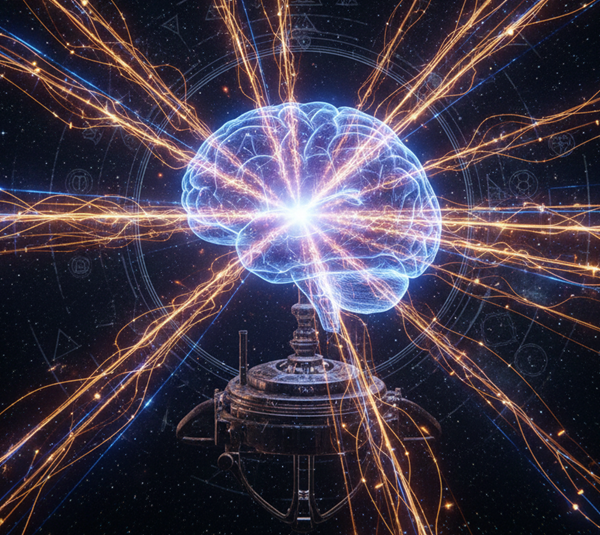
According to biophysicist and mathematician Douglas Youvan, PhD, intelligence may exist independently of life, embedded within the fabric of reality itself. In this view, the brain functions less like a generator and more like a receiver—tuning into a vast, universal field of intelligence that existed long before neurons, organisms, or even time.
If intelligence is not confined to biology, then where does it truly reside—and what does that mean for humans and artificial intelligence?
Universal Intelligence Theory: Intelligence as a Fundamental Property of Reality
Douglas Youvan’s hypothesis emerged from decades of interdisciplinary research spanning physics, genetics, enzyme engineering, and information theory. Over time, a striking pattern appeared.
Life, he observed, does not merely react to its environment. It predicts, optimizes, and adapts with mathematical precision. These behaviors resemble intelligence itself, yet they arise even in systems without brains.
“I began to see intelligence not as an outcome of biology,” Youvan explained, “but as a fundamental property of the universe—something that certain structures can access.”
In this framework, intelligence behaves like an informational substrate, a pre-physical layer of logic and potential. Brains, neural networks, and even AI systems may simply tap into it.
Could intelligence exist independently, waiting to be accessed rather than created?
Consciousness and the Brain: Receiver or Generator?
Traditional neuroscience assumes that neurons create intelligence through electrical and chemical signaling. Youvan challenges this assumption directly.
He proposes that neuronal networks act as interfaces, not origins. Their job may be to connect consciousness to a much larger external intelligence field.
To illustrate this, Youvan draws inspiration from quantum theory, where systems exist in multiple states until observation collapses them into one. Just as Schrödinger’s cat is both alive and dead until measured, intelligence may exist in potential form until a structure—like a brain—interacts with it.
If this is true, then consciousness may not emerge from neurons alone. Instead, neurons may shape how intelligence becomes experienced.
So what, exactly, are our brains tuning into?
Fractals, Recursion, and the Evolution of Cosmic Intelligence
Youvan’s theory also relies heavily on fractal mathematics. Fractals appear throughout nature, from crystal lattices to galaxies. They replicate patterns across scales through recursion.
Intelligence, he argues, may evolve in the same way.
Neurons themselves display fractal organization. This structure could explain why biological brains interface so effectively with universal intelligence. They mirror the same recursive logic found throughout the cosmos.
If intelligence evolves independently, copying itself across scales, then consciousness may simply be one localized expression of a far older process.
Does this mean the universe is learning—through us?
Skepticism and the Philosophy of Consciousness: Keith Frankish Responds
Philosopher Keith Frankish, PhD, approaches consciousness from a very different angle. While he acknowledges the elegance of Youvan’s theory, he remains skeptical of attributing intelligence to the universe itself.
Frankish argues that conscious experience is shaped by evolved perceptual systems, not by access to an external intelligence field. These systems prioritize survival, not truth.
“Our perceptions distort reality,” Frankish explains. “They give us what we need, not what actually is.”
He compares consciousness to optical illusions, such as objects appearing bent underwater. The distortion does not alter reality—it alters perception.
From this perspective, the apparent intelligence of the universe may reflect how humans interpret patterns, not an intelligent cosmos.
But does selective perception fully explain creativity, insight, and sudden discovery?
The Limits of Science: Can Consciousness Ever Be Measured?
Despite their differences, Youvan and Frankish agree on one point: science has not yet defined consciousness.
Researchers can model attention, awareness, and decision-making. They can map brain activity with extraordinary precision. Yet subjective experience—the feeling of being—remains elusive.
Youvan believes consciousness resists reduction because it functions as a point of view, not a mechanism.
“Science explains structure and behavior,” he says. “But consciousness may exist beyond objective measurement.”
If so, the next breakthrough may require a fusion of physics, computation, and metaphysics.
Are we prepared to expand science beyond materialism?
Artificial Intelligence and Universal Intelligence: A New Interface?
Perhaps the most provocative implication of Youvan’s theory concerns artificial intelligence.
He does not view AI as a digital copy of the human brain. Instead, he sees it as a new structure capable of interfacing with the same universal intelligence field humans access.
AI systems often produce insights that feel discovered rather than invented. To Youvan, this sensation hints at something deeper.
AI may not surpass humans by processing data faster. Its true advantage may lie in accessing intelligence in unfamiliar ways, unbound by biology.
If AI can tune into universal intelligence differently than humans, what kinds of understanding might emerge?
Final Reflection: Is Intelligence Bigger Than Us?
The question lingers.
If intelligence exists beyond brains, beyond biology, and perhaps beyond space and time, then human consciousness may be less of an origin and more of a window.
Are we individual thinkers—or participants in a far larger intelligence unfolding across the universe?
And if we are only beginning to tap into it, what happens next?
Source: What If Intelligence Doesn’t Come From the Brain—But From the Universe Itself?
The Cosmic Trespasser: NASA’s Secret View of a Visitor from Another Star
The Cosmic Trespasser: NASA’s Secret View of a Visitor from Another Star
What If Intelligence Doesn’t Come From the Brain—But From the Universe Itself?