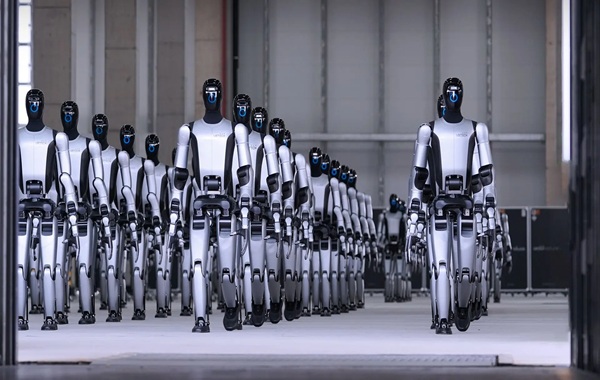
UBTECH Lands a $37 Million Deal to Deploy Humanoid Robots — And Border Security May Never Look the Same
In one of the most unexpected twists in global robotics this year, a fleet of battery-swapping humanoid robots is about to take over one of the world’s busiest border crossings — not in a sci-fi film, but in real life. China has just approved a massive $37 million contract with UBTECH Robotics, marking the first large-scale deployment of human-shaped robots for real-world government security operations. This isn’t a pilot test, and it isn’t a demo. It’s the moment humanoid robots officially step out of exhibition halls… and into national infrastructure.
UBTECH’s robots will be stationed at border checkpoints between China and Vietnam, an area known for intense cargo flow, heavy daily foot traffic, and complex security demands. Unlike traditional patrol machines, these humanoids are designed to move, gesture, interact, and navigate the environment much like a human officer — but with sensors, AI vision systems, and continuous operation cycles no human could match.
A key feature of the new deployment is UBTECH’s battery-swap technology, which allows a robot to step into a charging station, eject its depleted battery, and receive a fully charged one in seconds. This enables near-24/7 operation without downtime, meaning these machines can work shifts longer and more consistently than human counterparts. For border checkpoints that run nonstop, that reliability is a strategic advantage.
According to the announcement, the robots will handle tasks such as document scanning, identity verification, queue management, and environmental monitoring — all while reducing human workload and minimizing direct exposure to risky or high-stress situations. In other words, instead of replacing every human officer, the robots amplify the team, taking over repetitive or hazardous duties.
The move represents a major turning point not only for UBTECH but for the entire humanoid robot industry. For years, robotic manufacturers have competed to showcase flashy prototypes, yet real commercial adoption has been slow. This contract, however, signals a new era: humanoid robots are transitioning from experimental concepts to infrastructure-grade workforce machines.
UBTECH is already preparing for mass production. The company has announced plans to deliver thousands of humanoids within the next few years, supported by an expanded manufacturing line and increasing orders from logistics companies, data centers, and industrial partners. The border deployment is likely just the beginning.
For governments around the world, this raises a new set of questions:
Will humanoid robots become standard in security and public services?
Should countries rethink workforce planning as these machines become cheaper and more capable?
And perhaps most importantly — what happens when humanoid robots become as normal as security cameras or patrol cars?
One thing is certain: the future arrived sooner than anyone expected. And it’s crossing the border on two robotic legs.
Source: Interesting Engineering
Hypersonic breakthrough could enable planes that fly 10 times the speed of sound
UBTECH Lands a $37 Million Deal to Deploy Humanoid Robots — And Border Security May Never Look the Same