Twelve-Thousand-Six-Hundred-Year-Old DNA Reveals the Woman Who May Be the Mother of All Native Americans
History often changes in unexpected ways. Sometimes, it happens through the discovery of an ancient city buried beneath layers of sand. At other times, it begins with a single human skeleton that quietly waits beneath the earth for thousands of years before revealing its secrets. Could the remains of one small child truly reshape everything scientists believed about the earliest people of the Americas? Few archaeological discoveries have answered that question as dramatically as the burial of the Anzick child.
During the summer of nineteen sixty-eight, archaeologists uncovered an extraordinary burial site in Montana. Hidden beneath the soil lay the remains of a young boy who had died more than twelve thousand six hundred years ago, near the end of the last Ice Age. At first glance, the discovery seemed remarkable because of its age alone. However, the burial quickly proved to be something far more significant.
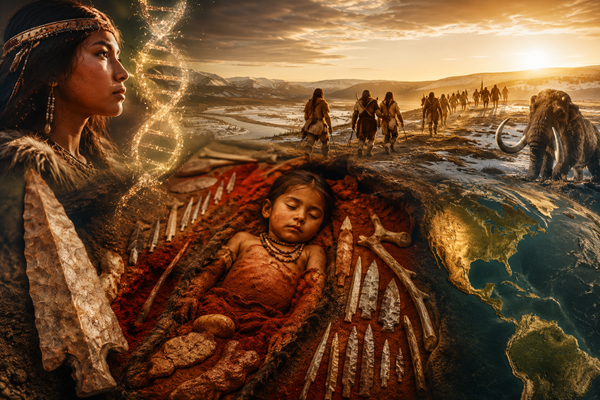
Unlike ordinary prehistoric graves, this child had been laid to rest with extraordinary care. His tiny body had been covered with brilliant red ochre, a mineral pigment frequently associated with ritual ceremonies across numerous ancient cultures. Around him rested more than one hundred twenty-five carefully crafted stone and antler artifacts, including elegant Clovis spear points and sophisticated hunting tools. Every object appeared intentionally placed, suggesting that the community viewed this child as someone worthy of exceptional respect.
Why would a society invest so much effort into burying a child? Did these objects represent gifts for the afterlife, symbols of status, or expressions of grief? Even today, these questions continue to fascinate archaeologists.
For decades, researchers could study only the visible evidence. They examined the tools, analyzed the burial arrangement, and estimated the child’s age. Nevertheless, one crucial question remained unanswered. Who exactly were the Clovis people, and how were they connected to today’s Indigenous peoples throughout North and South America?
The answers would not emerge until almost half a century later, when advances in ancient DNA sequencing unlocked a story preserved inside the child’s own genetic code.
What scientists discovered did far more than identify one prehistoric family. Instead, it fundamentally transformed our understanding of human migration, the settlement of the Americas, and the remarkable genetic continuity linking ancient populations with millions of Indigenous people living today.
Even more astonishing was the realization that this child’s maternal ancestry could be traced back to one of the original women whose descendants eventually spread across two continents.
How could the DNA of a child buried thousands of years ago still tell the story of humanity today?
The answer begins with one of the most extraordinary archaeological discoveries ever made.
The Anzick Child: The Only Known Clovis Burial Ever Discovered
Archaeologists later named the child the Anzick Boy, after the Montana family who owned the land where the burial was uncovered. Radiocarbon dating demonstrated that the remains were approximately twelve thousand six hundred years old, placing the burial firmly within the Clovis period.
At the time, this finding immediately attracted worldwide scientific attention. Although archaeologists had uncovered countless Clovis spear points and stone tools throughout North America, they had never discovered a complete human burial unquestionably associated with the Clovis culture.
That distinction still makes the Anzick burial unique.
Why is this so important?
Stone tools can reveal how ancient people hunted, traveled, and manufactured equipment. Campsites can reveal what they ate and where they lived. However, a carefully preserved burial offers something entirely different. It provides direct evidence of emotion, spirituality, ritual, and social behavior.
In other words, graves reveal humanity.
The Clovis culture flourished for only a relatively brief period, lasting approximately three centuries near the end of the last Ice Age. During much of the twentieth century, many archaeologists believed the Clovis people represented the very first inhabitants of the Americas. This idea became widely known as the “Clovis First” hypothesis.
However, archaeology rarely remains static.
Over subsequent decades, researchers discovered several archaeological sites older than Clovis, demonstrating that humans had reached the Americas even earlier. Although this overturned the Clovis First model, it did not reduce the importance of the Anzick burial. Instead, it shifted the scientific focus toward a different question.
If the Clovis people were not the very first Americans, who exactly were they?
Were they descendants of earlier migrants?
Did they disappear?
Or did their descendants survive and become today’s Native American populations?
The Anzick child eventually provided answers that artifacts alone could never reveal.
The Remarkable Clovis Burial That Preserved an Ancient Civilization
Everything about the burial suggested careful planning rather than a simple interment.
The child’s body rested beneath an abundance of ceremonial objects. Archaeologists recovered exquisitely crafted Clovis spear points, bifacial knives, antler rods, bone implements, and numerous stone tools. Many had never been used. Others appeared to have been manufactured specifically for burial.
Such investment required enormous amounts of labor.
Producing a single Clovis spear point demanded exceptional craftsmanship. Flint knappers carefully struck high-quality stone to create the distinctive fluted points that became the defining technological innovation of the Clovis culture.
Imagine the effort involved in creating more than one hundred twenty-five such objects—not for hunting, but for placing beside a deceased child.
This remarkable decision raises profound questions.
Did the child belong to an influential family?
Was he believed to possess spiritual significance?
Could the burial represent a symbolic offering intended for the afterlife?
Although no definitive answers exist, archaeologists generally agree that the burial demonstrates extraordinary emotional investment by the community.
Equally fascinating is the extensive use of red ochre.
Across prehistoric societies worldwide, red ochre frequently appears in ceremonial burials dating back tens of thousands of years. Researchers believe the vivid pigment often symbolized life, blood, renewal, transformation, or rebirth. Although its precise meaning almost certainly varied among cultures, its repeated appearance strongly suggests ritual importance.
Therefore, the Anzick burial was never simply about death.
Instead, it reflected a sophisticated belief system whose details remain hidden beneath thousands of years of history.
What stories would these people have told about death?
What ceremonies surrounded the child’s final journey?
Those answers disappeared long ago, yet their silent expressions remain preserved in stone, pigment, and careful burial traditions.
For nearly forty-six years, however, one mystery continued to overshadow every other question.
Who were these people genetically?
Scientists had no reliable way to answer that question.
Then everything changed.
Source: Twelve-Thousand-Six-Hundred-Year-Old DNA Reveals the Woman Who May Be the Mother of All Native Americans
Twelve-Thousand-Six-Hundred-Year-Old DNA Reveals the Woman Who May Be the Mother of All Native Americans