Human Ancestors’ Growth Spurt: The Complex Story of Body Size Evolution That Changed Humanity Forever
Meta Description: Human ancestors’ growth spurt was not a slow and steady process. A groundbreaking study reveals that body size evolution accelerated dramatically around two million years ago, reshaping the history of humanity.
Human Ancestors’ Growth Spurt Rewrites Everything We Thought We Knew
For decades, scientists believed that the story of human ancestors’ growth spurt was remarkably simple. According to the traditional view, our ancestors gradually became taller and heavier over millions of years. Every generation supposedly represented another small step toward modern humans.
However, what if that familiar story is incomplete?
A remarkable new scientific study conducted by researchers from the University of Reading and the University of Oxford challenges one of anthropology’s longest-standing assumptions. Rather than showing a slow, uninterrupted increase in body size, the fossil evidence reveals something far more dramatic.
Instead of a continuous climb, our evolutionary history appears to include an extraordinary turning point—a sudden leap in body size that occurred approximately two to two and a half million years ago.
Could this unexpected growth spurt have transformed not only our bodies but also our intelligence, survival strategies, and eventual domination of the planet?
The findings suggest exactly that.
Human Body Size Evolution Was Not a Straight Line
For many years, paleoanthropologists viewed body size evolution as one of the clearest long-term trends in human evolution. Early hominins—the evolutionary relatives that eventually led to modern humans—were thought to have steadily increased in both height and weight as millions of years passed.
The new research tells a far more complicated story.
Scientists analyzed body-mass estimates from three hundred eighty-six fossil specimens representing twenty-one different hominin species. Instead of focusing on a small portion of the fossil record, they examined nearly the entire evolutionary history of our lineage.
The results painted a surprisingly uneven picture.
Early relatives, including members of the genus Australopithecus, generally weighed around forty kilograms and stood only slightly taller than many children living today.
For millions of years, their body size changed only gradually.
Then everything changed.
Instead of continuing at the same pace, evolution suddenly accelerated within the genus Homo, producing one of the most significant physical transformations ever seen in our family tree.
What caused evolution to press the accelerator after moving so slowly for so long?
That question now lies at the center of one of paleoanthropology’s most fascinating debates.
The Human Ancestors’ Growth Spurt Began with Homo erectus and Homo ergaster
The strongest evidence points toward two remarkable species: Homo erectus and Homo ergaster.
Around two million years ago, these ancestors experienced a dramatic increase in average body weight. Many individuals reached approximately sixty kilograms, placing them within the range of many modern humans.
This was not merely a matter of becoming larger.
It represented a complete shift in how humans interacted with the world.
Larger bodies allowed these ancestors to walk farther while conserving energy. Consequently, they could travel enormous distances in search of food, water, and safer environments.
At the same time, they began exploiting more diverse ecosystems. Instead of relying primarily on plant foods, they increasingly incorporated meat into their diets, providing additional calories needed to support larger brains and more active lifestyles.
As their bodies evolved, their behavior evolved alongside them.
Was bigger truly better?
For these early humans, the evidence strongly suggests that it was.
Why Did Larger Bodies Become Such a Powerful Evolutionary Advantage?
Evolution rarely changes a single characteristic without affecting many others.
Consequently, the sudden increase in body size coincided with several revolutionary developments.
These early humans walked upright with greater efficiency than many of their predecessors.
They traveled farther.
They hunted more effectively.
They adapted to changing climates.
Moreover, they occupied environments that earlier hominins may have struggled to survive in.
Scientists believe that larger bodies also improved heat regulation during long-distance walking across open African landscapes. Additionally, greater muscle mass likely increased endurance, allowing early humans to spend more time searching for food while carrying tools, weapons, or gathered resources.
Could this physical transformation have opened the door for humanity’s eventual migration out of Africa?
Many researchers believe the connection is far from accidental.
Instead, body size may have become one of the key ingredients that made global expansion possible.
Human Evolution Was Filled with Surprising Exceptions
Although the overall trend within later members of the genus Homo points toward larger bodies, evolution rarely follows a single path.
Nature constantly experiments.
Some branches of our family tree ignored the apparent trend altogether.
Among the most famous examples is Homo floresiensis, often nicknamed the “Hobbit.” Living on the Indonesian island of Flores, this tiny human relative remained remarkably small despite existing long after larger members of the genus Homo had already appeared.
Similarly, Homo naledi, discovered in South Africa, also retained a relatively small body.
Even Homo habilis, one of the earliest members of our own genus, failed to exhibit the dramatic increase seen in Homo erectus.
Why would evolution favor large bodies in some environments while maintaining small bodies elsewhere?
Scientists suspect that isolated ecosystems, limited food supplies, local environmental pressures, and entirely different survival strategies all played important roles.
Yet many answers remain hidden within fossils that have yet to be discovered.
Body Size Evolution Is More Complex Than Scientists Once Imagined
Estimating the body weight of an individual who lived millions of years ago is anything but simple.
Unlike modern humans, fossil skeletons are often incomplete.
Sometimes researchers recover only a femur.
In other cases, they find fragments of a pelvis, arm, or foot.
Each skeletal element provides only part of the puzzle.
Previous studies frequently reached conflicting conclusions because different researchers relied on different bones, different mathematical formulas, and different fossil collections.
As a result, scientific debates persisted for decades.
The new study sought to resolve these disagreements by applying sophisticated statistical models that incorporated evolutionary relationships among species.
Researchers also tested their conclusions against one thousand different evolutionary family trees, ensuring that their results remained consistent regardless of slight differences in evolutionary reconstruction.
Rather than disproving earlier work, the analysis revealed that previous studies were often examining different chapters of the same much larger story.
The puzzle was never wrong.
It was simply incomplete.
Could Bigger Bodies Have Fueled the Rise of Human Intelligence?
One intriguing question naturally emerges from these findings.
Did larger bodies help produce larger brains?
Scientists have long recognized that body size and brain size often evolve together, although the relationship is far from straightforward.
A larger body requires more energy.
However, if an increasingly meat-rich diet supplied those additional calories, it may also have supported the growing metabolic demands of expanding brains.
Meanwhile, improved mobility allowed early humans to explore unfamiliar environments, discover new food sources, and develop increasingly sophisticated survival strategies.
Greater endurance may also have encouraged stronger social cooperation.
Long-distance hunting, food sharing, and group defense all become easier when individuals can travel efficiently across vast landscapes.
Could these physical changes have indirectly fueled language, cooperation, and technological innovation?
Although researchers cannot yet provide definitive answers, the possibility remains one of the most exciting frontiers in human evolution research.
The Human Family Tree Was Never a Ladder—It Was a Forest
Perhaps the most important lesson from this research extends beyond body size alone.
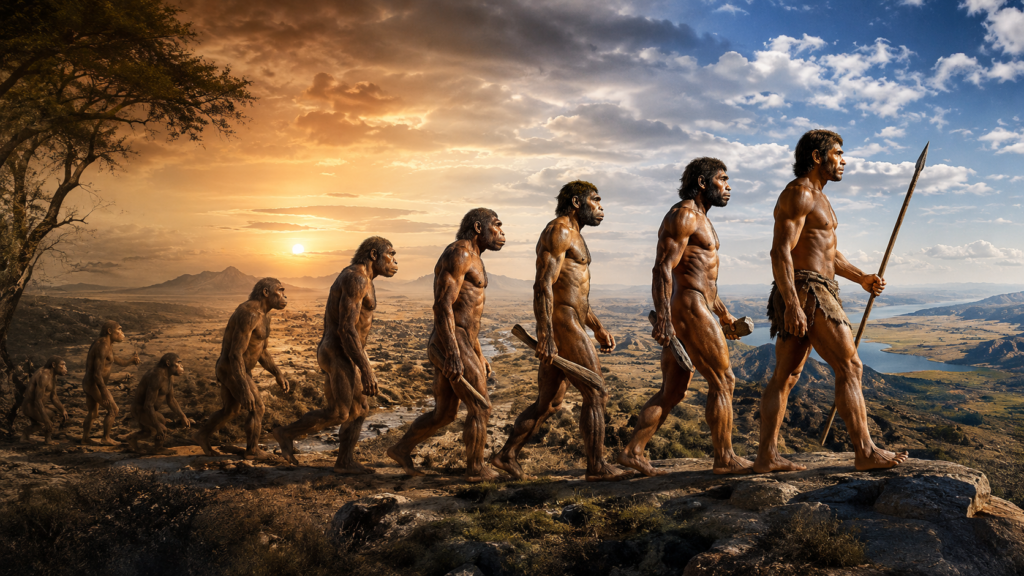
For generations, illustrations of human evolution often depicted a neat sequence of increasingly upright ancestors marching toward modern humanity.
Reality was dramatically different.
Our family tree resembled a dense forest rather than a straight ladder.
Numerous hominin species lived simultaneously.
Some grew larger.
Others remained small.
Some disappeared quickly.
Others survived for hundreds of thousands of years.
Many evolutionary experiments ended without leaving modern descendants.
Therefore, the emergence of Homo sapiens was not inevitable.
Instead, it resulted from countless environmental challenges, genetic changes, and evolutionary opportunities unfolding over millions of years.
Human Ancestors’ Growth Spurt Changed the Course of Human History
The evidence now suggests that human ancestors’ growth spurt was neither gradual nor universal.
Instead, one extraordinary evolutionary leap transformed members of the genus Homo, allowing them to become larger, more mobile, and better adapted to changing environments.
This transformation likely helped pave the way for migration beyond Africa, broader ecological success, and ultimately the worldwide expansion of humanity.
At the same time, smaller-bodied relatives continued evolving along entirely different paths, reminding us that evolution never follows a predetermined destination.
Every new fossil discovery has the potential to rewrite another chapter of our story.
And perhaps the greatest mystery still remains unanswered.
If one unexpected discovery overturned decades of scientific consensus, what astonishing secrets are still waiting beneath ancient rocks, hidden for millions of years?
Conclusion: The Story of Human Evolution Is Still Being Written
The latest fossil evidence reminds us that evolution is far more dynamic than once imagined. Instead of progressing in a slow, predictable march, our ancestors experienced bursts of innovation, periods of stability, and unexpected detours. The dramatic increase in body size around two million years ago stands out as one of the most important turning points in human history, influencing movement, diet, ecology, and perhaps even intelligence itself.
Yet every answer opens new questions. Why did some species remain small while others grew dramatically? How closely were body size, brain expansion, and technological innovation connected? And what future discoveries might force scientists to rethink today’s conclusions once again?
The human story is not finished. With every fossil unearthed, researchers uncover another piece of an extraordinary evolutionary puzzle that continues to surprise us.
Source: Human Ancestors’ Growth Spurt: The Complex Story of Body Size Evolution That Changed Humanity Forever
The Sumerian King List Reveals the Origin of Mesopotamian Kingship
The Sumerian King List Reveals the Origin of Mesopotamian Kingship
Human Ancestors’ Growth Spurt: The Complex Story of Body Size Evolution That Changed Humanity Forever
Sources
Gardner, J., et al. University of Reading — Research on hominin body size evolution.
University of Oxford — Department of Biology and Paleoanthropology research.
Nature Ecology & Evolution (study on hominin body mass evolution).
Smithsonian National Museum of Natural History — Human Origins Program.
American Museum of Natural History — Human Evolution Collections.
Leakey Foundation — Human Evolution Research.
Encyclopedia of Life Sciences (Wiley).
Journal of Human Evolution.