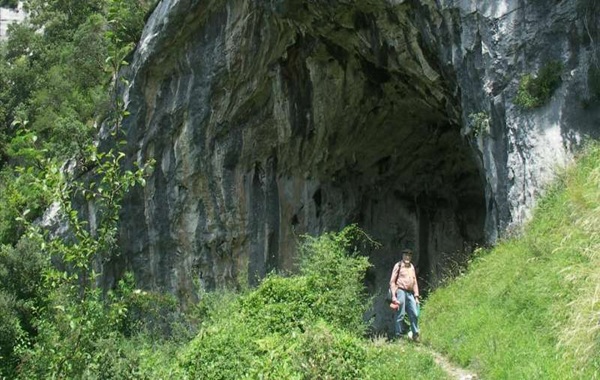
Thirty years at El Mirón cave uncover 40,000 years of Iberian prehistory
For the past three decades, Leslie Spier Distinguished Professor Lawrence Straus (University of New Mexico) and Manuel González Morales (Universidad de Cantabria) have co-directed excavations at El Mirón Cave in Cantabria, Spain. Since its inception in 1996, the project has uncovered one of the most complete prehistoric records on the Iberian Peninsula, documenting Europe’s longest continuous sequences of human occupation.
Analysis of the site has revealed evidence spanning 40,000 years across nine major cultural eras: Middle Paleolithic, Early Upper Paleolithic, Gravettian, Solutrean, Magdalenian, Mesolithic, Neolithic, Chalcolithic, and the Bronze Age. Located above the Asón River valley, the deep limestone cave features a wide, dry vestibule that served as a persistent living space. Throughout these eras, the cave accommodated fluctuating populations amidst shifting climates, ranging from the coldest periods of the Last Ice Age to Holocene conditions warmer than today.
Researchers have recovered hundreds of thousands of stone and bone artifacts. Because the immediate area lacked high-quality flint, Paleolithic inhabitants traveled 50 to 60 kilometers to source it for razor-sharp blades, while utilizing local quartzite for heavy-duty tools. The massive volume of faunal remains points to the systematic hunting of red deer, ibex, horse, chamois, and roe deer, as well as fishing for salmon and trout. During later eras, the cave transitioned to agricultural use; the Neolithic levels provided the earliest evidence of wheat agriculture, domesticated animals, and ceramics in northern Atlantic Spain, while subsequent layers contained large storage pits, livestock pens, and evidence of copper metallurgy.
The project’s landmark discovery occurred in 2010 when the team uncovered a 19,000-year-old Magdalenian-period ritual burial belonging to a middle-aged woman, famously dubbed the “Red Lady of El Mirón.” Her partial skeleton was interred in a tight fetal position behind a massive collapsed limestone block. The block itself features ancient engravings, including a V-shaped figure that scientists hypothesize served as a grave marker.
The burial is unique because the woman’s bones, the surrounding sediments, and the inner face of the rock wall were heavily coated with sparkling red ochre. Chemical analysis traced this pigment to an outcrop 25 kilometers away, suggesting her survivors intentionally hiked to the coast to retrieve it. Oddly, while fragile small bones remained perfectly preserved, her cranium and major long bones were missing. Scientists believe these major elements may have been intentionally removed by her peers to be used as venerated relics, hinting that she may have held a high-status role such as a matriarch, healer, or leader.
As only the second Upper Paleolithic burial ever found on the Iberian Peninsula, the Red Lady represents a monumental find. Crucially, the extraction of her ancient DNA by Nobel laureate Svante Pääbo at the Max Planck Institute has profoundly reshaped scientific understanding of Ice Age European populations, cementing El Mirón Cave as a treasure trove of global prehistoric significance.
Source: phys.org
Archaeologists Discover Mysterious Artificial Island Older Than Stonehenge in Scotland
Thirty years at El Mirón cave uncover 40,000 years of Iberian prehistory