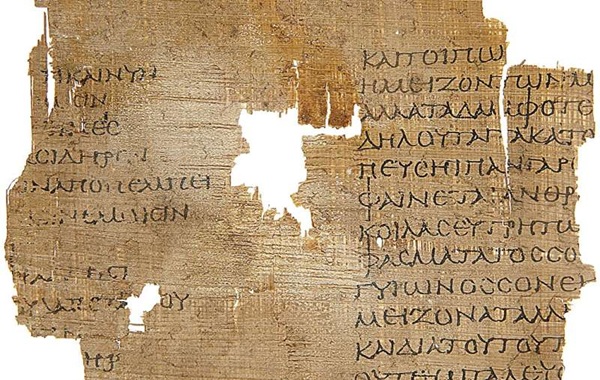
Thirty previously unpublished verses by Empedocles discovered on a papyrus from Cairo
A 2,000-year-old papyrus fragment, discovered in the archives of the French Institute of Oriental Archaeology in Cairo, reveals 30 previously unpublished verses by Empedocles, a pre-Socratic philosopher of the fifth century BCE. This discovery offers researchers direct access to a body of thought previously known only through quotations from later authors. The very first edition, translation, and commentary on these verses are published in the book “L’Empédocle du Caire,” edited by Nathan Carlig, Alain Martin, and Olivier Primavesi.
It was at the French Institute of Oriental Archaeology in Cairo (IFAO) that Carlig, a papyrologist at the University of Liège, identified papyrus P. Fouad inv. 218 as an unknown fragment of the “Physica,” the poem by the philosopher Empedocles of Agrigentum.
“Until now, our knowledge of Empedocles’s work relied exclusively on indirect sources such as fragmentary quotations, summaries, or allusions scattered throughout the works of authors such as Plato, Aristotle, or Plutarch. Papyrus P. Fouad inv. 218 allows us to read the philosopher in his original text, without the intermediary of often partial or biased sources. It is also the only known copy of the ‘Physica,’ fragments of other parts of which from the same scroll are preserved in Strasbourg,” states Carlig.
The text that has come to light deals with the theory of particle effluvia and sensory perceptions, particularly vision. Analysis of the text has revealed unexpected connections, including the probable direct source of a passage by Plutarch (second century CE), as well as a dialogue by Plato and a text by Theophrastus, a disciple of Aristotle, both from the fourth century BCE.
Unnoticed echoes of Empedocles have also been detected in the comic poet Aristophanes and in the Latin philosopher Lucretius. The study further suggests that Empedocles could be regarded as a precursor of the atomist philosophers, foremost among whom is Democritus of Abdera.
To grasp the significance of such a discovery, the authors offer an illuminating analogy: Imagine that in a few centuries’ time, all that remains of Victor Hugo are excerpts from “Les Misérables” in school textbooks, the musical “Notre-Dame de Paris,” and the program for a performance of the play “Hernani.” The discovery of a few pages from an original edition of Hugo’s work would then be a momentous event.
This is precisely what specialists in Empedocles are experiencing today. Like the humanists of the Renaissance, who scoured European libraries to unearth lost manuscripts, papyrologists have, since the late 19th century, pursued a similar quest through papyrus texts.
“It is, in a way, to borrow Peter Parsons’s words, a ‘second Renaissance’ of ancient literature,” says Carlig. The publication of this research opens up new perspectives on understanding Empedocles’ doctrine and, more broadly, his work, in order to better situate the philosopher within the history of Greek philosophy and to better define his relationship with his predecessors and successors.”
Source: phys.org
A New DNA Revelation Rewrites The History of The Neanderthals in Europe
Thirty previously unpublished verses by Empedocles discovered on a papyrus from Cairo